A More Personal Way to Coach

0

Dopamine in Relationships: What Gottman’s Research Reveals About the Stages of Love

How does dopamine shape attraction, bonding, and conflict in relationships? Explore Gottman’s principles for lasting love and emotional connection

When people talk about “chemistry” or “the spark,” they’re often describing dopamine. Dopamine is a neurotransmitter linked to pleasure, reward, motivation, and anticipation. In romantic relationships, dopamine surges during early attraction, creating excitement, focus, and emotional intensity. But while dopamine plays a powerful role in bringing two people together, it is not what sustains long-term love.

In Gottman’s framework, lasting love tends to unfold in three broad phases: an initial limerence phase driven by intense chemistry, a trust phase in which partners learn whether they can rely on each other, and a commitment phase in which they actively choose the relationship over time.

According to Dr. John Gottman’s decades of research with couples in the “Love Lab,” successful relationships are built on emotional attunement, trust, and friendship — not just neurochemical highs.

What Is Dopamine and Why Does It Matter in Relationships?

Dopamine is often described as one of the brain’s “reward chemicals.” It becomes active when we experience something pleasurable or anticipate something rewarding. In relationships, dopamine fuels infatuation, increases energy and focus on a partner, heightens desire and excitement, and reinforces bonding through positive experiences.

Early in dating, dopamine can make ordinary interactions feel extraordinary. A text message triggers anticipation. A glance feels charged. The brain quickly associates this person with potential reward, which helps explain why it is so hard to stop thinking about them.

Dopamine is also sensitive to novelty and unpredictability. As a relationship becomes more predictable, those sharp dopamine spikes naturally decrease. Studies of long-term couples suggest this is a normal adaptation, not a sign that love is gone. Gottman’s work indicates that couples who equate the fading of dopamine with the loss of love are more vulnerable to disappointment and to chasing the “spark” elsewhere.

Dopamine, Attraction, and the “Spark” of Early Love

Gottman describes the first phase of love as a limerence phase. It corresponds to what most people think of as the honeymoon period: dopamine-driven attraction, strong longing, and a narrowed focus on the other person. Brain imaging shows strong activation in reward regions when people in early romantic love see images of their partner.

From a Gottman perspective, limerence looks like positive sentiment override — the phase in which partners interpret each other generously and overlook flaws. Minor irritations are minimized, and people assume good intent. Dopamine in relationships helps create this glow, but in Gottman’s model it is only the first phase of love.

What matters for the future of the relationship is what happens as couples move out of limerence into the second phase: building trust. If you are in this high-dopamine stage and want to look beyond chemistry, Gottman’s guide on how to plan a successful relationship offers concrete questions about values, conflict, and life dreams.

When Dopamine Fades: Why Conflict and Disconnection Increase

When dopamine levels stabilize, many couples notice less automatic excitement, more irritation, and a decline in sexual novelty. This is often the point when conflict surfaces more regularly.

This is also where Gottman’s second phase — trust — either solidifies or erodes. In this view, trust is built through repeated experiences of “you are there for me” during stress, disappointment, and everyday needs.

Across thousands of couples, Gottman has identified four interaction patterns — criticism, contempt, defensiveness, and stonewalling — as strong predictors of relationship breakdown, known as the Four Horsemen. These patterns are more likely to appear when couples have leaned on dopamine-driven excitement but lack conflict-management skills. Each episode of harsh criticism or emotional withdrawal sends the message “I am not safe with you,” and slowly undermines the trust phase.

Without deliberate effort, partners begin turning away from emotional bids instead of turning toward them — a core Gottman concept. At this point, the issue is not that dopamine has disappeared, but that the relationship lacks structure: clear communication, habits of kindness, and shared ways of handling difficult conversations.

Long-term love requires emotional attunement, trust-building behavior, conflict-resolution skills, and shared meaning. Dopamine may start the relationship. Skills sustain it. For practical strategies grounded in Gottman’s research, see Conflict Resolution in Relationships.

Building Lasting Love: Gottman Principles Beyond Dopamine

While dopamine fuels early passion, both neuroscience and Gottman’s long-term data suggest that stable, fulfilling love rests on something deeper. Research on couples who report being “in love” after many years finds continued activation in reward circuits, but now combined with brain regions associated with calm and secure attachment.

Couples who thrive over time tend to live out what Gottman calls the Sound Relationship House:

  • They build and update Love Maps — detailed knowledge of each other’s inner worlds.
  • They express fondness and admiration, creating a resilient baseline of respect.
  • They turn toward bids for connection instead of ignoring them.
  • They manage conflict in ways that avoid the Four Horsemen.
  • They create rituals and shared meaning that make their life together feel coherent and significant.

In Gottman’s three-phase view, this is the commitment phase. Commitment means more than legal status; it is the ongoing choice to invest in the relationship, protect it from outside threats, and prioritize the partnership when life gets complicated.
 

Emotional Literacy

FREE Download | Emotional Literacy

Sign up for the Gottman Love Notes Newsletter to receive your free guide on emotional literacy. Learn about emotional intelligence, meta-emotions, and how to express feelings in a healthy way.

Final Thoughts: Dopamine Is the Spark — Not the Foundation

Dopamine is powerful. It brings people together. It motivates pursuit. It creates exhilaration. But sustainable love is not built on constant highs. It is built on friendship, trust, emotional responsiveness, and shared meaning — the very elements Gottman’s research has highlighted for decades. Dopamine may ignite limerence. Trust is built through hundreds of small, reliable responses. Commitment is the decision to keep showing up.

If you want to move from chemistry to deeper emotional connection, a concrete next step is to strengthen your emotional vocabulary. The Gottman Institute offers a FREE Download | Emotional Literacy tool that can help you name what you are feeling so you can share it more clearly — and respond more accurately — to your partner.

Ask Gottman

Your email address will not be published. Required fields are marked *

Recommended products

Original price was: $250.00.Current price is: $189.00.

The Gottman Relationship Adviser is a complete approach to relationship wellness. Measure your relationship health with the research-based Gottman Assessment, analyze five key areas of your partnership to identify your strengths and weaknesses, then start a tailored, step-by-step digital program proven to heal and strengthen your connection—all on your schedule and from anywhere.

The Adviser uses the legendary scientific Gottman Method to help you understand what’s really going on in your relationship—and gives you exactly what you need to improve it.


Original price was: $119.00.Current price is: $79.00.

Research-based Foundations for a Lifetime of Love.  The Gottman Relationship Coach is an inspiring and educational multimedia experience designed to enhance the well-being of relationships. Participants will be guided through research-based tools and communication skills that can transform relationships—all based on the popular Gottman Method. The first program, “How to Make Your Relationship Work”, is now available and includes:

  • The Gottman Method and How to Make Your Relationship Work
  • How do we predict the future of a relationship?
  • How to build a Sound Relationship House
  • What to do when the destructive Four Horsemen enter your relationship

“Buy Now” will take you to GOTTMAN CONNECT to purchase and view this product.

$599.00

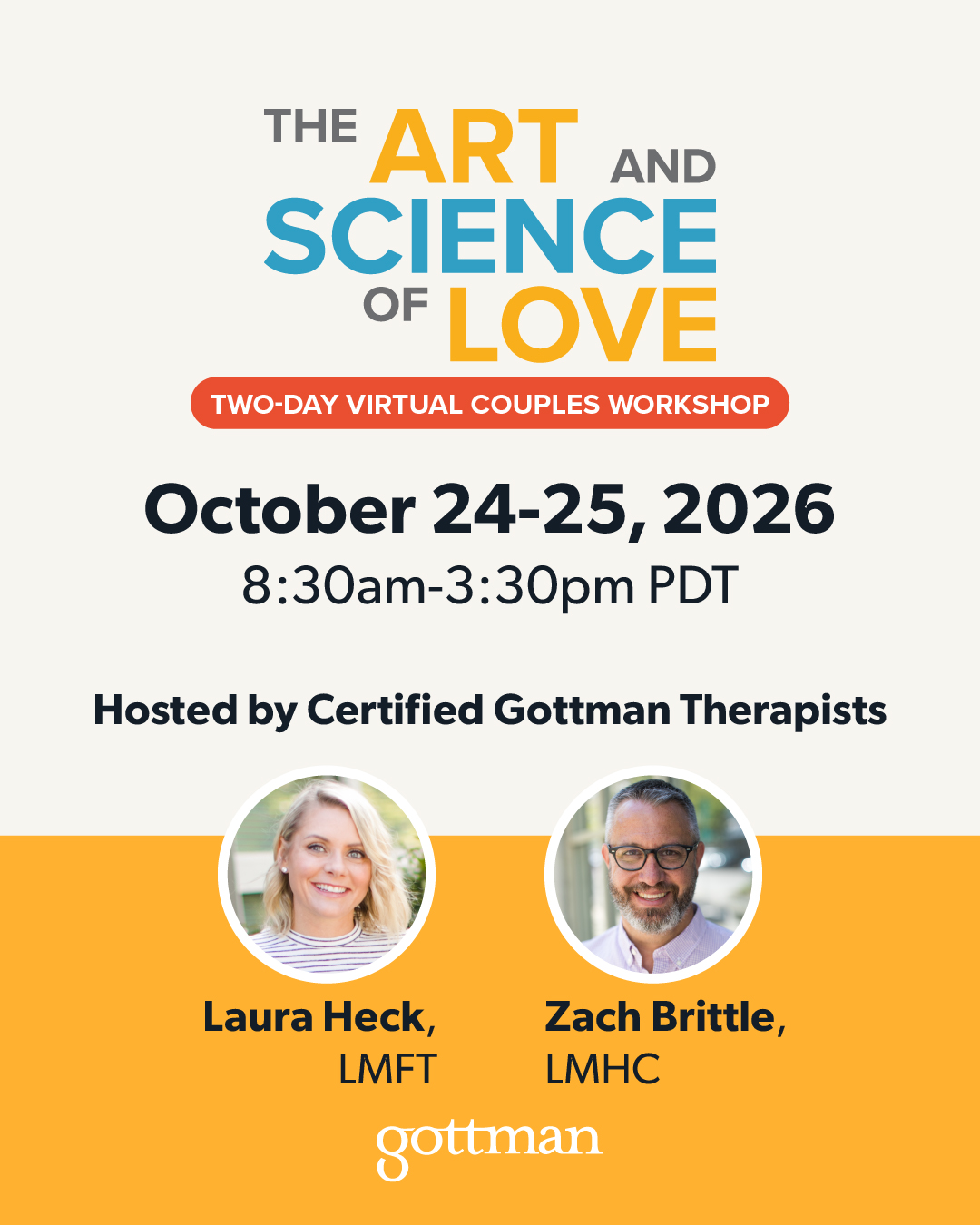
Created by “the Einstein of Love” (Psychology Today), this two-day workshop is grounded on what actually works in relationships that are happy and stable. See for yourself why millions of couples worldwide have benefited from the Gottman Method.

Quote from participant in most recent Live Virtual Workshop:

The Art and Science of Love workshop- where do I begin? It was an absolute stellar workshop. We were looking forward to this for weeks, and it exceeded our expectations! It was well-structured, and well-organized, and provided a wealth of information with real-time demonstrations of how to work through specific scenarios. The outstanding support that was provided throughout the exercises with therapists on standby- WOW! Priceless!

Includes the Art & Science of Love box set.  Please allow time for shipping.  Please Note: This is a live online event. To attend, you will need a reliable internet connection. Our staff will reach out to you with your personal registration and access information.

Related posts

Parenting adult children is a new and different stage.

It Doesn’t Get Easier. It Gets Different.

Zach Brittle, LMHC

As our children get older, our relationship shifts. Parenting becomes different but not necessarily easier.

Read More

Explore the vital link between individual behavioral health and relationship success. Learn why professional guidance is key to breaking unhelpful or toxic patterns and building a lasting bond.

Why Behavioral Health Is the Hidden Foundation of Your Relationship

Alexander Elguren

Explore the vital link between individual behavioral health and relationship success. Learn why professional guidance can be key to breaking unhelpful or toxic patterns and building a lasting bond.

Read More

A therapist working with a couple in session.

Everything You Need to Know about Therapy

Kendra Han

Are you wondering when to get therapy? Learn the Gottman signs of relationship distress, and take steps to improve communication, conflict resolution and more.

Read More

What is the 777 rule for marriage? And is it enough? Find out, and learn about Gottman's research, and simple steps to improve the connection and intimacy in your marriage!

The 777 Rule for Marriage: A Good Start — But Gottman’s Research Goes Deeper

Alexander Elguren

The 777 rule for marriage — couple spending intentional time together your marriage!

Read More

Cognitive overload in relationships — when the brain shuts down during conflict

Is your partner experiencing cognitive overload?

Alexander Elguren

Cognitive overload in relationships — when the brain shuts down during conflict

Read More

A couple saying goodbye as their adult daughter moves out.

Liminal Space: Maintaining Connection Through Life’s Major Transitions

The Gottman Institute

Major life changes often lead to a disorienting liminal space. Discover how to overcome communication barriers and strengthen your relationships here.

Read More

Improve your Relationship Skills with our Free Newsletters
0