0

Have Low Conflict Conversations about Money and Enhance Intimacy

Money doesn’t have to cause tension. Discover how low-conflict money conversations can build trust, emotional safety, and deeper intimacy.

Chapter 2 

Have Low-Conflict Conversations About Money and Enhance Intimacy 

You’ve met your soulmate and decided to get married, engaged, or move in together. But while making plans for your happy life together, you soon discover that you have a spender-saver dynamic and that discussing money evokes a variety of complex emotions such as shame, envy, anxiety, panic, and pride. Financial disparities between you and your partner’s incomes might also trigger resentment, especially if there are imbalances in the distribution of chores and childcare responsibilities. 

Or maybe you’ve been married a long time, and talking about money transactions is challenging because you have different financial histories and/or financial styles. For instance, when Melanie, forty-eight, and Rob, fifty, discuss money, Rob often gets defensive because he makes reckless decisions about spending that make it difficult for them to pay their bills at times and have caused him to have a bad credit score. As a result, they have not been able to qualify for a lower interest on their mortgage by refinancing it. 

This couple has been married for twenty years, and Melanie was raised in a single-parent family where money was tight. She identifies as having a moderate saving financial style with a money vigilance script which causes her to be frugal. On the other hand, Rob was raised in a two-parent middle-class home, and his financial style is that of a super spender. Because his parents often argued about money, Rob frequently feels anxious about the thought of discussing finances with Melanie. He has a money worship script that frequently collides with Melanie’s money vigilance script. They have three sons, ages six, ten, and twelve, who are all active in sports. Melanie works as a financial analyst at a bank, and Rob is self-employed as a carpenter. 

Even though Melanie and Rob are both employed full-time, they often find that they have more money going out than coming into their bank accounts. And they both have a tendency to blame each other for their financial problems rather than acknowledging that they’re equally responsible. As a result, they have a history of arguing excessively about money, and they’ve become emotionally distant from each other. 

Melanie explains, 

When it comes to money, Rob goes on spending sprees and doesn’t tell me, so we often overdraw our checking account and have to dip into our savings. Rob has a problem with overspending. Last month, for example, he went shopping with our three sons for school clothes and went crazy buying them stuff they didn’t need. Then to make matters worse, he charged several hundred dollars on his credit card and went over his limit and didn’t tell me. 

During our therapy session, Melanie shared that she set up an emergency fund (for three months of their expenses) when her grandmother left her a small inheritance recently. She also deposited some of the money into college funds for their children. She didn’t tell Rob the exact amount she inherited because she doesn’t trust him with money. Melanie told me that she’s working on building trust with Rob by being transparent during our sessions and their money talks at home. I explained to her that not disclosing the precise amount of her inheritance to Rob is more a matter of privacy rather than keeping a secret because he knows about the inheritance. Additionally, there aren’t any negative consequences associated with her keeping the amount private. However, I suggested that she might want to disclose the amount to him as a sign of goodwill. In Chapter 9, you’ll learn how to determine the difference between keeping financial information private or keeping secrets, which is considered financial infidelity. 

The next time I met with Melanie and Rob in my office, I spoke about the importance of full disclosure when it came to finances (for both of them) so they could build trust and financial intimacy. Melanie agreed to become transparent and disclosed the amount of money in their emergency fund and college funds to Rob, in spite of her fears. During follow-up sessions, we discussed the consequences of Rob’s reckless behavior on their finances. Rob stated that he was embarrassed about his irresponsible behavior with money that led to a poor credit score and late fees. He knows he gets defensive because he fears Melanie will give him a lecture and they’ll fight. This makes him avoid talking about money with Melanie. By attending regular therapy sessions, Melanie and Rob are working on having lower conflict so they can have more constructive money talks.


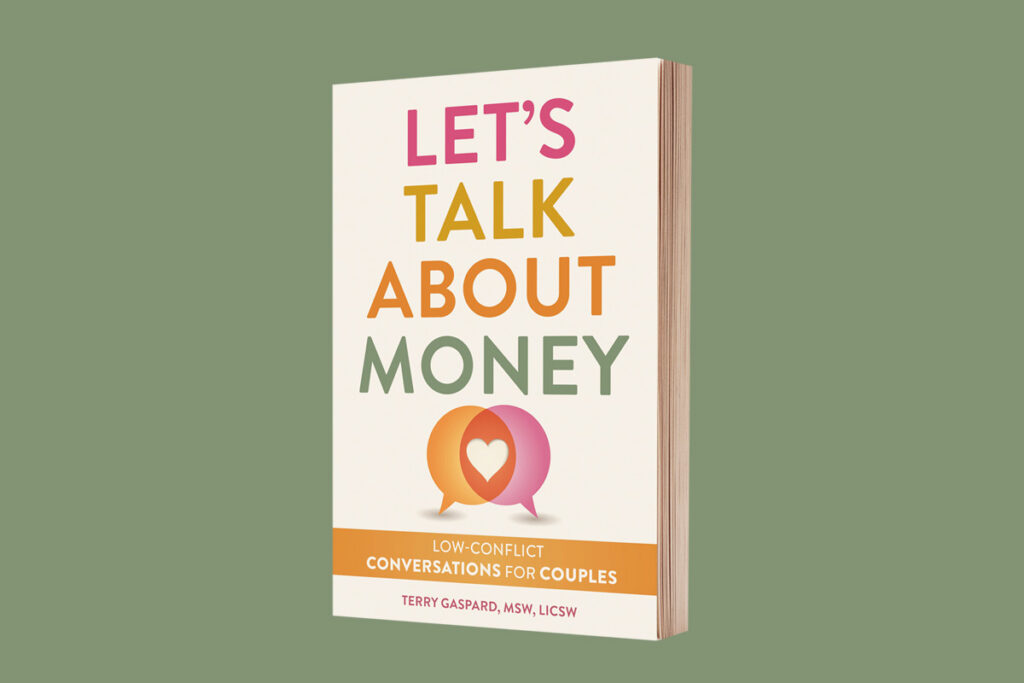
Excerpted from Let’s Talk About Money: Low-Conflict Conversations for Couples by Terry Gaspard. Copyright © Terry Gaspard, 2026. Published by Bloomsbury Academic.
Get your Relationship Communication Score

Answer simple questions and learn more about key relationship communication indicators like Feeling Heard, Turning Towards and Stonewalling

Ask Gottman

Your email address will not be published. Required fields are marked *

Terry Gaspard MSW, LICSW is a licensed therapist and author. She has published four peer reviewed articles, and two of her research studies were published in the Journal of Divorce and Remarriage. Terry is also a contributor to Patheos.com, TheGoodMenProject.com, and marriage.com. Terry’s award-winning book, Daughters of Divorce: Overcome the Legacy of Your Parents’ Breakup and Enjoy a Happy, Long-Lasting Relationship, was published in 2016. Her book, The Remarriage Manual: How to Make Everything Work Better the Second Time Around, was published in 2020 and was the winner of American Book Fest’s 2020 Best Book Award in “Self-Help: Relationships” and the 2022 Independent Publisher Book Award in Gold for Self Help.
Terry’s new book Let’s Talk About Money: Low-Conflict Conversations for Couples will be published by Bloomsbury Academic in January 2026 and will be available on audiobook by Podium. Find Terry on X (Twitter), Facebook, Blue Sky, Instagram and movingpastdivorce.com.

Recommended products

Original price was: $250.00.Current price is: $189.00.

The Gottman Relationship Adviser is a complete approach to relationship wellness. Measure your relationship health with the research-based Gottman Assessment, analyze five key areas of your partnership to identify your strengths and weaknesses, then start a tailored, step-by-step digital program proven to heal and strengthen your connection—all on your schedule and from anywhere.

The Adviser uses the legendary scientific Gottman Method to help you understand what’s really going on in your relationship—and gives you exactly what you need to improve it.


Original price was: $119.00.Current price is: $79.00.

Research-based Foundations for a Lifetime of Love.  The Gottman Relationship Coach is an inspiring and educational multimedia experience designed to enhance the well-being of relationships. Participants will be guided through research-based tools and communication skills that can transform relationships—all based on the popular Gottman Method. The first program, “How to Make Your Relationship Work”, is now available and includes:

  • The Gottman Method and How to Make Your Relationship Work
  • How do we predict the future of a relationship?
  • How to build a Sound Relationship House
  • What to do when the destructive Four Horsemen enter your relationship

“Buy Now” will take you to GOTTMAN CONNECT to purchase and view this product.

$799.00

Created by “the Einstein of Love” (Psychology Today), this two-day workshop is grounded on what actually works in relationships that are happy and stable. See for yourself why millions of couples worldwide have benefited from the Gottman Method.

Quote from participant in most recent Live Virtual Workshop:

The Art and Science of Love workshop- where do I begin? It was an absolute stellar workshop. We were looking forward to this for weeks, and it exceeded our expectations! It was well-structured, and well-organized, and provided a wealth of information with real-time demonstrations of how to work through specific scenarios. The outstanding support that was provided throughout the exercises with therapists on standby- WOW! Priceless!

Includes the Art & Science of Love box set.  Please allow time for shipping.  Please Note: This is a live online event. To attend, you will need a reliable internet connection. Our staff will reach out to you with your personal registration and access information.

Related posts

A woman rests her head against her partner’s chest outdoors.

The Loneliness of Wanting Your Partner

Alexander Elguren

Why partners can miss sex and still pull away from each other—and how to begin talking about it.

Read More

One partner using AI to get relationship advice while her partner sits nearby.

When AI Makes Couples More Certain, But Not More Connected

Dana McNeil

AI can offer relationship advice, but can it build connection? Explore how relying on AI may reinforce assumptions rather than foster understanding between partners.

Read More

An older man kisses his partner on the cheek at the beach.

A Sensitive Question in a Long Marriage: What Turns You On Now?

Alexander Elguren

What longtime partners can learn about intimacy after 50.

Read More

The Price of Keeping the Peace

Alexander Elguren

He Said the Money Was for Client Dinners. It Wasn’t.

Read More

A woman leans over her partner as they lie close together on a bed.

Out of Touch: A Couple’s Way Back to Desire

Alexander Elguren

Are we trying too hard to have more sex? How couples can make room for pleasure without adding pressure.

Read More

A woman rests against a man as he kisses the top of her head.

We Agreed. Why Are We Having This Argument Again?

Alexander Elguren

In relationship conflict, we often start persuading before we’ve finished listening. Understanding the three stages of a fight can change how we handle the next one.

Read More

Improve your Relationship Skills with our Free Newsletters
0