A More Personal Way to Coach

0

Is your partner experiencing cognitive overload?

Cognitive overload in relationships — when the brain shuts down during conflict

Cognitive overload in relationships — when the brain shuts down during conflict

Your brain has a budget. Not for money — for attention. Every decision, every worry, every unresolved argument draws from the same finite account. And when the account is empty, the person sitting across the dinner table gets what’s left: impatience, distraction, a flat “I don’t know” to a question that needed a real answer.

That’s cognitive overload. And it’s quietly damaging more relationships than most couples realize.

What Is Cognitive Overload?

Cognitive overload is what happens when your brain is running too many programs at once. Work, money, the kids, that argument you never finished — at some point the system stops processing and starts shedding. What sometimes gets dropped first can be the thing that needs the most care and nuance: attunement to your partner.

In Gottman’s framework, this matters because the relationship runs on small moments of connection. A bid for emotional connection. A question about your day. A sigh that’s really an invitation to ask what’s wrong. When one partner is cognitively overloaded, these bids can get missed. They might even get experienced as demands — one more thing on the pile.

Cognitive Overload: How Well Do You Really Know Your Partner?

Gottman calls the first level of the Sound Relationship House Love Maps — the detailed, updated knowledge each partner holds about the other’s inner world. Not their favorite movie from ten years ago. The thing weighing on them this week. Who they are becoming.

Building Love Maps requires cognitive bandwidth. It requires being curious enough to ask, and present enough to hear the answer. When both partners are depleted, Love Maps can go stale. You’re navigating by an outdated chart. You think you know them. You know who they were six months or maybe even years ago.

The couples in Gottman’s research who stayed connected weren’t the ones with the most free time. They were the ones who protected small pockets of connection for each other — even when everything else was competing for it.

Signs That Your Partner May Feel Overwhelmed

Cognitive overload doesn’t announce itself. It often looks like something else. It looks like forgetting the school pickup. Like snapping over a dish in the sink. Like going quiet for the whole evening and calling it “tired.”

Watch for the pattern, not the incident: increased irritability over small things, withdrawal from conversations that require emotional engagement, difficulty making decisions that used to be easy, a flattened response to things that used to matter.

These aren’t character flaws. They can be symptoms of a system running at capacity.

Steps to Take When You Experience Cognitive Overload

Step 1: Name it before it names you

Gottman recommends simply describing it: say what’s happening. “I’m overwhelmed and I can’t be present right now” is infinitely more connective than staring at your phone while your partner talks. Naming the state is itself a bid for connection — it says, I’m not turning away from you. I’m telling you where I am.

Step 2: Protect the transitions

The moments between contexts — arriving home from work, waking up, the first minutes after the kids go to bed — are where cognitive overload collides with relationship needs. Gottman’s research suggests building brief rituals around these transitions: a shared moment, a genuine question about each other’s day, a few minutes of decompression before the logistics start. Small buffers that let the brain shift gears.

Step 3: Audit the load together

Cognitive overload is often not one person’s problem. It’s a system problem. One partner might carry the mental load of the household. The other might carry financial anxiety. Neither understands why the other seems checked out. Mapping the load together — honestly, without blame — can redistribute the weight. This is shared meaning in action: building a life that neither person has to carry alone.

FREE Download | What Are You Really Fighting About?

Download an exercise designed to help you learn how to use conflict to communicate better rather than arguing endlessly.

Sign up for Love Notes and Get the FREE Gottman worksheet, What are You Really Fighting About.

What Are You Really Fighting About Free Download Graphic

Why “Flooding” Shuts Down Your Cognitive Problem-Solving Skills

Cognitive overload and flooding can be close relatives. Flooding is what happens when the cognitive overload becomes physiological: heart rate rises past 100 bpm, adrenaline kicks in, and the prefrontal cortex — the part of the brain responsible for empathy, perspective-taking, and creative problem-solving — goes offline.

Gottman measured this directly in his lab. Couples hooked to sensors during conflict discussions showed that once a partner crossed the flooding threshold, their capacity to hear repair attempts dropped to near zero. The words reached the ear. The brain couldn’t process them.

This is why Gottman recommends a minimum twenty-minute break when flooding hits. Not as a timeout. As a neurological necessity. The body needs that long to return to baseline. Trying to resolve a conflict while flooded is like trying to read in the dark — the equipment isn’t working.

The brain has a budget. Protect it. Your relationship is drawing from the same account.
 

Ask Gottman

Your email address will not be published. Required fields are marked *

Alexander Elguren wrote this article as part of Gottman Inc’s Editorial Team. The team is composed of staff members who contribute to Gottman Inc’s overall message. It is our mission to reach out to individuals, couples, and families in order to help create and maintain greater love and health in relationships.

Recommended products

Original price was: $250.00.Current price is: $189.00.

The Gottman Relationship Adviser is a complete approach to relationship wellness. Measure your relationship health with the research-based Gottman Assessment, analyze five key areas of your partnership to identify your strengths and weaknesses, then start a tailored, step-by-step digital program proven to heal and strengthen your connection—all on your schedule and from anywhere.

The Adviser uses the legendary scientific Gottman Method to help you understand what’s really going on in your relationship—and gives you exactly what you need to improve it.


Original price was: $119.00.Current price is: $79.00.

Research-based Foundations for a Lifetime of Love.  The Gottman Relationship Coach is an inspiring and educational multimedia experience designed to enhance the well-being of relationships. Participants will be guided through research-based tools and communication skills that can transform relationships—all based on the popular Gottman Method. The first program, “How to Make Your Relationship Work”, is now available and includes:

  • The Gottman Method and How to Make Your Relationship Work
  • How do we predict the future of a relationship?
  • How to build a Sound Relationship House
  • What to do when the destructive Four Horsemen enter your relationship

“Buy Now” will take you to GOTTMAN CONNECT to purchase and view this product.

$599.00

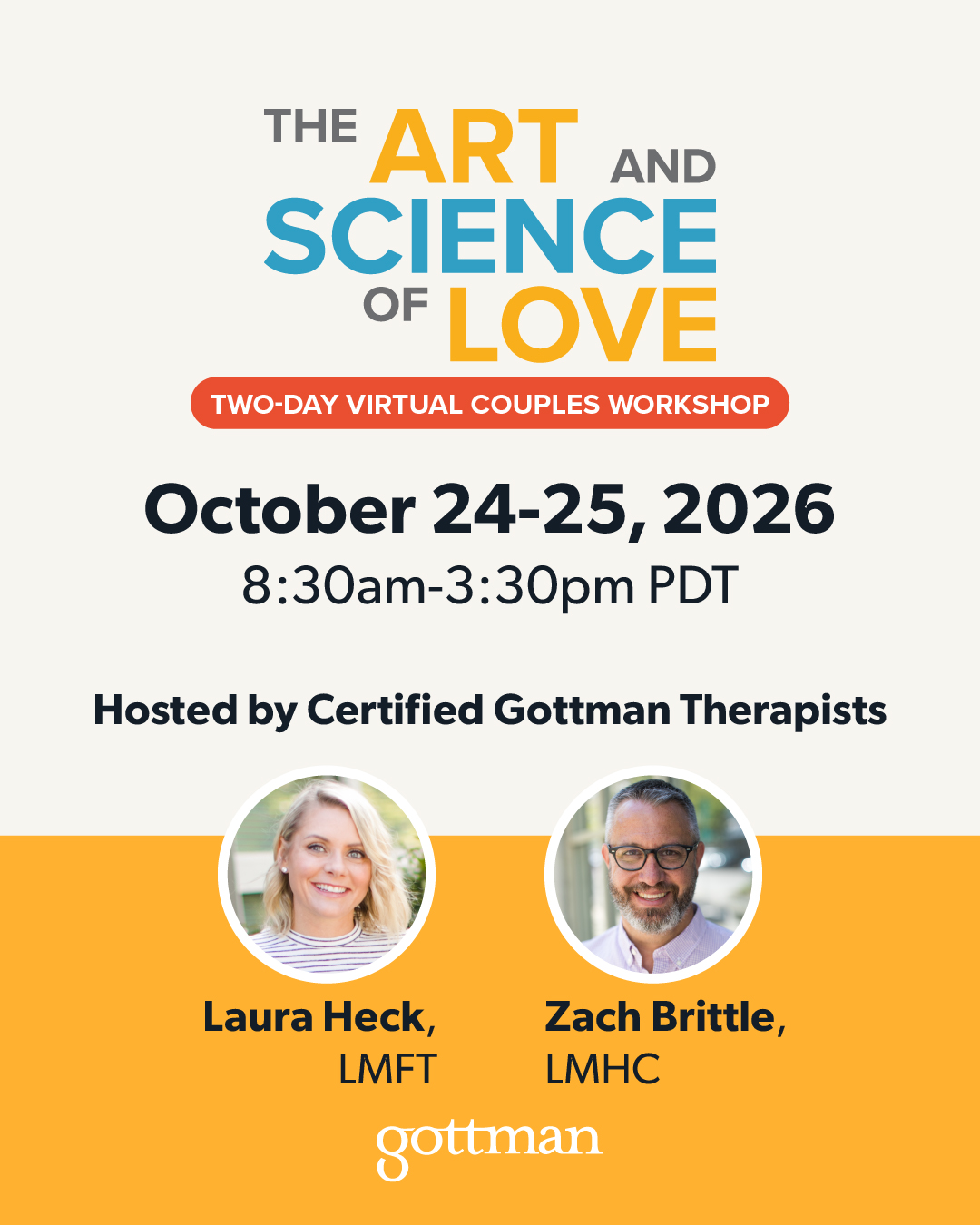
Created by “the Einstein of Love” (Psychology Today), this two-day workshop is grounded on what actually works in relationships that are happy and stable. See for yourself why millions of couples worldwide have benefited from the Gottman Method.

Quote from participant in most recent Live Virtual Workshop:

The Art and Science of Love workshop- where do I begin? It was an absolute stellar workshop. We were looking forward to this for weeks, and it exceeded our expectations! It was well-structured, and well-organized, and provided a wealth of information with real-time demonstrations of how to work through specific scenarios. The outstanding support that was provided throughout the exercises with therapists on standby- WOW! Priceless!

Includes the Art & Science of Love box set.  Please allow time for shipping.  Please Note: This is a live online event. To attend, you will need a reliable internet connection. Our staff will reach out to you with your personal registration and access information.

Related posts

Parenting adult children is a new and different stage.

It Doesn’t Get Easier. It Gets Different.

Zach Brittle, LMHC

As our children get older, our relationship shifts. Parenting becomes different but not necessarily easier.

Read More

Explore the vital link between individual behavioral health and relationship success. Learn why professional guidance is key to breaking unhelpful or toxic patterns and building a lasting bond.

Why Behavioral Health Is the Hidden Foundation of Your Relationship

Alexander Elguren

Explore the vital link between individual behavioral health and relationship success. Learn why professional guidance can be key to breaking unhelpful or toxic patterns and building a lasting bond.

Read More

A therapist working with a couple in session.

Everything You Need to Know about Therapy

Kendra Han

Are you wondering when to get therapy? Learn the Gottman signs of relationship distress, and take steps to improve communication, conflict resolution and more.

Read More

What is the 777 rule for marriage? And is it enough? Find out, and learn about Gottman's research, and simple steps to improve the connection and intimacy in your marriage!

The 777 Rule for Marriage: A Good Start — But Gottman’s Research Goes Deeper

Alexander Elguren

The 777 rule for marriage — couple spending intentional time together your marriage!

Read More

A couple saying goodbye as their adult daughter moves out.

Liminal Space: Maintaining Connection Through Life’s Major Transitions

The Gottman Institute

Major life changes often lead to a disorienting liminal space. Discover how to overcome communication barriers and strengthen your relationships here.

Read More

Do your personality traits make you prone to conflict? Explore the link between individual character and Gottman's Four Horsemen

Do Personality Traits Shape Gottman’s Four Horsemen?

Alexander Elguren

Do your personality traits make you prone to conflict? Explore the link between individual character and Gottman's Four Horsemen

Read More

Improve your Relationship Skills with our Free Newsletters
0