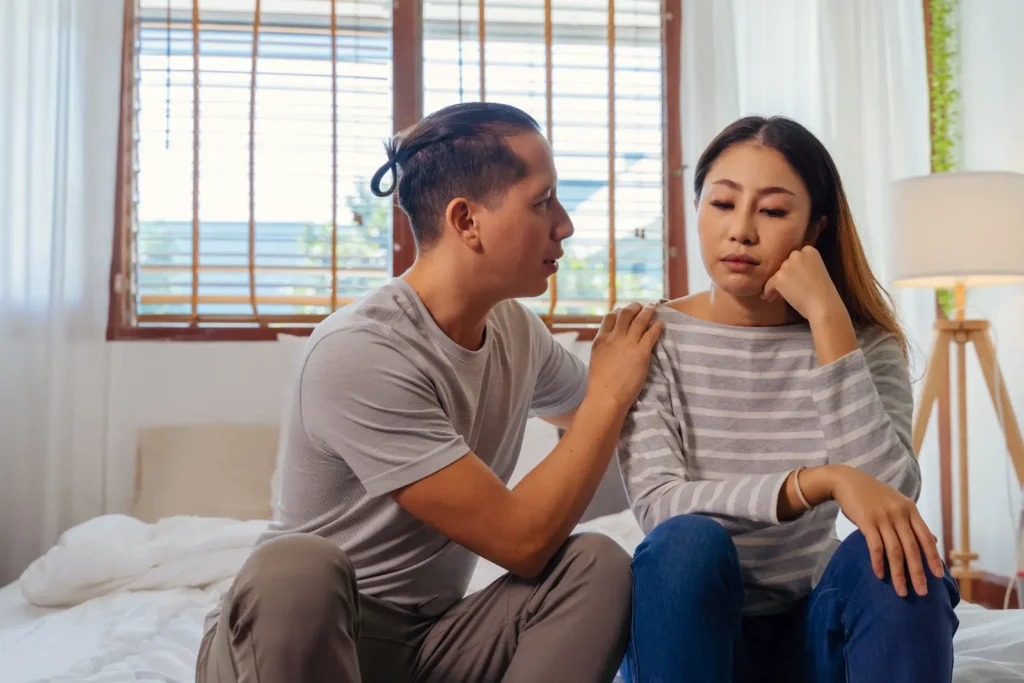
It was a Tuesday when her mother died, and by Saturday her husband had stopped knowing what to say. He had known her for twenty-two years. He had met her mother at the rehearsal dinner, had driven her to the hospital three times in the last year. Now he came home from work to find his wife folding laundry in the dark, and the thing that frightened him most was not her sadness. It was that he could no longer predict it. Some evenings she wanted to talk. Some evenings she wanted him to sit beside her and say nothing. He kept guessing wrong.
What Is Bereavement?
Bereavement is the period following the death of someone close, and the word carries a useful precision: it names the condition, not the feeling. Grief is what happens inside a bereaved person. Mourning is how a culture shapes that grief into ritual. Bereavement is the larger territory all three move through. It can follow the death of a parent, a child, a sibling, a friend, a partner — and it does not end on any fixed schedule.
Much of what has been written about bereavement treats it as an individual experience, and fairly so — the grief belongs, in the end, to the person who lost someone. But bereavement also happens to the relationships around the bereaved, sometimes most visibly to the partner who shares a home with them. The Gottman Institute has not published a dedicated study of bereavement in marriage. What its research and clinical writing does offer — including case material in What Makes Love Last? — is a way of thinking about the pressures that fall on a relationship when one person is grieving, or when both are.
What Are the Emotions Associated With Bereavement?
The emotional territory is wide, and much of it has been mapped by others. Elisabeth Kübler-Ross’s five stages — denial, anger, bargaining, depression, acceptance — are familiar to most readers, and the Gottman Institute’s introductory post on grief offers a thorough overview of the individual terrain.
What couples often discover is that these emotions do not arrive on a shared schedule. One partner may move through anger in the second month while the other is still somewhere closer to numbness. One may want to talk about the person who died, daily and by name; the other may find that talking makes the day harder. Neither response is wrong. But the asymmetry itself becomes a kind of second loss — the quiet disorientation of feeling out of sync with the person you usually face difficulty with.
A great deal of what looks, during bereavement, like marital trouble may not be marital trouble at all. It may be grief inhabiting two people on different timelines, each interpreting the other’s withdrawal as rejection when in fact both are simply ducking a wave.
Dealing With Bereavement
If there is one idea worth holding onto through a long season of bereavement, it may be this: the partner you married is, for a time, not exactly the partner sitting across from you. Grief changes sleep, appetite, patience, humor, and the topics a person can bear to hold in their mind. The assumptions you carried about what comforts them, what they want to be asked, what they need from a Saturday — many of those may need to be set down and, gently, picked up again in their current shape.
Gottman’s research has long emphasized the importance of what he calls Love Maps — the detailed, updated knowledge each partner carries of the other’s inner world. Love Maps are usually built slowly. During bereavement, they may need to be redrawn more deliberately, because the terrain has changed. What helped last week may not help this week. Curiosity, in these seasons, tends to serve couples better than certainty.
It can also help to treat bereavement as a stressor falling on the relationship rather than as a test of it. A great deal of couples research suggests that external shocks — a serious illness, the death of a parent, the loss of work — put strain on partnerships that were doing fine until the shock arrived. The strain is not evidence of a flawed relationship. It is what happens when life asks more of it than usual.
Helping a Loved One Through the Stages of Grief
There is no single correct way to support a grieving partner, and the stages themselves rarely arrive in the tidy sequence a diagram might suggest. What Gottman’s long study of couples does tend to find is that the small gestures matter more than the grand ones. Bereavement is full of what Gottman has called sliding door moments — small openings when one partner reaches, however quietly, for the other. A sigh over coffee. A hand on the back while rinsing a mug. A question asked, or not asked, as a partner walks through the room. Noticing these moments and turning toward them — rather than turning away, even inadvertently — is often more useful than advice or a plan.
The instinct to fix can be well-meant, and occasionally exactly right, but it can also land as pressure to feel differently. A willingness to be present, without steering, tends to age well. When a sliding door moment is missed — and some will be missed — repair remains possible. I’m sorry I didn’t hear you last night. A small repair is still a repair.
For the supporting partner, it is worth noticing the cost to oneself as well. Bereavement ripples. Supporting someone through a long grief can leave the supporter tired, lonely, uncertain whether they are doing enough. These feelings, too, are part of the territory. They are worth speaking about — with the grieving partner when possible, and with trusted others when not. The Gottman blog on grief during the holidays takes up this doubled burden in detail.
By Sunday, he had stopped trying to guess. He asked her, each evening, what kind of evening she needed, and some nights she did not know, and he sat beside her anyway. The laundry still got folded. The house was quieter than it used to be. But the marriage, it turned out, had survived — changed, as they were, and still holding.