Marriage and Couples
Marriage and Couples
More About Our Research
More About Gottman
Join the Gottman Pro Newsletter
Receive regular updates and clinical resources for professionals from the Gottman Institute.
John Gottman’s concept of “flooding” triggers the “fight or flight” response, risking conflict escalation or emotional disengagement. Subscribe for free resources on managing it in clients.
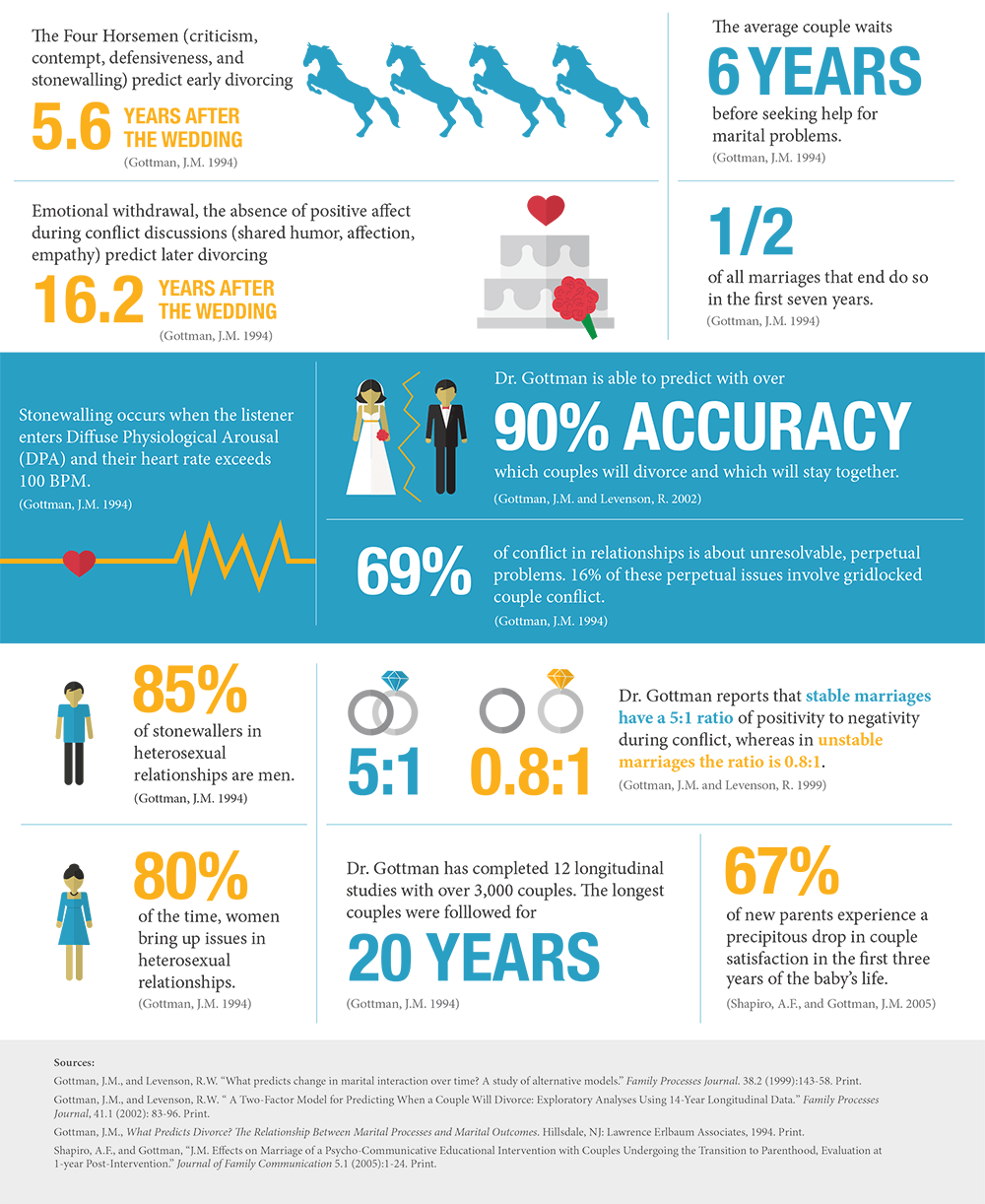
The infographic below highlights some of Dr. John Gottman’s most notable research findings on marriage and couple relationships. For a more in-depth review of the three phases of Gottman’s research with marriage and couples, continue reading.
Phase 1: The Discovery of Reliable Patterns of Interaction Discriminating the “Masters” From the “Disasters” of Relationships

In 1976, Dr. Robert Levenson and Dr. John Gottman teamed up to combine the study of emotion with psycho-physiological measurement and a video-recall method that gave us rating dial measures (still applying game theory) of how people felt during conflict. This was the new way of getting the “talk table” numbers. The research also became longitudinal. They made no predictions in the first study, but they were interested in a measure of “physiological linkage,” because a prior study showed that the skin conductance of two nurses was correlated only if they disliked one another. They thought that might be linked to negative affect in couples. Indeed it was.
They were also amazed that in their first study with 30 couples they were able to “predict” the change in marital satisfaction almost perfectly with their physiological measures. The results revealed that the more physiologically aroused couples were (in all channels, including heart rate, skin conductance, gross motor activity, and blood velocity), the more their marriages deteriorated in happiness over a three-year period, even controlling the initial level of marital satisfaction.
The rating dial and their observational coding of the interaction also “predicted” changes in relationship satisfaction. Such large correlations in the data were unprecedented. Furthermore, Gottman and Levenson had preceded the conflict conversation with a reunion conversation (in which couples talked about the events of their day before the conflict discussion), and they had followed the conflict discussion with a positive topic. Gottman and Levenson were amazed to discover that harsh startup by women in the conflict discussion was predictable by the male partner’s disinterest or irritability in the events of the day discussion. They found that the quality of the couple’s friendship, especially as maintained by men, was critical in understanding conflict. Furthermore, the ability to rebound from, or “repair”, conflict to the positive conversation became a marker of emotion regulation ability of couples.
Both Levenson and Gottman had discovered Dr. Paul Ekman and Dr. Wallace Friesen’s Facial Affect Coding System (FACS), and Gottman subsequently developed the Specific Affect Coding System (SPAFF), which was an integration of FACS and earlier systems in the Gottman lab.
The SPAFF became the main system that Gottman used to code couples’ interaction. At first, it took 25 hours to code 15 minutes of interaction, but later Gottman was able to get the same coding done in just 45 minutes, with no loss of reliability. Gottman also began applying time-series analysis to the analysis of interaction data. He wrote, Time-Series Analysis: A Comprehensive Introduction for Social Scientists, a book on time-series analysis to explain these methods to psychologists, and developed some new methods for analyzing dominance and bi-directionality with James Ringland.
Phase 2: Prediction and the Replication of the Prediction

Soon after, Gottman and Levenson received their first grant together and began attempting to replicate their observations from the first study. The subsequent studies they conducted in their labs with colleagues eventually spanned the entire life course — with the longest of the studies following couples for 20 years, in Levenson’s Berkeley lab.
The Gottman lab at the University of Illinois also studied the linkages between marital interaction, parenting, and children’s social development with Dr. Lynn Katz, and later at the University of Washington involved studying these linkages with infants with Dr. Alyson Shapiro. Gottman developed the concept of “meta-emotion”, which is how people feel about emotion (such as specific emotions like anger), emotional expression, and emotional understanding in general. Meta-emotion mismatches between parents in that study predicted divorce with 80% accuracy.
Gottman and Levenson discovered that couples interaction had enormous stability over time (about 80% stability in conflict discussions separated by 3 years). They also discovered that most relationship problems (69%) never get resolved but are “perpetual problems” based on personality differences between partners.
In seven longitudinal studies, one with violent couples (with Neil Jacobson), the predictions replicated. Gottman could predict whether a couple would divorce with an average of over 90% accuracy, across studies using the ratio of positive to negative SPAFF codes, the Four Horsemen of the Apocalypse (Criticism, Defensiveness, Contempt, and Stonewalling), physiology, the rating dial, and an interview they devised, the Oral History Interview, as coded by Kim Buehlman’s coding system.
Gottman could predict whether or not their stable couples would be happy or unhappy using measures of positive affect during conflict. With Dr. Jim Coan, he discovered that positive affect was used not randomly, but to physiologically soothe the partner. Gottman also discovered that in heterosexual relationships, men accepting influence from their wives was predictive of happy and stable marriages. Bob Levenson also discovered that humor was physiologically soothing and that empathy had a physiological substrate (in research with Dr. Anna Ruef), using the rating dial.
Phase 3: Theory Building, Understanding, and Prevention & Intervention
The third phase of Gottman’s research program was devoted to trying to understand the empirical predictions, and thus building and then testing theory. Ultimately, Gottman aimed to build a theory that was testable or disconfirmable.
Testing theory in the psychological field requires clinical interventions. In 1996, the Gottman lab returned to intervention research with Dr. Julie Schwartz Gottman. John and Julie Gottman designed both proximal and distal change studies. In a proximal change study, one intervenes briefly with interventions designed only to make the second of two conflict discussions less divorce-prone. In one of these studies, they discovered that a 20-minute break, in which couples stopped talking and just read magazines (as their heart rates returned to baseline), dramatically changed the discussion, so that people had access to their sense of humor and affection.
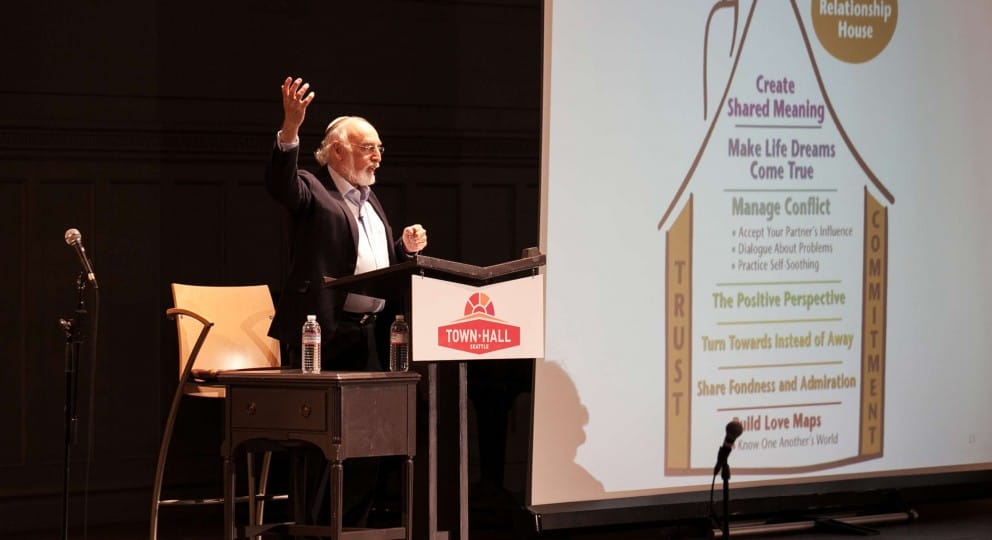
Together with Julie, John Gottman started building the Sound Relationship House Theory. That theory became the basis of the design of clinical interventions for couples in John Gottman’s book, The Marriage Clinic, and Julie Gottman’s book, The Marriage Clinic Casebook. In August of 1996, they founded The Gottman Institute to continue to develop evidence-based approaches to improving couples therapy outcomes.
Read more about The Gottman Institute’s mission here.
Same-Sex Couples
Same-Sex Couples
In separate lines of research, Dr. John Gottman and Dr. Julie Schwartz Gottman have observed the strength and resilience of same-sex couples, even in the midst of the cultural and social stresses to which same-sex couples are uniquely vulnerable. These couples — like all couples — need and deserve tailored, research-based support when they are in distress.
Together, the Gottmans have a commitment to assuring that gay and lesbian couples have resources to help strengthen and support their relationships. Dr. Julie Schwartz Gottman made a key contribution to research on daughters of lesbians: her work showed that daughters with lesbian moms do just as well as those raised by straight moms. Dr. John Gottman conducted the first longitudinal study of its kind of gay and lesbian relationships using multiple methods and measures. He was able to assess the emotional strengths and weaknesses of the relationships and to learn what makes these relationships more or less stable.
What Makes Same-Sex Relationships Succeed or Fail?
Dr. Gottman and his colleagues conducted a twelve-year study of same-sex couples to learn what makes same-sex relationships succeed or fail. The research demonstrates that all couple types—straight or gay—have many of the same problems and the same paths to staying happy together. But research has shown that there are also some qualities of strength (like humor and the ability to calm down during a fight) that are especially key to same-sex couples.
Read more about this research in the “Journal of Homosexuality” here.
The 12-Year Study
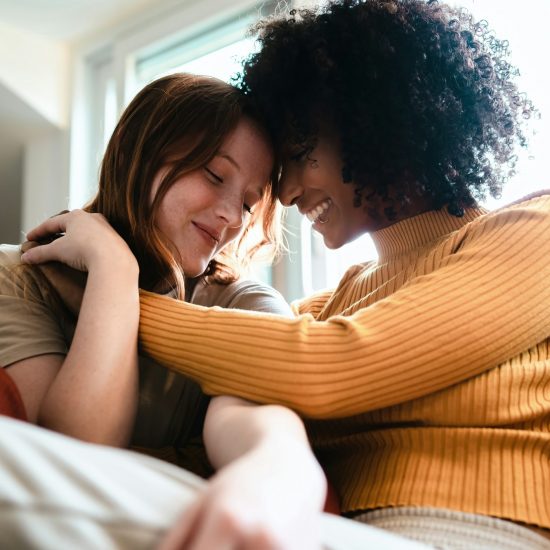
Using state-of-the-art methods while studying 21 gay and 21 lesbian couples, Dr. John Gottman and Dr. Robert Levenson have learned what makes same-sex relationships succeed or fail.
One key result: Overall, relationship satisfaction and quality are about the same across all couple types (straight, gay, lesbian) that Dr. Gottman has studied. This result supports prior research by Lawrence Kurdek and Pepper Schwartz: They find that gay and lesbian relationships are comparable to straight relationships in many ways.
“Gay and lesbian couples, like straight couples, deal with everyday ups-and-downs of close relationships,” Dr. Gottman observes. “We know that these ups-and-downs may occur in a social context of isolation from family, workplace prejudice, and other social barriers that are unique to gay and lesbian couples.” The research uncovered differences, however, that suggest that workshops tailored to gay and lesbian couples can have a strong impact on relationships.
Read the full article, titled “Observing Gay, Lesbian and heterosexual Couples’ Relationships – Mathematical modeling of conflict interactions,” in the Journal of Homosexuality here.

Results from the Gottman Gay/Lesbian Couples Study
Gay/lesbian couples are more upbeat in the face of conflict. Compared to straight couples, gay and lesbian couples use more affection and humor when they bring up a disagreement, and partners are more positive in how they receive it. Gay and lesbian couples are also more likely to remain positive after a disagreement. “When it comes to emotions, we think these couples may operate with very different principles than straight couples. Straight couples may have a lot to learn from gay and lesbian relationships,” explains Gottman.
Gay/lesbian couples use fewer controlling, hostile emotional tactics. Gottman and Levenson also discovered that gay and lesbian partners display less belligerence, domineering, and fear with each other than straight couples do. “The difference on these ‘control’ related emotions suggests that fairness and power-sharing between the partners is more important and more common in gay and lesbian relationships than in straight ones,” Gottman explained.
In a fight, gay and lesbian couples take it less personally. In straight couples, it is easier to hurt a partner with a negative comment than to make one’s partner feel good with a positive comment. This appears to be reversed in gay and lesbian couples. Gay and lesbian partners’ positive comments have more impact on feeling good, while their negative comments are less likely to produce hurt feelings. “This trend suggests that gay and lesbian partners have a tendency to accept some degree of negativity without taking it personally,” observes Gottman.
Unhappy gay and lesbian couples tend to show low levels of “physiological arousal.” This is just the reverse for straight couples. For straights, physiological arousal signifies ongoing aggravation. The ongoing aroused state—including elevated heart rate, sweaty palms, and jitteriness—means partners have trouble calming down in the face of conflict. For gay and lesbian couples this lower level of arousal shows that they are able to soothe one another.
Gottman Method Couples Therapy Established as Evidence-Based Treatment for Same-Sex Couples
In September of 2017, Certified Gottman Therapist Salvatore Garanzini and Alapaki Yee, MFT, along with Drs. John and Julie Gottman, published the results of the first outcome research study on couples therapy with gay and lesbian couples in the Journal of Marital and Family Therapy. The results proved that Gottman Method Couples Therapy is incredibly effective as an evidence-based therapy for gay and lesbian couples. Working with couples at the Gay Couples Institute, Yee and Garanzini discovered that gay and lesbian couples who received Gottman Method Couples Therapy improved over twice as much as most couples. Most couples therapy outcome studies show that couples tend to improve half a standard deviation, or 0.5. However, couples who took part in the study at the Gay Couples Institute improved approximately 1.2 standard deviations. These results happened with nearly half the number of sessions that is typical for heterosexual couples. This outcome study is the first of its kind, and all of the authors are proud to display the strengths of gay and lesbian relationships to the scientific community, given the current worldwide political climate toward same-sex relationships.
Gay and Lesbian Differences in Emotional Expressiveness
In a fight, lesbians show more anger, humor, excitement, and interest than conflicting gay men. This suggests that lesbians are more emotionally expressive—positively and negatively—than gay men. This result may be the effect of having two women in a relationship. Both have been raised in a society where expressiveness is more acceptable for women than for men, and it shows up in their relationships.
Gay men need to be especially careful to avoid negativity in conflict. When it comes to repair, gay couples differ from straight and lesbian couples. If the initiator of conflict in a gay relationship becomes too negative, his partner is not able to repair as effectively as lesbian or straight partners. “This suggests that gay men may need extra help to offset the impact of negative emotions that inevitably come along when couples fight,” explains Gottman.

Gay and Lesbian Couples and Families Information
Relationship Quiz: How Well Do You Know Your Partner?

Relationship Quiz: How Well Do You Know Your Partner?
This relationship quiz is all about how well you know your partner.
After doing extensive research for over four decades with thousands of couples, we’ve found that one of the most important components of a successful relationship is the quality of friendship between partners. And that requires knowing your partner’s likes, dislikes, needs, desires, beliefs, fears, and life dreams.
So, how well do you really know your partner? Take our quiz below to find out.
Share this quiz:
Recommended products
$250.00 Original price was: $250.00.$157.00Current price is: $157.00.
$35.00 Original price was: $35.00.$27.00Current price is: $27.00.
$599.00
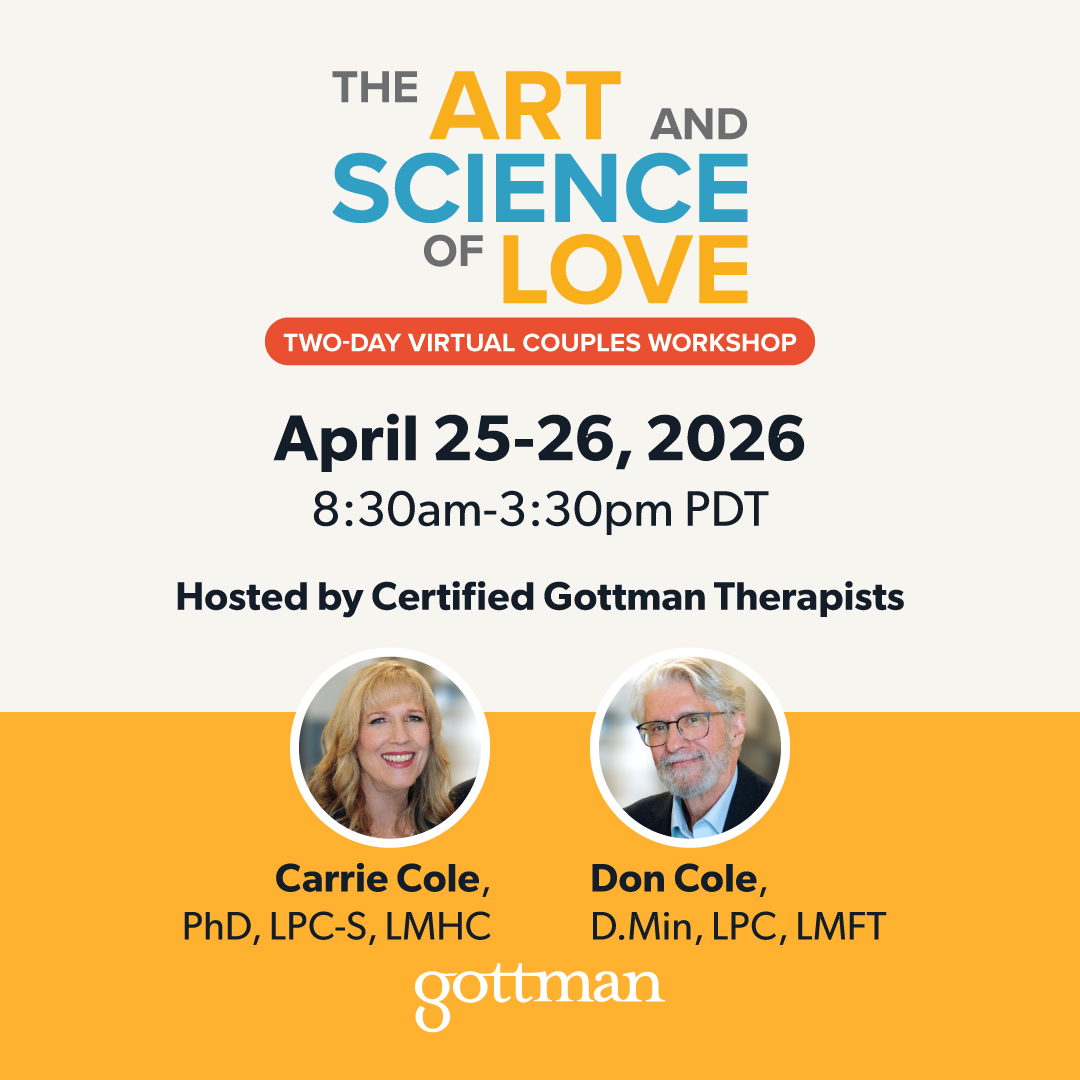
The Art and Science of Love workshop- where do I begin? It was an absolute stellar workshop. We were looking forward to this for weeks, and it exceeded our expectations! It was well-structured, and well-organized, and provided a wealth of information with real-time demonstrations of how to work through specific scenarios. The outstanding support that was provided throughout the exercises with therapists on standby- WOW! Priceless!Includes the Art & Science of Love box set. Please allow time for shipping. Please Note: This is a live online event. To attend, you will need a reliable internet connection. Our staff will reach out to you with your personal registration and access information.

$30.00 Original price was: $30.00.$17.00Current price is: $17.00.
NEW! Small Daily Habits. Big Relationship Wins.
Looking for an easy, research-backed way to strengthen your relationship? The Gottman 30 Day Relationship Journal helps you build a simple, meaningful journaling habit, in just a few minutes a day. For 30 days, you’ll receive a daily email straight to your inbox. Each day focuses on a specific Gottman relationship topic and includes three thought-provoking prompts designed to help you reflect, connect, and take action.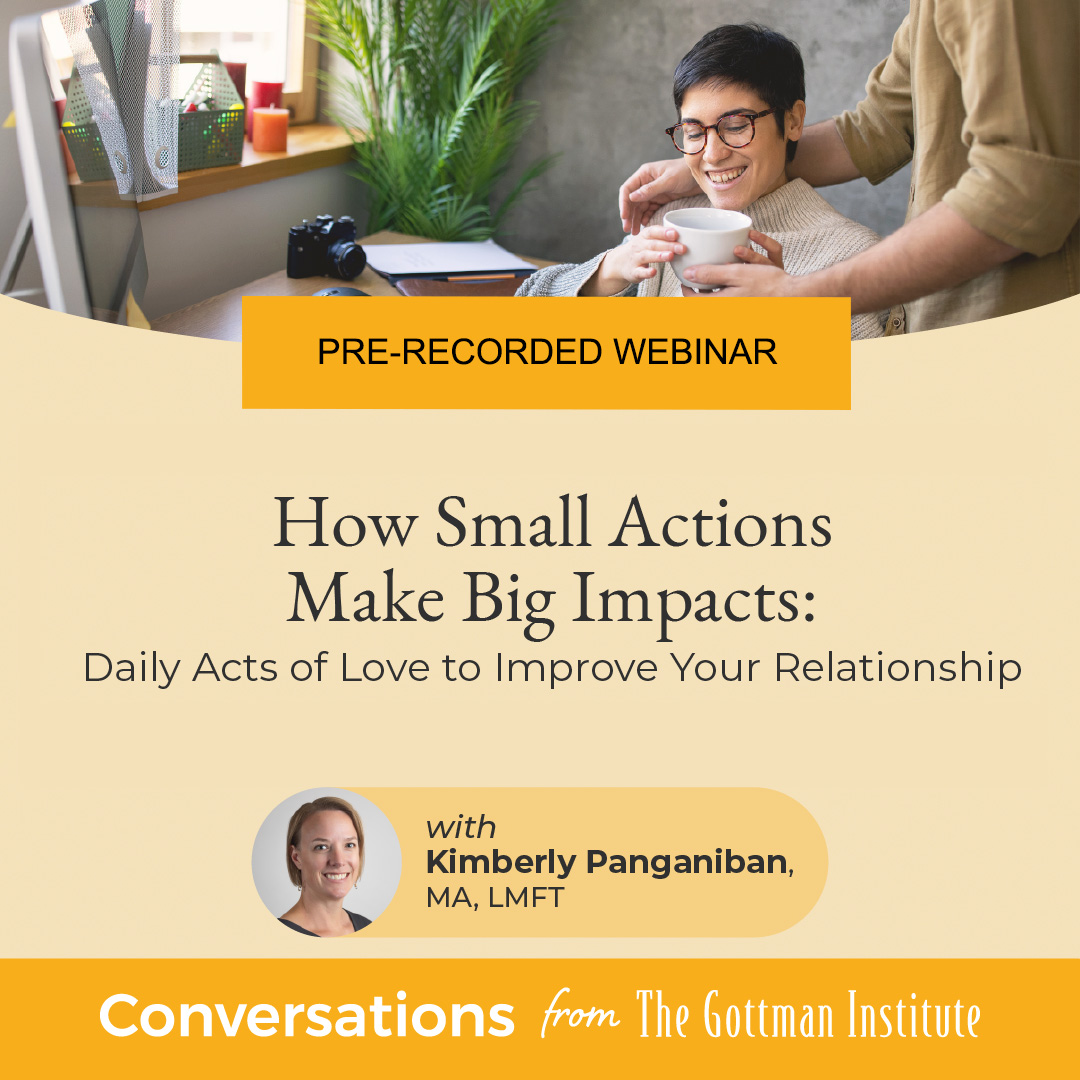
$45.00 Original price was: $45.00.$35.00Current price is: $35.00.
NEW! How Small Actions Make Big Impacts: Daily Acts of Love to Improve Your Relationship
Feeling disconnected or worried about keeping the spark alive amid life’s many responsibilities? Discover Gottman’s “Small Things Often” motto—easy, everyday habits that build long-lasting connection. Kimberly Panganiban shows you practical techniques to strengthen your bond in just a few moments a day, so you can keep your relationship on a positive path for the long run.
$298.00 Original price was: $298.00.$137.00Current price is: $137.00.
Quiz Results – How Well Do You Know Your Partner?
Thanks for taking our quiz
Thank you for the How well do you know your partner quiz. You will receive the results in your inbox shortly.
In the meantime, check out the Gottman Assessment for a more in-depth analysis of your relationship and the Gottman Relationship Adviser, for a complete approach to relationship wellness.
Note: These quizzes are intended to be psychoeducational. If you are looking for a Gottman Method-trained therapist in your area please visit the Gottman Referral Network.
Recommended Products
While you’re here, check out some of our most popular products:
$599.00
The Art and Science of Love workshop- where do I begin? It was an absolute stellar workshop. We were looking forward to this for weeks, and it exceeded our expectations! It was well-structured, and well-organized, and provided a wealth of information with real-time demonstrations of how to work through specific scenarios. The outstanding support that was provided throughout the exercises with therapists on standby- WOW! Priceless!Includes the Art & Science of Love box set. Please allow time for shipping. Please Note: This is a live online event. To attend, you will need a reliable internet connection. Our staff will reach out to you with your personal registration and access information.
$15.00
$30.00 Original price was: $30.00.$17.00Current price is: $17.00.
NEW! Small Daily Habits. Big Relationship Wins.
Looking for an easy, research-backed way to strengthen your relationship? The Gottman 30 Day Relationship Journal helps you build a simple, meaningful journaling habit, in just a few minutes a day. For 30 days, you’ll receive a daily email straight to your inbox. Each day focuses on a specific Gottman relationship topic and includes three thought-provoking prompts designed to help you reflect, connect, and take action.
$210.00 Original price was: $210.00.$37.00Current price is: $37.00.
Who This Bundle is For:
- New and long-term couples looking to invest in lasting love
- Anyone seeking practical communication tools and conflict resolution skills
- Partners wanting to reignite intimacy and rediscover excitement
- Couples needing easy, everyday ways to deepen emotional connection
- Those ready to build trust and a supportive, loving environment
Why You’ll Love It:
- Expert Insights: Learn from certified Gottman therapists and LMFTs
- Proven Techniques: Real-world strategies you can apply immediately
- Valuable Savings: Get $210 worth of webinars for just $59
- Instant Access: Pre-recorded sessions you can watch anytime, anywhere
$250.00 Original price was: $250.00.$157.00Current price is: $157.00.

$45.00 Original price was: $45.00.$37.00Current price is: $37.00.
Ever wonder what’s really going on in your relationship?
Tired of getting into fights and unsure what to do next? Or perhaps you’re curious about which areas of your relationship need improvement? The all-new Gottman Assessment, powered by the legendary scientific Gottman Method, can help you understand the state of your relationship—and get you the help you need to improve it.Research
Research
More About Our Research
More About Gottman
Join the Gottman Pro Newsletter
Receive regular updates and clinical resources for professionals from the Gottman Institute.
John Gottman’s concept of “flooding” triggers the “fight or flight” response, risking conflict escalation or emotional disengagement. Subscribe for free resources on managing it in clients.
In the beginning, Dr. John Gottman’s research was devoted to the discovery of reliable patterns in observational data. He wanted to see if there were indeed patterns of behavior, or sequences of interactions, that could discriminate happy from unhappy couples.
It was not at all clear that these patterns existed. Dr. Gottman and his colleagues began developing the math for sequential analysis, which now is a well-developed methodology. They began discovering consistent sequences that differentiated happily married from unhappily married couples, which Dr. Gottman wrote about in a book, called Marital Interactions: Experimental Investigations.
Since that time, the Gottman Method has grown from its initial basis in mathematical foundations, through a long history of published books, evolving research, and eventually into the applied method known today, which is taught to and used by thousands of skilled therapists around the globe.
This page covers a brief, but of course, non-exhaustive overview of major milestones and themes of research, from the beginning up to the current day. For more information, please consider checking out the FAQ, the Effectiveness page, the current research, or one of John and Julie Gottmans’ wonderful books, written for both couples and therapists.
Continuing the Tradition - Ongoing Research
Research continues, both internationally and right here in Seattle. Dr. Carrie Cole continues our work here as the Research Director, working in collaboration with John and Julie Gottman to continue the research in new directions.
We currently have several therapy studies ongoing in collaboration with independently-practicing Certified Gottman Therapists working with couples across the U.S. and beyond, and we are always looking for new couples who are interested in working with highly-trained therapists while also being part of the continued research legacy.
When you take part in our couples therapy research, you and your partner will:
- Engage in guided conversations and interventions that are designed to effectively manage conflict with a Certified Gottman Therapist.
- Gain valuable insights from decades of scientific research on love, trust, and communication.
- Contribute to developing and advancing effective strategies for helping couples thrive.
There are currently two opportunities to participate:
- The Outcome Study – traditional, regular couple therapy in 60- or 90-minute sessions
- The Marathon Study – intensive couples therapy (15-18 hours of treatment over 2-3 days) with follow-up
Participation is always voluntary and confidential. Every couple’s story adds valuable knowledge to the field of relationship science, helping therapists, researchers, and partners everywhere.
If you and your partner are interested in being a part of either study and working with a local or online highly-trained Certified Gottman Therapist, please check out the study pages above, or contact us for more information about being a part of the continued Gottman research legacy.
We are also seeking business teams to fill out a pilot survey related to applying Gottman communication strategies (e.g., bids for connection) to the workplace environment. If you think members of your team might be interested in filling out a brief survey about their experience as members of their team, please reach out to us at research@gottman.com.
Early Research and Findings
In the 1970’s, systematic observation of couples started in the Gottman lab. Psychology at that time was having a great deal of difficulty establishing reliable patterns in the personality of one individual. Advice suggested that psychologists should not study couples, because of the unreliability in studying one person might be squared by studying two people. That advice was wrong. Dr. Gottman showed that there was tremendous regularity in a couple over time.
In a series of research studies, Dr. Gottman developed new observational coding systems with his colleagues, and the lab applied brand new methods for studying sequences of interaction. They built a device called a “talk table,” in which people could interact and also rate how positive or negative their intentions were and how positive or negative were the impacts of the messages they received.
Collaboration with Robert Levenson
In 1975, Robert Levenson and John Gottman teamed up to combine the study of emotion with psycho-physiological measurement and a video-recall method that gave them rating dial measures of how people felt during conflict. They discovered Paul Ekman and Wallace Friesen’s Facial Affect Coding System (FACS), and Dr. Gottman subsequently developed the Specific Affect Coding System (SPAFF).
Dr. Gottman began applying time-series analysis to the analysis of interaction data. He wrote a book on time-series analysis to explain these methods to psychologists, and developed some new methods for analyzing dominance and bidirectionality with his colleagues. In 1980, Dr. Gottman and Levenson received their first grant together and began attempting to replicate their observations from their first study.
The Gottman lab at the University of Illinois also studied the linkages between marital interaction, parenting, and children’s social development (with Lynn Katz), and later at the University of Washington involved studying these linkages with infants (with Alyson Shapiro). Learn more about the research on parenting.
Divorce Prediction Studies
Gottman and Levenson discovered that couples interaction had enormous stability over time (about 80% stability in conflict discussions separated by 3 years). They also discovered that most relationship problems (69%) never get resolved but are “perpetual” problems based on personality differences between partners. Learn more about the research on marriage and couples.
In seven longitudinal studies, one with violent couples (with Neil Jacobson), the predictions replicated. They could predict whether a couple would divorce with an average of over 90% accuracy, across studies using the ratio of positive to negative SPAFF codes, the Four Horsemen of the Apocalypse (Criticism, Defensiveness, Contempt, and Stonewalling), physiology, the rating dial, and an interview they devised called the Oral History Interview.
The Sound Relationship House Theory and The Gottman Institute
In 1994, Dr. Gottman began working with his wife, clinical psychologist Dr. Julie Schwartz Gottman, developing the Sound Relationship House (SRH) theory and interventions based on John’s research. Together, they designed both proximal and distal change studies. In a proximal change study, one intervenes briefly with interventions designed only to make the 2nd of two conflict discussions less divorce prone. In one of these studies they discovered that a 20-minute break in which couples stopped talking and just reading magazines (as their heart rates returned to baseline) dramatically changed the discussion so that people had access to their sense of humor and affection.
In 1996, Drs. Julie and John Gottman co-founded The Gottman Institute to bring this research to the world. We are committed to an ongoing program of research that increases the understanding of relationships and adds to the development of interventions that have been carefully evaluated. Read more about our mission.
Creation of the Love Lab
In 1986, John Gottman and his colleagues built an apartment laboratory at the University of Washington that was dubbed the “Love Lab” by the media. This is where they discovered the basis of friendship and intimacy and its relation to conflict in their Bids and Turning Coding System. With that work they discovered how couples create and maintain friendship and intimacy and how it’s related to conflict.
When 14-year longitudinal data became available Levenson & Gottman discovered a second dysfunctional pattern, emotional disengagement. It was marked by the absence of positive affect during conflict (no interest, affection, humor, or empathy). Now they could predict not only if a couple would divorce, but when. Couples who had the Four Horsemen divorced an average of 5.6 years after the wedding, while emotionally disengaged couples divorced an average of 16.2 years after the wedding.
The Love Lab Today
The newest iteration of the Love Lab, directed by Dr. Carrie Cole, an incredibly skilled clinician and dear friend of the Gottmans, is located in the heart of downtown Seattle, WA, where it serves to continue the tradition of data collection while at the same time translating decades of relationship science into a clear, compassionate experience for couples. The new Love Lab combines assessment, research, tools, and treatment. In a comfortable setting, partners engage in guided conversations—everyday check-ins and conflict discussions—while the research team observes interaction patterns shown by research to predict relationship health, and non-invasive physiological measures and validated questionnaires add depth to the picture.
What makes the Love Lab unique is its precision. Rather than guessing at “what’s wrong,” our
team maps the micro-behaviors that drive disconnection (like harsh start-ups, flooding, or missed bids) and the habits that sustain thriving relationships (turning toward, repair attempts, shared meaning). Dr. Cole synthesizes these findings into a personalized feedback session and an actionable plan that is followed during intensive treatment sessions. The couple receives specific targeted interventions, communication frameworks, and referrals or follow-up coaching when needed.
Whether you’re proactively strengthening a good partnership or navigating high-stakes
challenges, the Gottman Love Lab gives you a science-based roadmap to greater trust, intimacy, and resilience—delivered with warmth, clarity, and respect.
This deep assessment and intensive treatment process is ideal for couples seeking a rapid
transformation in their relationship. To speak to a scheduler to see if the Gottman Love Lab is
right for your relationship, click here.
Research on Same-Sex Couples
Levenson and Gottman also conducted a 12-year study of gay and lesbian couples, work they published in two papers in the Journal of Homosexuality. The research demonstrates that all couple types—straight or gay—have many of the same problems and the same paths to staying happy together. But research has shown that there are also some qualities of strength (like humor and ability to calm down during a fight) that are especially key to same-sex couples. Read more about this research in the Journal of Homosexuality here, and learn more about our research on same-sex couples.
Research on Affair Recovery
The Gottmans, Carrie Cole, and professors Taylor Irvine and Paul Peluso have collaborated to continue research in the area of affairs and infidelity. Their initial pilot study has demonstrated the efficacy of Gottman Method Couples Therapy in helping couples heal from the trauma and betrayal of an affair, and their work continues. You can see their paper in The Family Journal. Training is available for Gottman Therapists to apply Gottman Method Couples Therapy to the specific challenge of affair recovery, via the Atone-Attune-Attach model, and we are excited to continue to support and see research done in this area.
The International Research Community
Other teams have also contributed to the body of work underlying the Gottman Method, and we would be remiss to neglect to mention their contributions. Some of this work that looks specifically at therapeutic outcomes are mentioned on the Effectiveness page. Much of it has been done by international teams working with couples across the globe, adding to both the body of knowledge and expanding the diversity of couples and therefore strengthening the foundation of the method as an approach that works for and can be adapted to couples of any age, background, religion, culture, or presenting challenge.
Research FAQ
Research FAQ
More About Our Research
The following Frequently Asked Questions are drawn from common inquiries about Dr. Gottman’s research on couples. The Gottman Institute welcomes the opportunity to share the insight that science can provide the field of relationship study, and we hope these brief responses provide a greater level of detail and depth of understanding.
Frequently Asked Questions
Is any of the research current/ongoing?
Yes! Research has been ongoing, both here and at teams located around the globe. Some of this work that looks specifically at therapeutic outcomes are mentioned on the Effectiveness page. Much of it has been done by international teams working with couples across the globe, adding to both the body of knowledge and expanding the diversity of couples and therefore strengthening the foundation of the method as an approach that works for and can be adapted to couples of any age, background, religion, culture, or presenting challenge.
The Gottman Institute also continues research collaborations, such as the recent research with Taylor Irvine and Paul Peluso looking at work with affair couples, as well as in-house research done in collaboration with Certified Gottman Therapists across the globe, which you can read about here.
Can my partner and I be a part of the research?
We have two ongoing studies that we are actively recruiting couples for:
The Outcome Study looks at applying the Gottman Method to diverse and varied couples presenting for any issue and seeking to work with a highly-trained Gottman therapist.
The Marathon Study looks at an intensive 3-day experience, followed by a bit of follow-up, to study the intensive therapy format.
We are also seeking business teams to fill out a pilot survey related to applying Gottman communication strategies (e.g., bids for connection) to the workplace environment. If you think members of your team might be interested in filling out a brief survey about their experience as members of their team, please reach out to us at research@gottman.com.
Is Dr. Gottman really able to predict whether a couple will get divorced with 94% accuracy?
Statements about the 94% accuracy rate of divorce prediction have become a source of confusion. What Dr. Gottman is able to say is that a particular couple is behaving like the couples that were in the group that got divorced in his 1992 study (Buehlman, K., Gottman, J.M., & Katz, L.), a study in which Dr. Gottman predicted with 93.6% accuracy which couples would divorce.
Altogether, Dr. Gottman has completed seven studies that explored what predicts divorce. These studies included three groups: 1) couples that divorced 2) couples that stayed together and were happy and 3) couples that stayed together and were unhappy. Dr. Gottman’s research helped him identify specific behavior patterns in couples that he later termed the “Masters” and “Disasters” of relationships.
Six of the seven studies have been predictive—each began with a hypothesis about factors leading to divorce. Based on these factors, Dr. Gottman predicted who would divorce, then followed the couples for a pre-determined length of time. Finally, he drew conclusions about the accuracy of his predictions. He has also consistently evaluated other theoretical models that might predict differently and reported the results of these analyses (e.g., Gottman & Levenson, 2002). This is true prediction. Prior to his six prediction studies, Dr. Gottman did an initial post-hoc analyses study back in 1980 to help him determine what factors were useful in predicting divorce.
Can you tell us more about Dr. Gottman’s post-hoc analysis, and how it’s different from prediction studies?
Post-hoc analysis is looking at statistics retroactively – that is, statistically analyzing what has happened after the event or situation being studied has passed. The first of Dr. Gottman’s seven relevant studies was a post-hoc analysis (data mining). At first, Dr. Gottman had no idea what might cause divorce, so he looked for patterns in the behavior of couples that later divorced. By contrast, prediction research starts with making a prediction, and then seeing if the prediction works. It allows one to reliably predict an event or situation in the future, based on the results of the research. The next six of Dr. Gottman’s research studies consistently gleaned results that allowed him to reliably predict divorce, and each subsequent study added variables and examined new couples populations.
How statistically significant is it that Dr. Gottman can predict divorce with such a high rate of accuracy?
Dr. Gottman’s ability to predict divorce among newlyweds is more clearly understood by imagining an urn that contains 130 white balls (representing couples that stayed married) and 17 red balls (representing couples that ended up divorcing) for a total of 147 balls. The chances that Dr. Gottman could blindly pick balls out of the urn and guess which were red and which were white with 90% accuracy could only happen by chance 1 x 10-19 times. That is the number point one (0.1) with 18 zeroes in front of the number one. This means it is practically impossible that Dr. Gottman could predict which couples would divorce with much accuracy by chance alone. The factors he used to make his predictions were indeed clearly related to why couples ended up divorced. By looking for those factors, he was able to predict divorce fairly accurately. For the Gottman, Katz and Hooven study, where Gottman et. al. picked out all seven divorced couples out of 56, the probability is approximately .000000000384 or 3.84×10⁻⁹.
Did Dr. Gottman (or any other researcher) replicate the findings in the research studies?
The divorce and happiness change predictions are probably among the most replicated studies in the family research field. For example, Rand Conger’s group (including Ron Simons) at Iowa State University replicated some of Gottman’s divorce prediction studies. Julia Babcock at the University of Houston also replicated some of Gottman and Jacobson’s work on domestic violence.
What are the negative behavior patterns that can predict divorce?
Dr. Gottman calls these destructive behaviors, “A Positive-to-Negative Ratio of 0.8 or Less,” and has named the most corrosive negative behavior patterns, “The Four Horsemen of the Apocalypse.” Specifically, these are:
- Criticism: stating one’s complaints as a defect in one’s partner’s personality, i.e., giving the partner negative trait attributions. Example: “You always talk about yourself. You are so selfish.”
- Contempt: statements that come from a relative position of superiority. Contempt is the greatest predictor of divorce and must be eliminated. Example: “You’re an idiot.”
- Defensiveness: self-protection in the form of righteous indignation or innocent victim-hood. Defensiveness wards off a perceived attack. Example: “It’s not my fault that we’re always late; it’s your fault.”
- Stonewalling: emotional withdrawal from interaction. Example: The listener does not give the speaker the usual nonverbal signals that the listener is “tracking” the speaker.
These predict early divorcing – an average of 5.6 years after the wedding. Emotional withdrawal and anger predict later divorcing – an average of 16.2 years after the wedding.
Can physiological data really predict changes in marital satisfaction?
Yes. The more “diffusely physiologically aroused” (in other words, in “fight or flight” mode,) someone is during a conflict conversation, the more his or her marital satisfaction is likely to decline during a period of three years.
Are there any gender differences between men and women when it comes to physiological arousal?
Our studies have found that men tend to react with more signs of physiological stress than do women during disagreements, and therefore, men are more likely to withdraw (stonewall). (It is interesting to note that we have also followed same-sex couples, and stonewalling occurs between them as well.)
What research methods does Dr. Gottman use to study couples?
Dr. Gottman and his colleagues brought a multi-method approach to the measurement of couple processes. Methods include:
- Interactive behavior (Coding partners’ behavior and emotions as couples interact in various contexts)
- Perception (Self assessment through questionnaires, video recall, attributional methods and interviews)
- Physiology (Measuring autonomic and endocrine systems)
- Interviews (Oral history, meta-emotion, attunement)
- New questionnaires.
Are you sure couples’ behavior when observed by researchers is the same as how they behave at home?
No. We know couples tend to be more polite to each other when they’re observed. (We know this because we have also studied audio and video tapes couples made at home without researchers present.) Because of this, we underestimate the real differences between happy and unhappy couples. Given our ability to estimate what will happen to a relationship longitudinally, this is not a problem. And, after about 45 minutes, couples tend to forget they’re being observed all together.
If we could go to the “Love Lab,” and if we learned that we were in the category of having a high probability of divorce, does that mean there’s no hope? Should we break up now, even if our relationship seems good to us?
No! The most important discovery to come from our research is how we can predict divorce, and from that we know what couples need to do differently to strengthen their relationships. Changing those negative behaviors that predict divorce to more positive behaviors that predict success can significantly change the course of your relationship and make it better.
Does the Love Lab still exist?
It does! The new Love Lab in downtown Seattle is more of a therapy office than an apartment, and work is done during the daytime rather than overnight, but observational methods and physiological measurements are still taken today. This newest Gottman Love Lab—directed by Dr. Carrie Cole, a dear friend of John and Julie Gottman—offers research-grounded assessments and guidance to help couples understand their patterns, strengthen friendship and intimacy, manage conflicts more productively, and build a relationship that lasts.
Can my partner and I go through the full Love Lab experience?
You can. Directed by Dr. Carrie Cole, the Gottman Love Lab, located in the heart of Seattle, WA,
translates decades of relationship science into a clear, compassionate experience for couples. In a comfortable setting, partners engage in guided conversations—everyday check-ins and conflict discussions—while the research team observes interaction patterns shown by research to predict relationship health. Noninvasive physiological measures and validated questionnaires add depth to the picture.
What makes the Love Lab unique is its precision. Rather than guessing at “what’s wrong,” our
team maps the micro-behaviors that drive disconnection (like harsh start-ups, flooding, or missed bids) and the habits that sustain thriving relationships (turning toward, repair attempts, shared meaning). Dr. Cole synthesizes these findings into a personalized feedback session and an actionable plan that is followed during intensive treatment sessions. The couple receives specific targeted interventions, communication frameworks, and referrals or follow-up coaching when needed.
Whether you’re proactively strengthening a good partnership or navigating high-stakes
challenges, the Gottman Love Lab gives you a science-based roadmap to greater trust, intimacy, and resilience—delivered with warmth, clarity, and respect.
This deep assessment and intensive treatment process is ideal for couples seeking a rapid
transformation in their relationship. To speak to a scheduler to see if the Gottman Love Lab is
right for your relationship, click here.
The Effectiveness of the Gottman Method
The Effectiveness of the Gottman Method
*In addition to the body of research guiding and informing the development of the Gottman Method of doing couples therapy and the related Sound Relationship House theory, here have also been quite a few published outcome studies to date on applications of Gottman Method programs.
- A dismantling study of the two-day The Art and Science of Love workshop with one year follow-up:
A component analysis of a brief psycho-educational couples’ workshop: one-year follow-up results, Journal of Family Therapy, Babcock, J. C., Gottman, J. M., Ryan, K. D. and Gottman, J. S. (2013).
- Several studies that focus on the study of the Bringing Baby Home two-day workshop; also reported in the Gottmans’ book, And Baby Makes Three:
Short-term change in couples’ conflict following a transition to parenthood intervention. Couple and Family Psychology: Research and Practice, 4(4), 239–251. Shapiro, A. F., Gottman, J. M., & Fink, B. C. (2015).
Bringing baby home together: Examining the impact of a couple‐focused intervention on the dynamics within family play, American Journal of Orthopsychiatry, 81(3), 337–350. Shapiro, A. F., Nahm, E. Y., Gottman, J. M., & Content, K. (2011).
Short-term change in couples’ conflict following a transition to parenthood intervention, Couple and Family Psychology: Research and Practice, 4(4), 239–251. Shapiro, A. F., Gottman, J. M., & Fink, B. C. (2015).
- A study of the couples psychoeducational workshop, The 7 Principles for Making Marriage Work:
The effectiveness of the in-person and online Gottman Seven Principles Couple Enhancement Program: A propensity score matching design, Journal of Marital and Family Therapy, Zahl-Olsen, R., Thuen, F., & Bertelsen, T. B. (2024).
- A study on the application of Gottman Method Couples Therapy for treating couples struggling with affair recovery:
A Pilot Study Examining the Effectiveness of Gottman Method Couples Therapy Over Treatment-as-Usual Approaches for Treating Couples Dealing with Infidelity, The Family Journal, 32(1), 81-94. Irvine, T. J., Peluso, P. R., Benson, K., Cole, C., Cole, D., Gottman, J. M., & Schwartz Gottman, J. (2024).
- Outcomes are also presented in this series of papers treating situational domestic violence with very good results at 18 month follow up with observational, archival, and physiological data:
- Reducing Situational Violence in Low-Income Couples by Fostering Healthy Relationship and Conflict Management Skills
- Physiological Reactivity in Low-Income, Situationally Violent Couples: Impact of Conjoint Skills-Based Treatment for Couples
- Creating Healthy Relationships in Low-Income, Violent Couples: Reducing Conflict and Encouraging Relationship Skills
6. Outcomes have also been demonstrated with Gay and Lesbian couples by Sam Garanzini and Alapaki Yee at the Gay Couples Institute:
Results of Gottman-Method Therapy with Gay and Lesbian Couples, Journal of Marital and Family Therapy, 43, 674–684. Garanzini, S., Yee, A., Gottman, J., Gottman, J., Cole, C., Preciado, M., Jasculca, C. (2017).
Join the Gottman Pro Newsletter
Receive regular updates and clinical resources for professionals from the Gottman Institute.
John Gottman’s concept of “flooding” triggers the “fight or flight” response, risking conflict escalation or emotional disengagement. Subscribe for free resources on managing it in clients.
Several other clinical trials on Gottman Method programs have been completed with overseas populations:
- Emotion Coaching: Sophie Havighurst, Ann Harley and team of Melbourne, Australia completed a number of randomized clinical trials:
- Tuning In to Kids: An Emotion-Focused Parenting Program – Initial Findings from a Community Trial
- Tuning in to Kids: Improving Emotion Socialization Practices in Parents of Preschool Children
- Tuning in to Kids: An Effectiveness Trial of a Parenting Program Targeting Emotion Socialization of Preschoolers
- An Emotion-Focused Early Intervention for Children with Emerging Conduct Problems
- Tuning in to Teens: Improving Parent Emotion Socialization to Reduce Youth Internalizing Difficulties
- Improving Parenting of Toddlers’ Emotions Using an Emotion Coaching Parenting Program: A Pilot Study of Tuning in to Todddlers
- Tuning into Kids: Reducing Young Children’s Behavior Problems Using an Emotion Coaching Parenting Program
- Dads Tuning in to Kids: Piloting a New Parenting Program Targeting Fathers’ Emotion Coaching Skills
- Emotion Coaching: Dr. Christina Choi of Korea, has written several books and papers on the use of Emotion Coaching with the Korean population.
- Emotion Coaching: Dr. Louise Gilbert and a team in the UK have done several studies utilizing emotion coaching in schools, demonstrating efficacy in educational settings
- Infertility: Mehrnoosh Hosseinpoor and a team from Iran published an outcome study on the application of Gottman Method to couples struggling with infertility
- General Couples Counseling:
- Neda Deylami and a team in Iran published an outcome study on an 8-week psychoeducational intervention based on the Gottman Sound Relationship House model
- Afarin Rajaei and a team in Iran published The Effectiveness of Couples Therapy Based on the Gottman Method Among Iranian Couples With Conflicts: A Quasi-Experimental Study
- Maryam Davoodvandi and a team in Iran published Examining the Effectiveness of Gottman Couple Therapy on Improving Marital Adjustment and Couples’ Intimacy
We are also currently conducting a randomized clinical trial, a study on intensive or marathon-style couples therapy, a replication and extension of the domestic violence study, a study on treating affairs, and a study treating addiction. See Dr. Gottman’s Principia Amoris for the mathematical basis of Gottman work.
In addition to those listed above, below are other key articles reviewing the effectiveness of the Gottman Method. Also see complete research citations here.
- Empirical Status and Basis of Gottman Method Couples Therapy
- Reliability & Validity of the Gottman Sound Relationship House Scales
- Proximal-Change Experiment
- Promoting Healthy Children by Supporting Healthy Couples: Impacts of Relationship Education for a Diverse Array of Couples
These articles are provided for informational purposes only and are not authorized for any other use. For permission to reproduce or disseminate, please contact the publishers of each journal directly.
More About Our Research
The Art and Science of Love

The Art and Science of Love
A weekend workshop for couples based on real science.
Discover The Art and Science of Love at our world-renowned weekend workshop for couples created by Drs. John and Julie Gottman and see for yourself why millions of couples worldwide have benefited from the Gottman Method.
“Created by the Einstein of Love” -

Learn to recognize the Four Horsemen
and what to do if they are attacking your marriage
Learn about the effects of physiological flooding
and how it may affect conflict resolution
Identify your relationship’s strengths
and how to build on them together
Use the Fondness and Admiration System
to renew, respect, and care for one another
Strengthen Your Relationship In Two Days
The Art and Science of Love virtual event is a two-day workshop grounded on what actually works in relationships that are happy and stable. See for yourself why millions of couples worldwide have benefited from the Gottman Method. This is a synchronous event with Q&A throughout the session, as well as private roving therapist support during each exercise time. Additionally, couples will receive a physical box set of workshop materials to further their learning by use of tangible materials.
Discover The Art and Science of Love at our world-renowned weekend workshop for couples created by Drs. John and Julie Gottman and see for yourself why millions of couples worldwide have benefited from the Gottman Method.
2 days filled with engaging presentations and experiential activities designed to confirm, strengthen, or restore your love
For couples of every age, ability, and sexual orientation
Shown to achieve results similar to those of 6 months of marital therapy
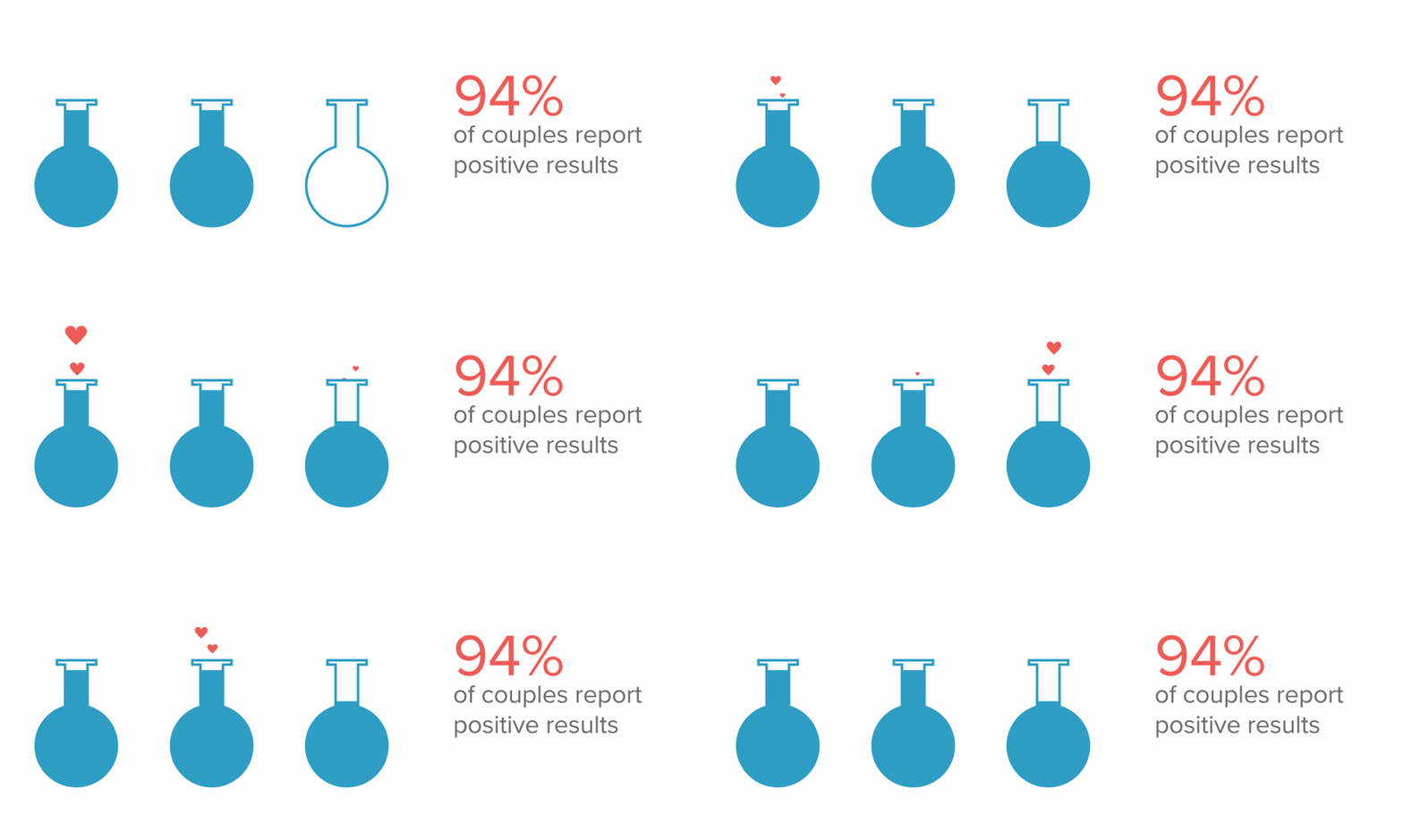
Has produced positive results for 94% of those who attend
Based on over 50 years of research with thousands of couples, The Art and Science of Love workshop will give you new insights and research-based skills that can dramatically improve the intimacy and friendship in your relationship and help you manage conflict in a healthy, positive way.
Art & Science of Love workshop is now available online
John and Julie Gottman’s ASL workshop is available online to take from the comfort of your own home.
Workshop Description
Our curriculum is developed from 50 years of research with more than 3,000 couples. It’s grounded on what actually works in relationships that are happy and stable, not idealistic notions or anecdotal evidence of what a relationship should be. On day one, you will learn how to build friendship in your relationship and express feelings of respect and affection. On day two, you will learn how to manage conflict and communicate effectively.
The workshop has produced positive results for 94% of those who attend based on exit surveys!

What will I learn?
You and your partner will learn how to foster respect, affection, and closeness in your relationship. You will build and share a deeper connection with each other. You’ll learn how to keep conflict discussions calm, how to break through conflicted gridlock, and how to strengthen and maintain the gains in your relationship.
Other workshop topics include:
Learn to recognize the Four Horsemen of the Apocalypse and what to do if they are attacking your marriage
Identify your relationship’s strengths and how to build on them together
Learn about the effects of physiological flooding and how it may affect conflict resolution
Create an Emotional Bank Account that you can draw upon in times of stress
Use the Fondness and Admiration System to renew, respect, and care for one another
Develop your problem-solving skills, including the six skills for effective conflict resolutions
Who is the workshop for?
This workshop is designed for ALL couples in a committed relationship.
You do not need to be married.
If you have a strong relationship, this workshop will provide you with insights and tools to foster further closeness, friendship, and trust.
If your relationship is distressed, this two-day workshop will provide you with a greater understanding of your relationship and a road map for repair.
No public discussion or disclosure is involved.
All work is done as a couple and Gottman-trained therapists are available to support one-on-one during exercises.
This educational workshop may not be appropriate for couples dealing with addiction, domestic violence, or other serious relationship issues. In those situations, we recommend seeking counseling with a Gottman-trained therapist.

What is included in the price?
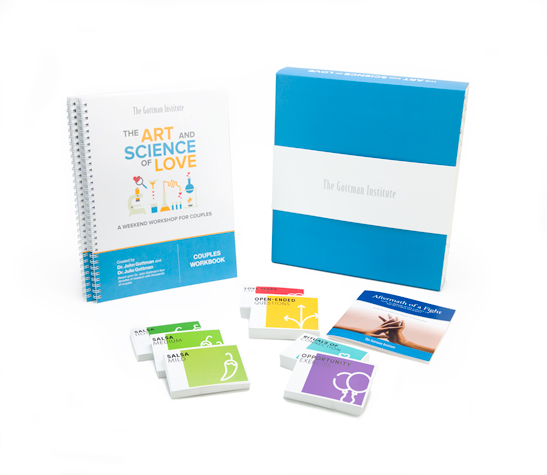
In addition to a greater understanding of how to build friendship, manage conflict, and create shared meaning in your relationship, you will receive The Art and Science of Love box set, which contains:
- Two (2) Couples Workbooks
- One (1) Repair Checklist
- One (1) Aftermath of a Fight Booklet
- Seven (7) Card Decks
- Love Map
- Opportunity
- Open-Ended Questions
- Rituals of Connection
- Salsa (Mild, Medium, Hot)
Workshop Reviews
More than 1,500 couples complete The Art and Science of Love workshop every year. Here’s what some of them have said about the workshop.
“When our daughter decides to get married, our wedding gift to her and her chosen will be a week-end at one of the Gottman’s couples workshops. I can think of no better way to give a couple a good send-off on their marriage.”
Anonymous couple
- Cedar Rapids, IA
I had put my marriage on cruise control. I had gotten lost and didn’t stop to ask for directions along the way. I thought I could work it out for myself. How different my married life would have been if I could have gone to a workshop like this 20 years ago!
Anonymous couple
- Chicago, IL
“[This workshop] saved our relationship, in my opinion. It showed us how to communicate properly. I’ll be forever grateful, thank you!”
Anonymous couple
- Seattle, WA
“Excellent! Very practical and immediately useful. We would like to send our entire family to your seminars.”
Anonymous couple
- Seattle, WA
Frequently Asked Questions
How effective is the workshop?
The Art and Science of Love has been shown to achieve results similar to those of 6 months of marital therapy and 94% of previous workshop attendees have reported positive results after attending this groundbreaking weekend workshop.
Will John Gottman personally be conducting the workshop?
No Drs. John and Julie Gottman no longer present in person Art and Science of Love couples workshops in Seattle, WA. The Art & Science of Love virtual couples workshop is hosted by:
Faith Drew, Ph.D. and George Bitar, Ph.D. are a husband and wife team of Certified Gottman Therapists who present the Art and Science of Love both in person and in virtual events. Faith and George each have a Ph.D. in Marriage Therapy, and together they run Connect Couples Therapy in Charlotte, NC.
Donald Cole, D.Min. and Carrie Cole, PhD serve as the Clinical Director and Research Director of The Gottman Institute, respectively. They are both Certified Gottman Therapists and Advanced Clinical Trainers in Gottman Method Couples Therapy, and together run the Gottman Love Lab in Seattle.
Who attends the workshops?
Couples of all ages, incomes, races, nationalities, professions, religions, abilities, and orientations attend our workshops. Couples attend who already have a strong, healthy relationship, and couples attend to repair relationship damage and get back on track. Parents sometimes attend who have decided to end their relationship but want to do so in a way that doesn’t negatively impact their children, and receive skills to become healthy co-parents moving forward. We welcome all couples who want to work on making their relationship stronger.
Can we attend the workshop even if we aren’t married?
We strongly encourage all couples in committed relationships to attend, whether you are dating, engaged and seeking premarital preparation, not married and living together, or committed to a potentially life-long relationship but don’t plan to get married—this workshop is for you!
Is this workshop appropriate for premarital couples?
Yes. We strongly encourage attending our workshop as premarital preparation.
Is this workshop appropriate for LGBTQ couples?
Yes. We welcome all couples. While some of the workshop language is heteronormative, our curriculum does include research data on same-sex relationships.
Is the cost per person or per couple?
Per couple.
Can I give the couples workshop as a gift to someone else?
Yes. Gift certificates are available upon request.
Can I come to the workshop alone if I can’t convince my partner to attend?
Sorry, no. Our workshops are specifically designed to be interactive and experiential for couples only.
How can I convince my partner to attend a workshop or go to counseling?
We believe that it is important for all individuals to learn the basics of how relationships work based on our scientific research. Many individuals have found that a good place to start is by sharing some of the research on our website with their partners. We have videos of Dr. John Gottman covering our concepts of the Four Horsemen of the Apocalypse (with Anderson Cooper), the Magic Relationship Ratio, and Making Marriage Work, all of which introduce the most important concepts that Drs. John and Julie Gottman will present at the Art and Science of Love workshop. You can also visit the Gottman Relationship Blog for more information on our methods, and you can look through our Research Overview page. For a preview of the kinds of exercises you’ll do at the workshop, you can download our free Gottman Card Decks app.
I’d love to come to your workshop, but my partner is a private person and is not comfortable sharing in a group setting. Is there public disclosure?
No problem. Couples sit as an audience during Drs. John and Julie Gottman’s lectures, but we provide lots of extra square footage for privacy while couples engage in the workshop exercises. Our Certified Gottman Therapists are available to work one-on-one with couples who desire support and assistance during exercises. There is no group work, and no mandatory sharing.
Is there public disclosure?
No. Couples sit as an audience during the lectures, but for couples’ individual exercises we provide lots of extra space and seating for you to engage in those exercises with plenty of privacy. Couples will not be asked to publicly participate in any exercises in front of the audience, nor will any of your exercises be publicly disclosed by The Gottman Institute in any form.
Will we be left on our own or will we receive assistance?
Our highly experienced team of Certified Gottman Therapists are on hand at every workshop. These therapists are available to work one-on-one with you during the exercises. Couples are not required to use clinical help, but we strongly encourage using this resource while you have the opportunity.
How many couples attend the workshop?
The venue, weather, time of year, and several other factors affect the size of each workshop. The Seattle workshops with Drs. John and Julie Gottman tend to average between 300-350 couples. Local workshops presented by trained Certified Gottman Therapists may offer smaller group sizes. All workshop leaders use The Art and Science of Love curriculum designed by Drs. John and Julie Gottman. These workshops are offered independent of The Gottman Institute.
Are we appropriate for your workshop if we don’t have any really huge problems?
Yes. Couples who attend our workshop tend to fall into two categories: enhancement and repair. We applaud couples who are wise enough to attend the workshop for enhancement purposes. Our brains are more open to new learning when we are not stressed out, and our workshop is designed with plenty of humor and romance, so enhancement couples have a terrific time while learning. Feedback from both enhancement and repair couples indicates that the couples workshop is very beneficial.
Would it make sense for us to attend your workshop if we are already separated or in the process of divorce?
Sometimes. While each situation is unique, we do have many couples attend the workshop who are separated or have begun divorce proceedings. These couples continue to report that the workshop was very helpful to them. Our staff will discuss the specifics of your situation with you during the registration process to see if it is appropriate for you.
Should I do anything to prepare?
There are no prerequisites to attending a couples workshop. The workshop is self-contained and is appropriate even if you’ve never heard of Dr. John Gottman and his work. Some find it helpful to peruse the information and videos on our website, but even this is not required.
Can I bring my newborn?
No. We recognize that newborns spend a lot of time sleeping, and it is difficult to be away from them during the first couples months. However, you will not be able to focus entirely on your relationship and it can be a distraction for other couples.
Do you provide childcare?
No. While we do not recommend any specific childcare service, some couples have reported positive results with care.com.
Do we stay in a hotel during the weekend?
Yes, if you are coming from out of town. Our staff will provide hotel information for each venue. If you are local, you can certainly go home. However, we recommend you try to preserve your focus on your relationship throughout the entire weekend, if possible. Try not to go home to kids, jobs, neighbors, pets, all the daily distractions and stressors we face. Try to keep the weekend just for the two of you.
We do not live in Washington but we would like to attend a couples workshop in our area. Are workshops offered in other states or online?
Yes. While Drs. John and Julie Gottman only present The Art and Science of Love in Seattle, we offer a video online workshop and live virtual couples workshops.
Also, Certified Gottman Couples Workshop Leaders offer workshops for couples around the world. Please be sure to check workshop locations and presenters for workshops in your area.
Do you provide discounts or scholarships to attend?
Scholarships are not currently available for the Art and Science of Love programs.
I’m a therapist. Can I receive Continuing Education credits for attending the workshop?
Continuing Education Credits are not currently available for the Art & Science of Love Couples Workshop.
Take the first step to improve your relationship today
Learn practical skills to improve the friendship and understanding in your relationship and help you manage conflict in a positive way.
The Art and Science of Love 2
You learned a lot about strengthening your relationship at The Art and Science of Love couples workshop. How did things go after that weekend? Were you able to incorporate your newfound knowledge into your relationship as well as you wanted? It can be a challenge to remember it all after you get home. That’s what this workshop is for.
Whether you want to build on your first experience for deeper comprehension or re-commit to your relationship after being “out of practice,” The Art and Science of Love 2 leads to a greater command of the skills needed for a strong relationship.
Workshop Description
Through interactive exercises, entertaining role-plays, and enlightening presentations, you’ll refresh and expand the skills previously learned, as well as deepen your connection with your partner. You will be able to work together privately, receive support from Certified Gottman Therapists, and gain a fresh focus for meeting the challenges in your relationship in an intimate workshop setting.
This workshop is based on the inspiring couples research presented by Drs. John and Julie Gottman in their books, lectures, and other programs, including The Art and Science of Love. Developed by popular demand, The Art and Science of Love 2 is your opportunity to take your partnership to the next level
Workshop presenters will provide a review of the Sound Relationship House and share proven methods for developing effective problem solving skills, including repair and compromise). New presentations and exercises have been developed to help partners identify and achieve mutual relationship goals.
In addition, you’ll learn thought-provoking information and research on brain neurobiology that can help increase your understanding of the Gottman Method. There will be opportunities to ask questions and receive support from roving Certified Gottman Therapists, who are available to assist, if needed, during any of the exercises.
Most importantly, this workshop will help you put it all together so you can more deeply integrate these new behaviors with your everyday life.
Click here to read the story of The Art and Science of Love 2.
What will I learn?
You and your partner will learn conflict management skills, foster greater intimacy, and enhance your understanding of repair and its significance for effective communication.
You will reinforce and expand the skills learned through The Art and Science of Love workshop, including reducing the Four Horsemen, sharing Dreams Within Conflict, processing the Aftermath of a Fight, and using a softened start-up with new exercises to reduce defensiveness.
You will also have the opportunity to talk about current relationship issues like money and/or sexuality and learn new tools to enhance these areas of your relationship.
Who is the workshop for?
This two-day program is for couples who have previously attended The Art and Science of Love in person workshop or who have had practice with the material in the DVD Set.
Are you looking to rekindle the spark and connection in your relationship? Are you willing to recommit to making your relationship the best ever? Are you looking to integrate the Gottman Method into you everyday life? Then this workshop is for you.
What is included in the price?
In addition to a greater understanding of how to build friendship, manage conflict, and create shared meaning in your relationship, you will receive two copies of The Art and Science of Love 2 couples workbook.
Workshop Reviews
Thousands of couples have attended The Art and Science of Love 2. Here’s what some of them have said about the workshop.
“Our goals to deepen our understanding of the Gottman Method were met. Quite simply, this stuff takes practice and this more personal setting is great!”
– Anonymous evaluation from Seattle, WA
“It was like the light went on. We were able to apply the Gottman Method in many areas after attending The Art and Science of Love, but this workshop gave us a further strengthening and deepening experience.”
– Anonymous evaluation from Bellingham, WA
“We now have more awareness of the tools to enhance and enrich our relationship.”
– Anonymous evaluation from Seattle, WA
Additional Workshop Information
Questions
Please email us at couples@gottman.com. Workshop questions only, please. We are unable to respond to therapeutic questions via email. Also, please be sure to include your email address in your message.
Disclaimer
This workshop is psycho-educational and not therapy. All information gathered during the registration process is confidential. There is no group work or public disclosure other than the voluntary questions that participants ask during the workshop.
Frequently Asked Questions
How is The Art and Science of Love 2 different from The Art and Science of Love?
The Art and Science of Love 2 is much smaller, in a more intimate setting. It is designed to give you the opportunity to sharpen your skills and practice the Gottman concepts so they are integrated into your everyday life. There is more emphasis upon the development of intimacy in your relationship.
Further work on the use of repair and the Dreams Within Conflict concept is also covered. Specific subjects include money, sex and intimacy, and interpersonal neurobiology. The Art and Science of Love 2 workshop also incorporates different audio-visual presentations.
Can we still attend if we did The Art and Science of Love DVD Set?
Yes. The Art and Science of Love DVD Set provided you with information and exercises to strengthen your relationship. This workshop is an appropriate next step to practice the tools and integrate them in your relationship.
How long should we wait between The Art and Science of Love and The Art and Science of Love 2?
It varies according to each couple’s needs. Some attend within a very short time (a month or two) because they want to truly integrate the skills, and find the workshop environment helpful. Some want to try things on their own for longer, and come to the advanced workshop when the need for more practice arises. Contact us if you’re not sure.
What if my partner and I are basically doing ok, but could use a refresher?
Yes, definitely. Couples who are doing “okay” have given us clear feedback that The Art and Science of Love 2 workshop is refreshing and energizing for their relationship. The Gottman research and tools are rich and deep and more learning is always possible.
The Art and Science of Love 2 workshop presents additional tools, skills and information that help couples enrich their relationship.
What if we made progress and liked the concepts, but had difficulty with the exercises at the first workshop?
Couples at all stages have attended the The Art and Science of Love 2 workshop to relearn, refresh or rekindle the tools of the Gottman model. At the workshop, we will present different exercises and new information to support a deepening of your relationship.
What if we attended The Art and Science of Love 2 workshop in the past? Can we attend again?
Absolutely! Couples who have attended past workshops say that this experience was so helpful for their relationship that they would attend again. A number of couples attended several years in a row.
Gottman Store for Couples
Gottman Store for Couples
Product search
Find a Couples Therapist

Find a Couples Therapist
Use the Gottman Referral Network to easily find a Gottman-trained couples therapist near you.
What is the Gottman Referral Network?

The Gottman Referral Network (GRN) is the primary resource for couples worldwide who are seeking professional help from Gottman-trained therapists. GRN members have received training in Gottman Method Couples Therapy, an approach based on 40 years of research with thousands of couples. Free to access, this database puts you directly in touch with experienced clinicians who use Gottman relationship-building techniques.
Therapists listed on the GRN have been trained by either Drs. John and Julie Gottman or Certified Gottman Therapists to work with individuals, children, and/or families on many issues. Many of our therapists specialize in treating anxiety, depression, addictions, trauma, abuse, and domestic violence, multi-cultural issues, and blended families, among others.
Gottman Referral Network therapists are located throughout the world. Gottman clinicians work from their own private practice or agency offices located.
Whether you are in crisis or whether you need a fresh look at an ongoing problem, a Gottman-trained therapist will contribute many years of training and experience toward helping you and your partner create a healthier and happier future.
What are the different levels of Gottman-trained therapists?
While on the Gottman Referral Network you’ll notice each therapist listed has a level of training listed below their name. The gold color denotes a therapist that has attained the level of Certified Gottman Therapist. All therapists listed on the Gottman Referral Network have completed at least Level 2 Training in Gottman Method Couples Therapy.
Therapists listed on the Gottman Referral Network (GRN) are all licensed or certified therapists who practice independently in their state, province, or country and are not supervised or monitored by Drs. John and Julie Gottman or The Gottman Institute. However, each has been specifically trained to provide Gottman Method Couples Therapy.
- Certified Gottman Therapist: Prior to their intensive training with Drs. John and Julie Gottman, Certified Gottman Therapists completed a graduate degree in Psychology or a related field and were trained to provide therapy to individuals, families, children and/or adolescents as well as to couples. Many have had their own private therapy practices for many years or even decades prior to entering training in Gottman Method Therapy. Certified Gottman therapist have completed all levels of Gottman Method training including the certification track.
- Level 3 Trained: The Certification Practicum, a four day program led by Drs. Julie & John Gottman. Level 3 trained therapists must complete Levels 1 and 2 before entering Level 3 Training.
- Level 2 Trained: Assessment, Intervention & Co-Morbidities, a four day training led by Drs. John and Julie Gottman, either in person or on DVD/videotape. A Level 2 trained therapist must complete Level 1 before entering Level 2 Training.
Are there any fees for using the Gottman Referral Network?
Using the Gottman Referral Network to find a Gottman-trained therapist is free of charge.
Fees for therapy provided by Gottman-trained therapists are arranged directly with the independent therapist. Many therapists accept insurance when applicable.
More Information
If you would like further information about the Gottman Referral Network you can contact us here.
Gottman Card Decks App

Gottman Card Decks App
See for yourself why millions of couples worldwide have benefited from The Gottman Institute’s research-based approach to relationships. Inspired by the popular card decks from The Art and Science of Love weekend workshops for couples (now available virtually) this fun app offers helpful questions, statements, and ideas for improving your relationship.
Download to explore 14 card decks with more than 1,000 flashcards, tap the star to favorite a card, easily tab back and forth between All and Favorites, and access more free resources from The Gottman Institute.

The Gottman Relationship Adviser, the world’s first complete relationship wellness tool for couples, takes the guesswork out of improving your relationship. Measure your relationship health with a research-based self-assessment, then receive a tailored digital relationship plan proven to heal and strengthen your connection.
For an in-depth analysis of your relationship health check out the Gottman Assessment, a virtual relationship evaluation tool for couples.
Check out our free relationship quiz for couples.
Get the free relationship app