The biology of feeling safe is older than language, and older than YouTube.
Before anyone called it ASMR, you already knew what it was. A parent humming you to sleep. A friend braiding your hair in silence. Someone reading aloud in a voice so low it wasn’t meant for anyone else in the room.
What is ASMR?
ASMR (Autonomous Sensory Meridian Response) is a pleasantly tingling, wave-like sensation. It typically starts on the scalp and can move down the neck and spine. It is often paired with a deep sense of calm and well-being. For some people it’s triggered by whispering, soft repetitive sounds, or slow, focused attention. Researchers describe it less as something mystical and more as a gentle, full-body relaxation response.
What Does ASMR Stand For?
The term was coined in 2010 by Jennifer Allen, but the experience is far older than the acronym. Bob Ross, the American painting instructor whose television show The Joy of Painting ran for over a decade, was triggering it in millions of viewers throughout the 1980s, with that famous hushed baritone and the gentle scratch of brush on canvas, decades before anyone thought to give the feeling a clinical name. He never explained what he was doing. He didn’t need to. The nervous system already understood.
Why?
And more to the point: why does the feeling seem so familiar?
How Does ASMR Work?
During ASMR, researchers see increased activity in areas like the medial prefrontal cortex, nucleus accumbens, and insula. These circuits also show up in social bonding, reward, and emotional awareness.
Scientists suspect that familiar players like dopamine, endogenous opioids, and perhaps oxytocin are involved in these patterns, although the exact chemistry is still being mapped out.
That is all prologue, of a kind. Because the really interesting finding isn’t what happens in the brain during ASMR. It’s where else this response shows up.
- Primates spend a striking amount of their waking hours grooming each other. Up to a fifth of the day—and not mainly for hygiene. Studies suggest that grooming releases endorphins and is associated with lower heart rate. It reduces cortisol in both parties, sending an ancient signal: I am being taken care of. I am safe here.
- Lullabies tap the same circuit. A series of studies from Harvard’s Music Lab looked at songs from hundreds of communities around the world. They found that lullabies, almost everywhere, share certain features: slower tempo. Gentle repetition. Softer dynamics. In one experiment published in Nature Human Behaviour, American infants relaxed—lower heart rate, less physiological arousal—when they heard unfamiliar lullabies from distant cultures, even though they had never heard those languages before.
- A Japanese tea ceremony. A barber’s hands circling your temples. A parent reading aloud, voice dropping as the child’s eyelids grow heavy.
Why Does ASMR Feel Good?
Because your nervous system recognizes trust.
Not trust as a feeling, and not trust as a decision you make about someone after knowing them long enough. Trust as the body calculates it: continuously, silently, below the threshold of awareness.
The Gottman Institute was founded by Drs. John and Julie Schwartz Gottman, whose research on what makes love last — and what makes it fall apart — has reached tens of millions of people worldwide. They spent decades measuring this, and finding how granular the body’s bookkeeping turns out to be. Hormones. Stress hormones. Oxytocin. Pulse. Micro-expressions. Measuring how we respond in the tiniest moments to our partners bids for connection.
Trust isn’t a single thing. It’s an accumulation. Updated with every positive or negative interaction. And at its deepest level, trust is the belief that the other person is thinking about what’s best for you even when you’re not in the room. That they carry you with them. Your care doesn’t go away even if you are not here with me right now. You´ve got my back even in the moments when I am not at my best.
John Gottman found that trust is built or eroded in moments. Sliding door moments: the micro-interactions, maybe dozens per day, where someone makes a bid for connection and the other person chooses how to respond. Turn toward, with warmth or curiosity. Turn away, letting it pass unnoticed. Or turn against, with irritation or dismissal. A sigh after a long day. A comment about something on the news. A hand reaching across the couch.
In Gottman’s research, what all these deposits build toward is, among other things, friendship. Not friendship as a pleasant side effect of romance, but as something the relationship actually depends on.
Why? Because when friendship is strong, it becomes a reservoir of goodwill that changes how the nervous system processes conflict. Partners with strong friendships give each other the benefit of the doubt. They can fight about money or parenting or something that happened at dinner, and the body doesn’t register it as a threat. (Without that reserve, even neutral comments might land as criticism.)
Joy. Playfulness. Silliness. The quiet accumulation of moments where someone’s presence feels like relief. A shared glance. Laughter about something no one else would understand. The Gottman research found that this kind of everyday positive affect helps couples repair and de-escalate during conflict.
The signals that build trust in those moments?
A soft voice, even when saying something hard.
The Gottmans call this softened start-up: a way of raising a complaint that keeps your partner’s nervous system below the threshold where it shuts down. An “I feel” statement. A specific wish. No blame, no “you always.”
The Gottman research shows that the first three minutes of a conversation predict its outcome. With ninety percent probability. What determines those three minutes isn’t the topic. It’s whether the delivery keeps both people regulated enough to stay present.
Undivided attention.
The Gottmans call this turning toward: when someone makes a bid for connection, you meet it as well as you can. Not halfway, not while glancing at a phone.
Repetition.
The Gottman principle of Small Things Often holds that trust isn’t built in grand gestures. It’s built in accumulation: the same deposit, made again and again, until the nervous system stops bracing for the withdrawal.
No demands.
The Gottmans call it stress-reducing conversation: you listen to someone talk about their day and the pressures outside the relationship. You take turns. Your only job is to be present. Don’t solve (unless asked). Don’t redirect. Just stay. The absence of agenda is a trust signal: I’m not here to get something from you.
Can ASMR Help with Stress and Anxiety?
We’re relationship researchers, and our decades of research on what happens between people. But it might throw some interesting light on the question… We can’t speak to whether ASMR treats clinical anxiety.What we can say is that experimental studies suggest ASMRcan reduce momentary stress and heart rate in some people, in ways that look a little like the down-shift we see in couples when flooding subsides.
The Gottman research on flooding describes what happens when your heart rate spikes past 100 BPM during conflict conversation or interacting with your partner. Something shuts down. The brain can’t process clearly. You lose your sense of humor. Maybe also your empathy. It is not your personality. It is pulse. People need one specific thing before they can re-engage: about twenty minutes of time out. Calm sensory input. Maybe reading a magazine. No cognitive demands. No rehearsing the fight in your mind.
When interactions tend to get charged with strong negatives and escalate, relationships suffer. Conflict escalates. So,? Downregulating is essential, Shifting into deep, safe relaxation is intrinsically rewarding, with your partner or on your own.
The real question, and the reason we’re writing about this, is whether you can experience more ASMR in your own relationships. Whether you can become, for someone in your life: a reliable source of safety.

FREE Download | Sexy Game of Hearts
Sign up for Love Notes and Get the FREE Gottman Game of Hearts, filled with conversation starters and prompts around sex and intimacy.
Adding ASMR moments to your relationship
ASMR works because it passes the body’s trust audit. Every time. The practices below, from the Gottman research, share some of the same qualities. Except they’re real. And they compound over time.
Rituals of Connection.
The Gottmans found that satisfying, healthy relationships have reliable rituals of connection: small, predictable moments of contact woven into ordinary life. How you say goodbye in the morning. How you reconnect when you walk through the door. Like a moment over a shared coffee where the two of you can connect. The few minutes before sleep when phones are down and voices are low. The same principle can apply to non-romantic relationships: the weekly call with a sibling, the walk with a friend that happens every Thursday, the way a parent always sits on the edge of the bed before lights out. These rituals echo something ASMR taps into. Not intensity. Repetition. The nervous system doesn’t always need fireworks. It needs to know you’ll be back tomorrow.
Stress-Reducing Conversation.
Twenty minutes. One person talks about something stressful outside the relationship. The other person’s only job is to listen. No fixing. No advice (unless solicited). Just stay in the room. Present and undemanding.
Turning Toward the Small Bids.
Bids for connection: the fundamental unit of emotional connection. A bid is any attempt to reach for your partner’s connection. Pointing out a bird outside the window. Sighing after reading an email. Saying “listen to this” while scrolling. Small, easy to miss, easy to ignore ways of saying I want to feel connected to you. In the strongest relationships, people turn toward those bids 86% of the time. (In the relationships on their way to divorce, 33%.) Not with grand responses. With presence. A glance. An mm-hmm that says I’m here. Each of those small turns is a deposit in the trust ledger. And it goes both ways.
Non-Demanding Touch.
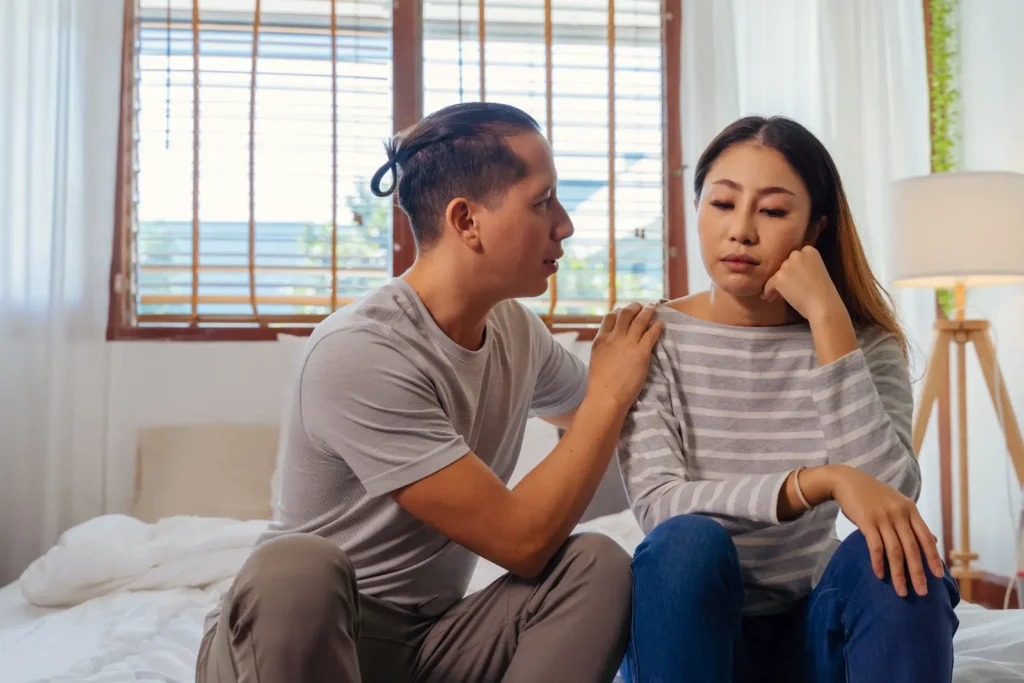
Touch that expects nothing in return. A hand on a shoulder as you walk past. Sitting close enough that your arms touch while reading. The Gottmans are specific about why: touch is valuable in itself. It activates the parasympathetic nervous system, releases oxytocin, and sends the signal the body has been tracking since infancy: someone is here, unhurried, wanting nothing. A hand on a friend’s back. A child leaning against you on the couch. The body doesn’t need context. It needs contact.
If you’re curious about how Gottman’s research can help your own relationships, explore the Gottman approach here. One small thing at a time.