What is Gottman Method couples therapy?
Gottman method couples therapy is based on over 50 years of research by Drs. John and Julie Gottman of the Gottman Institute in Seattle, Washington. Dr. John Gottman is a world-renowned relationship researcher whose comprehensive longitudinal research into what makes committed relationships work is unparalleled by any other researcher to date. Based on their systematic groundbreaking observations of thousands of couples, Drs. John and Julie Gottman developed a simple, practical, and highly effective model for healthy relationships called the Sound Relationship House which is both easy to teach and implement in everyone’s lives.
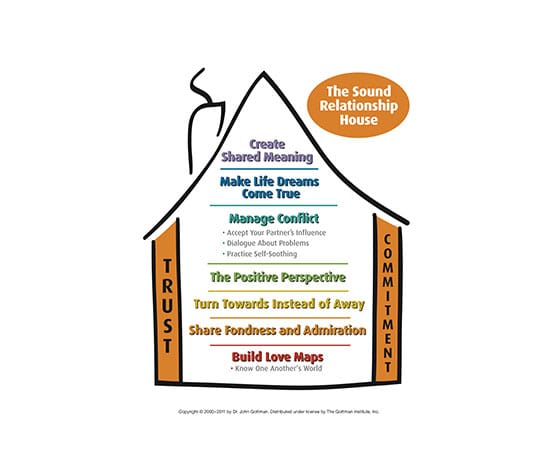
Gottman’s Sound Relationship House
As the Gottman Institute celebrates its 30th anniversary, the Sound Relationship House model is still sought after as a roadmap for healthy relationships by therapists and couples alike. No other model offers a structured, transparent, and effective method of couples therapy that has been shown to improve relationships in multiple research studies. No other model of relationship therapy offers the scientific backing, the structured and effective skill-building, and the clinical tools and techniques that make Gottman approach easy to understand and integrate into any committed intimate relationship. This has been demonstrated over and over again in my practice and teaching experience over 25 years.
What happens during Gottman Method couples therapy?
When you request Gottman Method couples therapy, we will first get to know both of you and your relationship history using the Gottman scientific protocol for evaluating the strengths and challenges in a relationship. This includes a clinical interview where we trace the trajectory of your relationship history, a conflict sample where we understand what your communication skills and challenges are, a thorough online questionnaire that both partners complete from the Gottman Institute, and two individual meetings with each partner.
Your Gottman trained therapist will then meet with both of you to share the relationship assessment based on the Sound Relationship House model and collaboratively arrive at a treatment plan that outlines the specific goals and outcomes that you wish to achieve. Following this treatment planning session, the therapist will meet with you for approximately 6-12 sessions and guide you through specific Gottman interventions. There are specific structured interventions (with cheat sheets) on the Conflict Blueprint, the Friendship and Intimacy blueprint, and the Shared Meaning blueprint, that help the couple systematically work through their issues, learn effective communication skills, understand each other at a complex level, and build win-win solutions and compromises.
Finding the Fit With The Gottman Method
The reason I became a Gottman method couples therapist was because in 1999 my own marriage was in trouble, and I was not willing to break up my family or give up on my marriage with someone that I truly loved. Being a therapist myself, I persuaded (a.k.a dragged) my husband to couples therapy. We went to probably five different couples therapists in our area. None of them could offer us a reasonable, hands-on plan or technique that we could take home.
As a matter of fact, most of the couples therapists seemed lost and confused about how to help us. They would basically try to do individual therapy with each of us in the room. This often led to one of us having to sit and watch while the other person was being worked with, or hearing comments from therapists such as, “If you could learn to do X better, then your marriage will improve.” We often left these couples therapy sessions more frustrated, and more angry and resentful at each other.
Sometimes we gave each other feedback in the couples session that was difficult to forget or forgive. It made us question how couples therapy was even helping us, and we even had three of the five therapists give up on us and tell us that we should get a divorce. This was not the answer we went to couples therapy looking for! None of them seemed to have a structured approach or a sound clinical foundation for a relational and systemic understanding about marriages.
It made sense as a psychologist…
About the same time, in my professional career at the University of Texas at Austin as a staff psychologist, I was asked to work with foreign students who were living in international student housing with their spouses, and facing a lot of challenges, stress, and difficulties in adapting to American culture and preserving their marital happiness. None of the models I had studied up until that point based on well-known psychological theories, such as Psychodynamic theory, Cognitive Behavioral theory, or Social Learning Theory, made sense to these international spouses or provided them with the practical tools to make substantive changes in relationships.
Feeling frustrated and disappointed, both personally and professionally, I began searching for proven research and therapy models to study. A colleague suggested John Gottman’s Book, Why Marriages Succeed or Fail. When I read this book, I knew John Gottman had been watching my husband and I in our living room, and that he had nailed our conflict style. Within a few pages of that book, I thought John understood our marriage better than any other therapist we had seen thus far. And none of his understanding required us to go back into our childhoods, or talk about our deep-seated psychological injuries, or our pathological character. The Gottman approach was simple, straightforward, and honest. It talked about the kinds of small behavioral changes my husband and I would need to make on a daily basis to turn the ship of our marriage around from chaos to contentment.
When I applied Gottman’s ideas to my international student couples, they were so easy to translate into a variety of foreign languages, and everyone understood what I was talking about in terms of improving their friendship, or learning to listen and communicate differently during conflict.
And for my relationship…
Soon after that, my husband and I went to Seattle and attended the Art and Science of Love weekend couples retreat at the Gottman Institute. My husband, who has an engineering brain, had disliked most of the theories or concepts our previous couples therapists had proposed. But sitting in the Gottman couples retreat, he repeatedly expressed surprise and agreement with the scientific conclusions that Gottman had reached, with his methodology of observation, and really appreciated the simple practical steps he was being asked to take to improve our marriage.
At one point, he turned to me and said, “Honey, I can do this.” That is the first time I had heard my husband express optimism about a therapeutic approach towards relationships. This is when I realized that the Gottman Method may be the perfect vehicle for us to build the bridge between my cultural, emotional and relational style to my husband’s logical, skeptical, and analytical style.
So how do you know if this method is a right fit for your partnership?
If you are the kind of couple that:
- Doesn’t want to spend years and tens of thousands of dollars on couples therapy that focuses on transforming each of you from the inside-out.
- Wants straight answers with practical tools and exercises with cheat sheets that you can implement from day one.
- Wants a therapy based primarily on building strengths, friendship, and positivity rather than airing resentments and pain.
- Wants your couples therapist to offer tools and tips based on solid science and not their personal or clinical experience.
- Likes to understand the logical and empirical foundations behind why you should do certain things.
If you are looking for couples therapy informed by solid research, systematic analysis and planning, and an organized approach to teaching skills or transforming dysfunctional patterns in your relationship without blaming or pathologizing, then Gottman Method Couples Therapy may be the best fit for you. You can find a Gottman trained therapist near you here.
A Happier Relationship Starts Today
Subscribe to Gottman Love Notes and get regular relationship tips and resources from the experts, plus a monthly free couples exercise and access to special pricing on Gottman products.