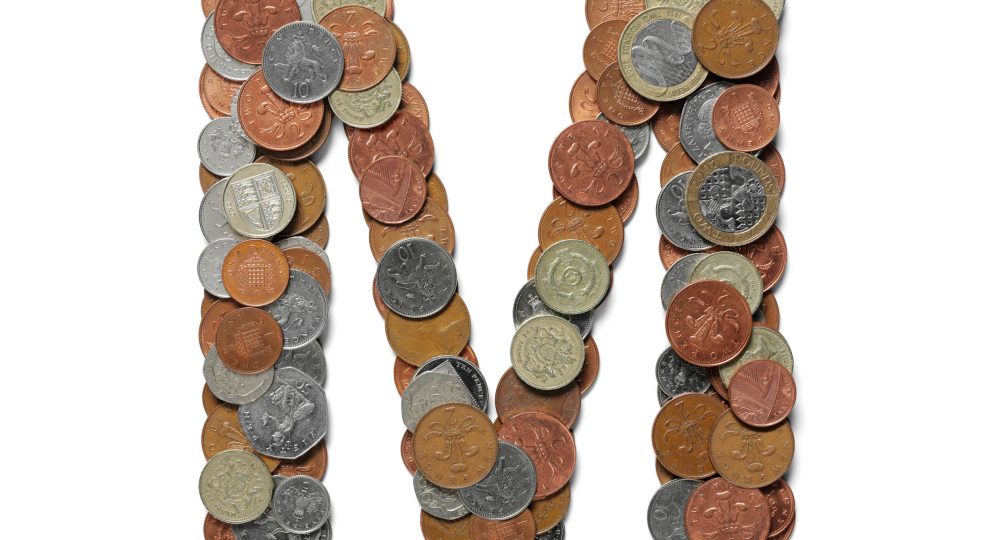
Usually, when two people get married, they stand up in front of their friends and family and they make a promise to stick together, no matter what. For better and for worse. In sickness and in health. For richer and for poorer. This last one is tricky, especially if you consider the math. Whenever two people get hitched, one becomes richer and the other becomes poorer. It’s the law of averages.
It should come as no surprise that money is one of the six most common areas of marital conflict revealed by Dr. John Gottman’s research. As a therapist, the money conversation is one of my favorites to have with couples. It’s the perfect playground for a discussion about solvable versus perpetual problems. You see, money is always two things.
First, and most simply, money is math. $1 + $1 = $2. You can use that $2 to buy a thing that costs $2. If you spend less than $2, you have money left over. If you spend more than $2, you owe somebody money. And while I personally do not know how to calculate simple interest, I do know that earning and paying interest on money you save and owe is subject to fundamental mathematical rules. In the mathematical sense, money is actually pretty easy.
But money is something else, isn’t it? It’s loaded. It has meaning. You and your partner likely have different ideas about what a dollar is worth. You have different ideas about savings, and debt, and wealth, and poverty. What does $2 represent? Do you even know? Is it security? Luxury? Power? Value?
Here’s a fun exercise: Imagine that your income were to increase right now by 20%. First, do you know how much of a raise you’d be getting? That’s the math. Second, what would you do with the extra money? That’s the meaning. Now imagine that your income were to decrease by 20%. What would you have to cut out of your lives?
It’s important that you have these conversations early, because sorting out the math only exposes the need to create shared meaning around money. The healthiest couples are in agreement together about where they hold value in their household. This agreement is essential when navigating the many economies at play in the relationship.
Yes, economies. There is, of course, the economy of the dollar bill. But there are also the economies of attention, affection, time, energy, and labor among others. The cost of paying someone to do yard work may offset the emotional and/or physical cost of spending the day in the dirt. You may have to weigh the value of a once in a lifetime family vacation against the fact that you may have to put the bulk of it on a credit card. Understanding your economies will help you make those tough choices.
In any case, the money that moves in and out of your household budget should serve to support and enhance your core values as a couple. You just need to know what those values are. You might agree that savings are important, but you may not agree on what you’re saving for. A car? A house? College for your children? European vacation?
You may have to have the same conversation about whether you will prioritize philanthropy. Will you give a portion of your income to charity? How much? To which charities? Why? Personally, I am a champion of philanthropic intent. It is the one thing that has changed the way we think about money. In choosing to give away our money, we’ve found that it has less power over us. It was one of the ways that we were able to determine the meaning of our money.
In my practice, I’ve found that I have the money conversation most often with pre-married couples and newlyweds. There’s a special place in my heart for these couples. On my imaginary list of “Top 5 Regrets from the First Year of Marriage” I would have to include: Not meeting with – and listening to – a financial advisor*. There’s a litany of reasons why we didn’t make this a priority, but it boiled down to feeling hopeless about the math. I was unemployed, swimming in debt, and uncertain about my financial hopes and dreams. But our fear of the conversation cost us more than it didn’t. If you haven’t done it already, I encourage you talk with someone who can help you understand the math and meaning of money, especially if you’re just getting started.
In the end, as important as it is to get your finances in order, it’s just as important to remember that richer and poorer may have very little to do with money. According to Dr. Gottman in The Seven Principles for Making Marriage Work, “What’s most important in terms of your marriage is that you work as a team on financial issues and that you express your concerns, needs, and fantasies to each other before coming up with a plan.” In other words, the way you go about crafting your financial future and creating shared meaning is, by far, the best value on your investment.
Dr. John Gottman’s 50+ years of research with thousands of couples has revealed effective conflict resolution actions that provides both the speaker and listener with responsibilities for making the conversation constructive. Learn more about Dealing with Conflict.