A More Personal Way to Coach

0

L is for Love & Like

"Love" is the obvious word here. But with all due respect to love, it’s probably a little too obvious for my tastes. Don’t get me wrong, I love love, but it often clouds the real issue at the heart of a relationship.

“Love” is the obvious word here. But with all due respect to love, it’s probably a little too obvious for my tastes. Don’t get me wrong, I love love, but it often clouds the real issue at the heart of a relationship. You’ve heard that love covers a multitude of sins? Maybe that’s the problem.

The “multitude of sins” is what erodes the integrity of a relationship. I touched on this a bit in January when I wrote about Betrayal. It’s not necessarily the gigantic elephant-in-the-room betrayals that destroy a relationship. It’s the little ones, the day-after-day ones that chip away at trust and lead husbands and wives to question commitment to wives and husbands.

Love, however, has remarkable endurance. It survives more often than it doesn’t. Love is the reason couples come into my office. It’s because couples love each other that they’re in pain. It’s because of love that diminished trust and commitment are so distressing. Love is the tie that binds, and because it is so foundational and so constant, it is easy to take it for granted. It’s easy to assume love. It’s obvious. But sometimes love sometimes misses the point.

Yesterday, my wife and I got into it. We were due for a fight and we went for it. We both raged for a hot minute. Yelled across two rooms to make sure we were “heard.” She got critical. I got defensive. Typical stuff. The natural progression of a fight like this is that, one of us – usually me – will start cleaning the house in a huff. Yesterday, I made the bed. Swept the kitchen. Started unloading the dishwasher and eventually ran out of steam. This too is typical and at this point, one of us – usually my wife – offers a hug. So we’ll hug. She’ll say, “I love you.” And I’ll cringe.

Yesterday, when my wife said, “I love you,” the words stung. Not because they weren’t true. And not because they weren’t what I wanted to hear. It’s just that, I know my wife loves me. What I really need, is to know that she likes me. I need to know that she enjoys, respects, admires, and appreciates me. And to be fair, I need her to know that I enjoy, respect, admire, and appreciate her. This is what I mean when I suggest that sometimes love misses the point. 

Tell me if you’ve heard this one before: “I still love him. I’m just not in love with him.” You’ve heard it before. I know you have. It’s among the most cliche of cliches. What does that even mean? What’s the difference between “love” and “in love?” I believe it’s the difference between “love” and “like.” 

In my Imagination post, I offered a quick look at architectural integrity of Dr. Gottman’s model of the Sound Relationship House. As I said then, the SRH derives its integrity from the twin pillars of trust and commitment. The whole structure deserves a full inspection, but for now, it’s worth noting that the house’s foundation is in “liking” each other. 

Notice how the bottom level of the SRH emphasizes the relational friendship:

  • Build Love Maps: Know your partner’s world. Become an expert in her likes and dislikes. Listen to his stories. Again. Know about her dreams as well as her fears. Care about his favorite movies and his least favorite food.
  • Share Fondness & Admiration: Let your partner know that you’re proud of them. Notice their creativity, intelligence, empathy. Out loud. Say: “Well done,” “You look hot,” “Thank you.”
  • Turn Towards Instead of Away: Hold hands. Answer his questions. Ask her opinion. Laugh at his jokes. Meet her eyes.

All of these things lead to what Gottman calls The Positive Perspective, or Positive Sentiment Override (PSO) , which is essential for managing and surviving conflict. In the same way that a multitude of sins chip away at a relationship, PSO protects and fortifies your friendship and helps you survive those days when you’re due for a fight.

It’s important to say, “I love you.” One of the early signs that a relationship is failing is that couples stop telling each other. They simply stop saying the words. So don’t stop. But also, don’t stop at, “I love you.”

My wife and I survived yesterday. It was just one of those days. And I know that “those days” can add up for couples and sometimes feel overwhelming. But days like these have taught us a new skill, or at least a new phrase: “I love you and I like you.”

It might not be as obvious, but it helps.
Ask Gottman

Your email address will not be published. Required fields are marked *

Zach Brittle is a Certified Gottman Therapist, best selling author of The Relationship Alphabet, and host of the highly-rated podcast Marriage Therapy Radio. He has a private practice in Seattle, WA and offers online coaching to couples across the country. He he has been happily married to his wife for 20 of 21 years. Together they have two daughters, a minivan, and most of the silverware they received at their wedding.

Recommended products

Original price was: $250.00.Current price is: $189.00.

The Gottman Relationship Adviser is a complete approach to relationship wellness. Measure your relationship health with the research-based Gottman Assessment, analyze five key areas of your partnership to identify your strengths and weaknesses, then start a tailored, step-by-step digital program proven to heal and strengthen your connection—all on your schedule and from anywhere.

The Adviser uses the legendary scientific Gottman Method to help you understand what’s really going on in your relationship—and gives you exactly what you need to improve it.


Original price was: $119.00.Current price is: $79.00.

Research-based Foundations for a Lifetime of Love.  The Gottman Relationship Coach is an inspiring and educational multimedia experience designed to enhance the well-being of relationships. Participants will be guided through research-based tools and communication skills that can transform relationships—all based on the popular Gottman Method. The first program, “How to Make Your Relationship Work”, is now available and includes:

  • The Gottman Method and How to Make Your Relationship Work
  • How do we predict the future of a relationship?
  • How to build a Sound Relationship House
  • What to do when the destructive Four Horsemen enter your relationship

“Buy Now” will take you to GOTTMAN CONNECT to purchase and view this product.

$599.00

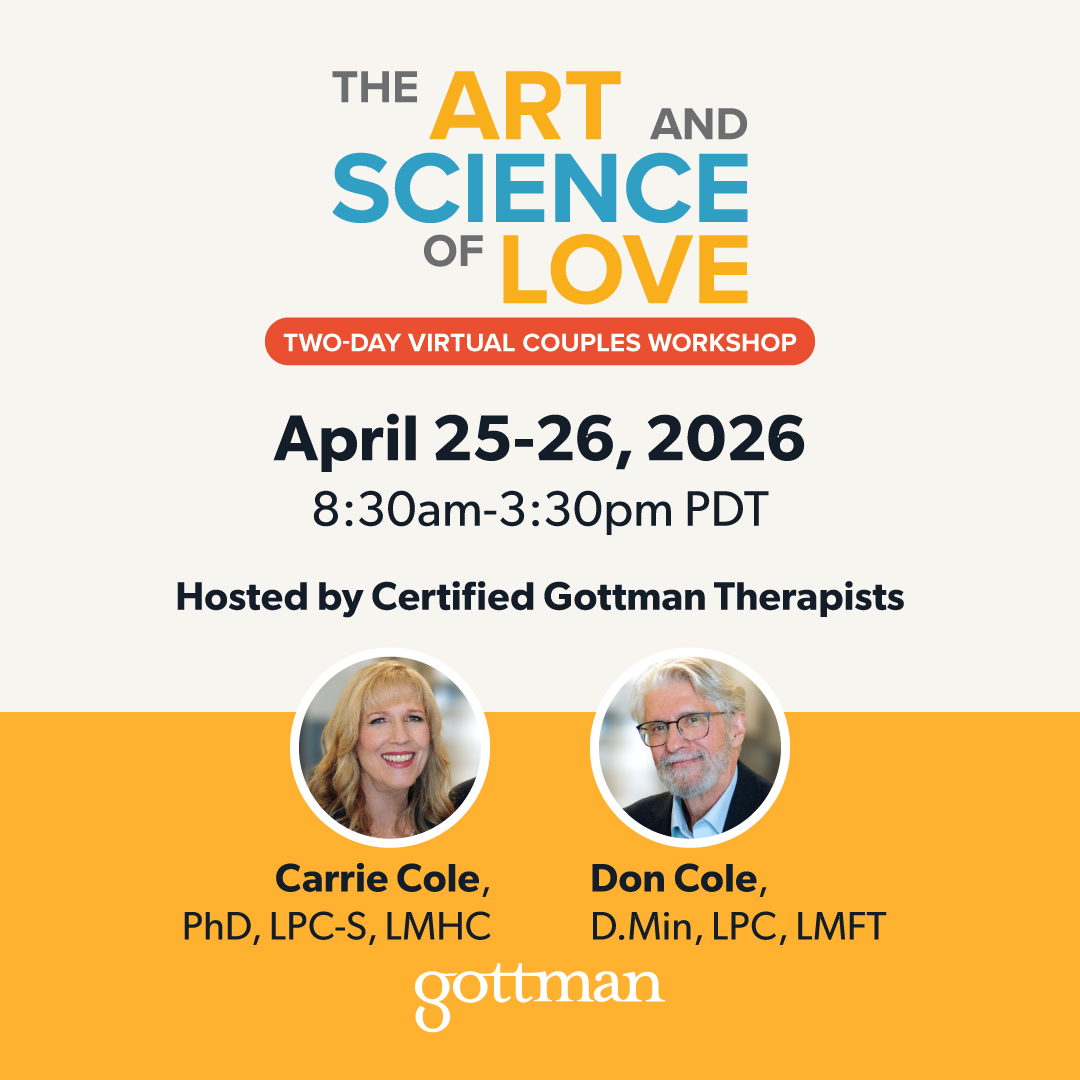
Created by “the Einstein of Love” (Psychology Today), this two-day workshop is grounded on what actually works in relationships that are happy and stable. See for yourself why millions of couples worldwide have benefited from the Gottman Method.

Quote from participant in most recent Live Virtual Workshop:

The Art and Science of Love workshop- where do I begin? It was an absolute stellar workshop. We were looking forward to this for weeks, and it exceeded our expectations! It was well-structured, and well-organized, and provided a wealth of information with real-time demonstrations of how to work through specific scenarios. The outstanding support that was provided throughout the exercises with therapists on standby- WOW! Priceless!

Includes the Art & Science of Love box set.  Please allow time for shipping.  Please Note: This is a live online event. To attend, you will need a reliable internet connection. Our staff will reach out to you with your personal registration and access information.

Related posts

Parenting adult children is a new and different stage.

It Doesn’t Get Easier. It Gets Different.

Zach Brittle, LMHC

As our children get older, our relationship shifts. Parenting becomes different but not necessarily easier.

Read More

Explore the vital link between individual behavioral health and relationship success. Learn why professional guidance is key to breaking unhelpful or toxic patterns and building a lasting bond.

Why Behavioral Health Is the Hidden Foundation of Your Relationship

Alexander Elguren

Explore the vital link between individual behavioral health and relationship success. Learn why professional guidance can be key to breaking unhelpful or toxic patterns and building a lasting bond.

Read More

A therapist working with a couple in session.

Everything You Need to Know about Therapy

Kendra Han

Are you wondering when to get therapy? Learn the Gottman signs of relationship distress, and take steps to improve communication, conflict resolution and more.

Read More

What is the 777 rule for marriage? And is it enough? Find out, and learn about Gottman's research, and simple steps to improve the connection and intimacy in your marriage!

The 777 Rule for Marriage: A Good Start — But Gottman’s Research Goes Deeper

Alexander Elguren

The 777 rule for marriage — couple spending intentional time together your marriage!

Read More

Cognitive overload in relationships — when the brain shuts down during conflict

Is your partner experiencing cognitive overload?

Alexander Elguren

Cognitive overload in relationships — when the brain shuts down during conflict

Read More

A couple saying goodbye as their adult daughter moves out.

Liminal Space: Maintaining Connection Through Life’s Major Transitions

The Gottman Institute

Major life changes often lead to a disorienting liminal space. Discover how to overcome communication barriers and strengthen your relationships here.

Read More

Improve your Relationship Skills with our Free Newsletters
0