0

J is for Judgment

J is an eight-point Scrabble letter. Only Q and Z are worth more. Turns out there simply aren’t a lot of words that start with J. 

J is an eight-point Scrabble letter. Only Q and Z are worth more. Turns out there simply aren’t a lot of words that start with J. This fact is especially true in the area of relationships. J has been the hardest post to originate. Sometimes, when I’m stuck, I turn to the back of one of the Gottman books for inspiration. I found “jealousy” and “Jews, Orthodox,” but mostly the Js are last names.

One name “Johnson, Susan” is definitely worthy of comment. Along with the Gottmans, Dr. Sue Johnson is an important pioneer in the world of evidence based couples therapy. As one of the creators of Emotion Focused Therapy (EFT), she helps couples understand the science of love and the art of repair. Clinicians and couples alike would be wise to explore how her work dovetails with Gottman Method Couples Therapy (GMCT). But, because I’m not an expert in Sue Johnson, I decided not to write about her. 

Ultimately, I decided to focus on “judgment” – mostly because “judgment” and “judging” and “judgmental” get a bad rap when it comes to relationships. The general understanding of these words is pejorative, implying – ironically? – that judgment isn’t just. But I would argue that judgment is an essential element of any healthy relationship. The real danger is negative judgment.

“Judge” is a lot like “catch.” Have you ever been caught? Like with your hand in a cookie jar? How about when you were falling down the stairs? When someone catches you, it can be punitive or protective. “Pride” is another word like this. Pride can go before the fall or it can empower and encourage you. One of my favorite song lyrics from The Avett Brothers says, “I wanna have pride like my mother has, And not like the kind in the bible that turns you bad.” You must ensure that your pride doesn’t turn you bad. You have to do the same with your tendency toward judgment.

I want to let you in on a little secret about therapists. Presumably, couples enter counseling to get a non-judgmental perspective about what’s going on in their relationship. But we are judging you. All the time. No doubt, some of my colleagues will balk at this notion, but I’m not afraid to own it. On the Myers Briggs Type Indicator, I am an INTJ, which means that judging is what I do. It’s who I am. In fact, I couldn’t do my job without it. The capacity for judgment is a gift, even a responsibility. 

Husbands and wives both feel a certain kind of freedom in the therapist’s office. That freedom comes from the belief that their highest hopes and deepest fears can be safely expressed. They say things to me and to one another that they wouldn’t consider saying at home. But it’s not because there’s no judgment. It’s because the judgment is measured and considered and articulated in a way that serves the relationship.

Whether you are an introvert or an extrovert, sensitive or intuitive, a thinker or a feeler, a perceiver or a judger, you can relate in a healthy way. But if your inclination is toward judgment, you need to pay extra careful attention. Speaking from experience, we judgers are prone to contempt – after all, the judge’s bench is raised – and criticism. Because we know what’s “just,” we’re pretty good at pointing out what’s wrong with everyone else, and to letting them know how to fix it so they can be just like us.

But this type of judgment is dangerous. It transforms the home into a courtroom, where cases are won and lost. Verdicts are handed out. Punishments are levied. In these homes, where one partner is wielding judgment like a sword, both partners suffer. It’s tragic when the judge cares more about justice than the relationship.

The best judges are known for their wisdom. Their patience. Their ability to understand and articulate the nuances of the law. Their discernment. The best judges get to the heart of the matter. In relationships, they understand the science of love and the art of repair. They know that their job is to catch their loved one when falling, not simply when they’ve broken the law. 

One of the goals of Gottman Method Couples Therapy (GMCT) is to ensure that couples do not become “therapy-dependent.” This goal is achieved by equipping couples with the ability to make considered decisions and come to sensible conclusions (i.e. judgment) and teaching them to express those judgments in healthy, positive ways. That freedom that couples feel in the therapists’ office… that’s what home should feel like. Not like a courtroom.
Share this post:

Zach Brittle is a Certified Gottman Therapist, best selling author of The Relationship Alphabet, and host of the highly-rated podcast Marriage Therapy Radio. He has a private practice in Seattle, WA and offers online coaching to couples across the country. He he has been happily married to his wife for 20 of 21 years. Together they have two daughters, a minivan, and most of the silverware they received at their wedding.

Recommended products

Original price was: $250.00.Current price is: $119.00.

The Gottman Relationship Adviser is a complete approach to relationship wellness. Measure your relationship health with the research-based Gottman Assessment, analyze five key areas of your partnership to identify your strengths and weaknesses, then start a tailored, step-by-step digital program proven to heal and strengthen your connection—all on your schedule and from anywhere.

The Adviser uses the legendary scientific Gottman Method to help you understand what’s really going on in your relationship—and gives you exactly what you need to improve it.


Original price was: $119.00.Current price is: $69.00.

Research-based Foundations for a Lifetime of Love.  The Gottman Relationship Coach is an inspiring and educational multimedia experience designed to enhance the well-being of relationships. Participants will be guided through research-based tools and communication skills that can transform relationships—all based on the popular Gottman Method. The first program, “How to Make Your Relationship Work”, is now available and includes:

  • The Gottman Method and How to Make Your Relationship Work
  • How do we predict the future of a relationship?
  • How to build a Sound Relationship House
  • What to do when the destructive Four Horsemen enter your relationship

“Buy Now” will take you to GOTTMAN CONNECT to purchase and view this product.

$599.00

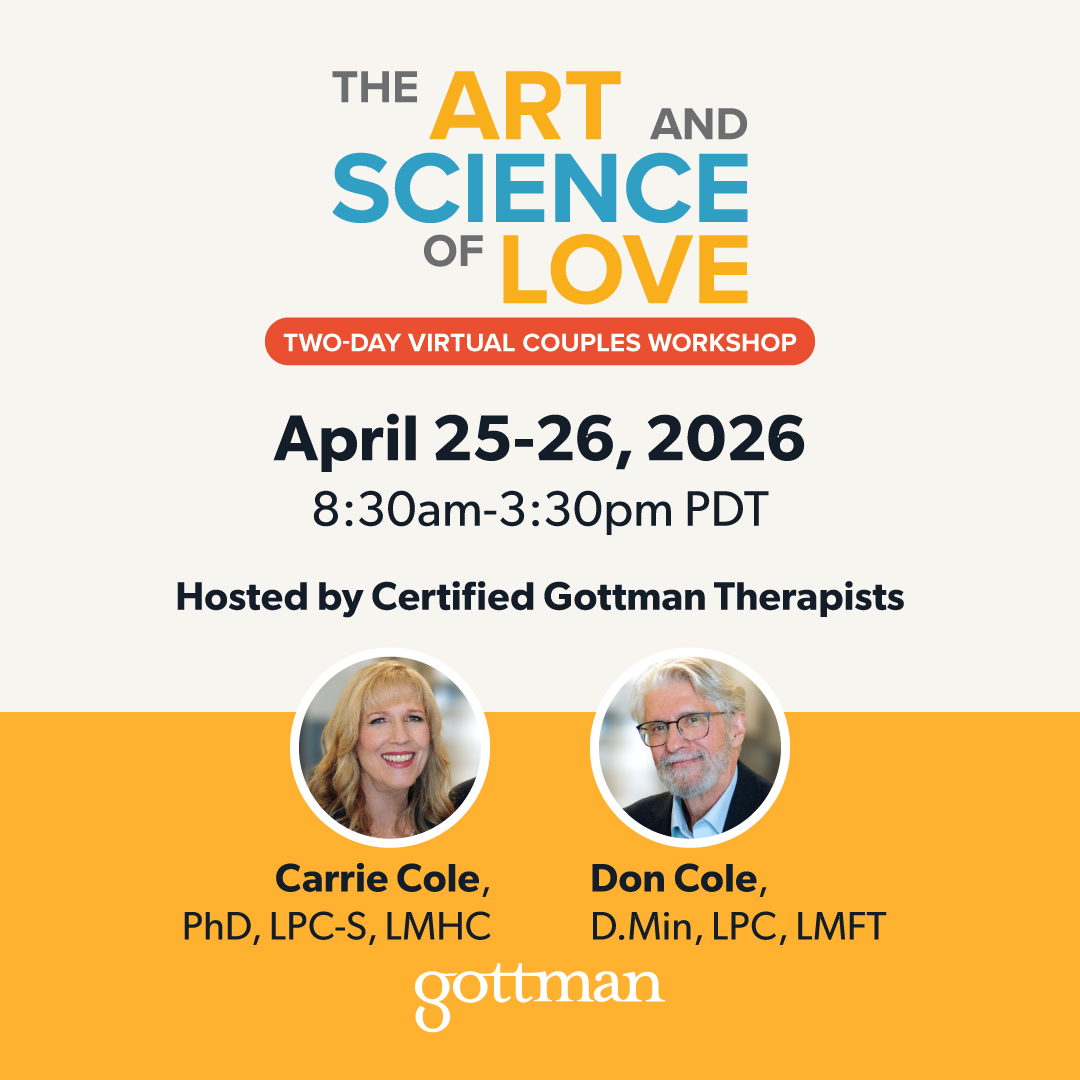
Created by “the Einstein of Love” (Psychology Today), this two-day workshop is grounded on what actually works in relationships that are happy and stable. See for yourself why millions of couples worldwide have benefited from the Gottman Method.

Quote from participant in most recent Live Virtual Workshop:

The Art and Science of Love workshop- where do I begin? It was an absolute stellar workshop. We were looking forward to this for weeks, and it exceeded our expectations! It was well-structured, and well-organized, and provided a wealth of information with real-time demonstrations of how to work through specific scenarios. The outstanding support that was provided throughout the exercises with therapists on standby- WOW! Priceless!

Includes the Art & Science of Love box set.  Please allow time for shipping.  Please Note: This is a live online event. To attend, you will need a reliable internet connection. Our staff will reach out to you with your personal registration and access information.

Related posts

Couple working with an therapist.

Can a Relationship Survive an Affair?

Mac Stanley Cazeau

When your partner has an affair, it can feel like the end of the world. Is it possible to heal from the trauma of infidelity?

Read More

Husband trying to be intimate with his wife in bed.

The Perpetual Problem of Mismatched Sex Drives

Jordan Rullo

Learn how to maintain connection and intimacy even when you and your partner have different sex drives.

Read More

A older couple enjoying time together in the bedroom.

Sex After 50: What the Research Says

John Gottman

There are benefits to staying sexually active as you age. Learn the barriers to sex after 50 and strategies to improve your connection.

Read More

A married couple working together and building a partnership.

Partnership Over Power: Why Accepting Influence Is So Important

Alex Spangler

Accepting influence means taking your partner into consideration when you make decisions. It is a defining feature of happy couples.

Read More

A couple experiencing relationship burnout and emotional disconnection.

Relationship Burnout

Kendra Han

Learn the signs of relationship burnout and how to recover from it. You may feel stuck, but there are proven ways to reconnect.

Read More

Becoming ‘Our Kids’: The Journey of Blending Families

Brianne Korthase

Blending families can be a challenging journey. Discover some strategies to make it go smoothly and promote healthy relationships without resentment.

Read More

Improve your Relationship Skills with our Free Newsletters
0