0

10 Real-World Examples of Gaslighting in Relationships (and How to Spot Each One)

The cruelest part isn't the lie. It's that you slowly start to believe you're the one who's wrong.

Gaslighting rarely begins with an obvious lie. It begins with a small one — the kind you would doubt yourself over before you doubted them. Over time, those small denials add up, until you are no longer sure what you saw, said, or felt. The 10 examples of gaslighting below show how the pattern actually sounds and feels in a relationship, so it becomes easier to name — and naming it is where its power starts to fade.

What is gaslighting in a relationship?

The American Psychological Association defines gaslighting as manipulating someone into doubting their own perceptions, memory, or understanding of events. In a relationship, it tends to look less like a single dramatic act and more like a slow erosion. The Gottman Institute’s clinical writing on gaslighting, drawing on Certified Gottman Therapist Dr. Dana McNeil, describes the hallmark move: instead of taking responsibility, the gaslighter implies you misunderstood, misremembered, or overreacted. The damage does not land on the facts. It lands on your trust in yourself.

10 real-world examples of gaslighting

  1. Flat denial. They insist something you clearly remember “never happened.”
  2. Trivializing. Your hurt is recast as you being “too sensitive” or “dramatic.”
  3. Rewriting history. They confidently retell a shared event in a version that favors them.
  4. Blame-shifting. Somehow you end up apologizing for their behavior.
  5. Withholding. They refuse to engage — “I’m not doing this again” — until you chase and concede.
  6. Discrediting you to others. They tell friends or family you’re “unstable,” quietly isolating you.
  7. Feigned confusion. “I have no idea what you’re talking about,” repeated until you give up.
  8. Using your insecurities. Something you once confided becomes the lever they pull.
  9. Intermittent warmth. Occasional affection or praise after harm, keeping you off balance and hopeful.
  10. Questioning your mind. “You’re imagining things,” “You’re losing it” — aimed directly at your grip on reality.

What are the most common gaslighting phrases?

A few phrases recur so often they are worth memorizing as warning signs: “That never happened.” “You’re overreacting.” “I never said that.” “You’re too sensitive.” “You’re imagining things.” “Everyone agrees with me.” “Stop being so dramatic.” On their own, any of these can be innocent. As a steady pattern — always landing on your perception rather than their behavior — they are a signal.

How do you recognize gaslighting while it’s happening to you?

The clearest early sign is often in your body, not your logic. You apologize constantly. You replay conversations trying to find where you went wrong. You start keeping mental “evidence” to prove your own memory to yourself. You feel confused, foggy, or like you are walking on eggshells in your own home. That growing self-doubt is the cost gaslighting extracts — and it is the opposite of the emotional safety a relationship is supposed to provide.

How do you respond to gaslighting in a relationship?

Start by trusting your own account. Writing things down, soon after they happen, can steady a memory that someone else is trying to unsettle. Resist the pull to “win” the argument or to fix the other person — that is not your job, and it rarely works. Lean on outside perspective: a trusted friend, or a therapist who can reflect reality back to you. And it bears saying plainly: sustained gaslighting is a form of emotional abuse. If a relationship has begun to feel toxic, or you do not feel safe, that is the moment to reach for professional support — and, where needed, distance — rather than carry it alone.

Gaslighting can leave you questioning your thoughts, feelings, and even your memories. Rebuilding trust in yourself starts with understanding your emotions and learning to express them with confidence.

Download our Free Emotional Literacy Guide for practical exercises that help you identify emotions, strengthen self-awareness, and communicate with greater clarity in every relationship.
Emotional Literacy

FREE Download | Emotional Literacy

Sign up for the Gottman Love Notes Newsletter to receive your free guide on emotional literacy. Learn about emotional intelligence, meta-emotions, and how to express feelings in a healthy way.

Ask Gottman

Your email address will not be published. Required fields are marked *

Recommended products

Original price was: $250.00.Current price is: $189.00.

The Gottman Relationship Adviser is a complete approach to relationship wellness. Measure your relationship health with the research-based Gottman Assessment, analyze five key areas of your partnership to identify your strengths and weaknesses, then start a tailored, step-by-step digital program proven to heal and strengthen your connection—all on your schedule and from anywhere.

The Adviser uses the legendary scientific Gottman Method to help you understand what’s really going on in your relationship—and gives you exactly what you need to improve it.


Original price was: $119.00.Current price is: $79.00.

Research-based Foundations for a Lifetime of Love.  The Gottman Relationship Coach is an inspiring and educational multimedia experience designed to enhance the well-being of relationships. Participants will be guided through research-based tools and communication skills that can transform relationships—all based on the popular Gottman Method. The first program, “How to Make Your Relationship Work”, is now available and includes:

  • The Gottman Method and How to Make Your Relationship Work
  • How do we predict the future of a relationship?
  • How to build a Sound Relationship House
  • What to do when the destructive Four Horsemen enter your relationship

“Buy Now” will take you to GOTTMAN CONNECT to purchase and view this product.

Price range: $599.00 through $799.00

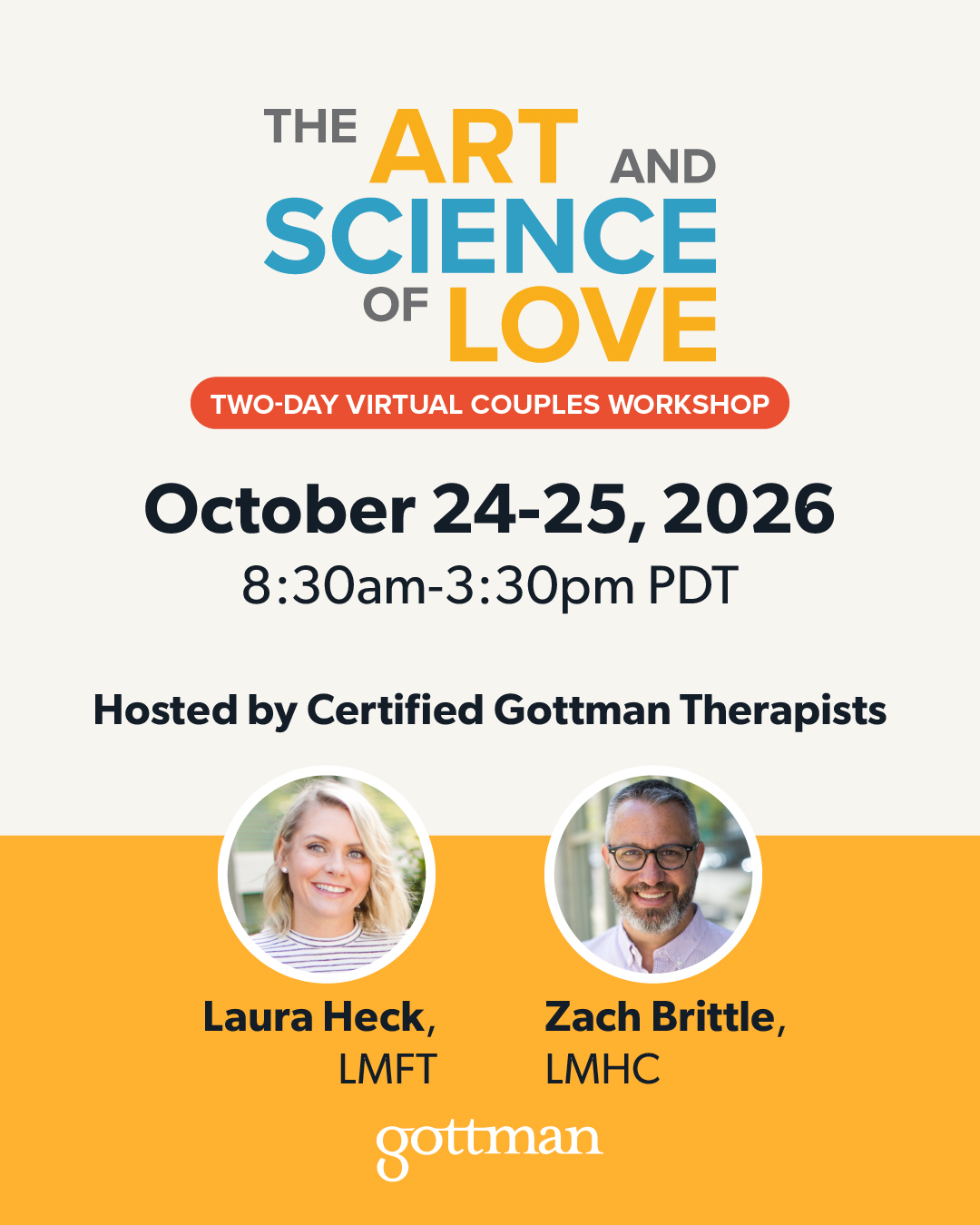
Created by “the Einstein of Love” (Psychology Today), this two-day workshop is grounded on what actually works in relationships that are happy and stable. See for yourself why millions of couples worldwide have benefited from the Gottman Method.

Quote from participant in most recent Live Virtual Workshop:

The Art and Science of Love workshop- where do I begin? It was an absolute stellar workshop. We were looking forward to this for weeks, and it exceeded our expectations! It was well-structured, and well-organized, and provided a wealth of information with real-time demonstrations of how to work through specific scenarios. The outstanding support that was provided throughout the exercises with therapists on standby- WOW! Priceless!

Includes the Art & Science of Love box set.  Please allow time for shipping.  Please Note: This is a live online event. To attend, you will need a reliable internet connection. Our staff will reach out to you with your personal registration and access information.

Related posts

A couple embracing under an umbrella on a rainy street.

Are We Too Quick to Call Limerence an Obsession?

Alexander Elguren

In an era of negativity about limerence, some of us still have love stories to tell.

Read More

Woman breaking up with partner in a gently caring way.

Breaking Up with Care: 3 Common Mistakes to Avoid

Laura Silverstein

Ending a relationship with someone you once loved (or still love) is one of the hardest conversations you may ever have.

Read More

The Four Horsemen in Action, and What to Do Instead

Alex Spangler

Learn what these destructive dynamics look like in everyday life and how to communicate differently.

Read More

Self-Help Relationship Tools: Do They Really Work?

The Gottman Institute

Do relationship self-help tools really work? Learn how research-based Gottman tools can improve communication and reduce conflict.

Read More

Young man mid-backflip above the sea beside a rocky cliff.

Inside the Teenage Brain: Why a Risk Can Look Like an Opportunity

Alexander Elguren

Before the next party or ride with friends, talk about what your teenager expects to happen—and what they can do if it doesn’t.

Read More

Teenage boy sitting on a paved path beside grass in a city park.

You Want Your Teenager to Find a Purpose. Are You Asking the Right Questions?

Alexander Elguren

How to explore what matters to your teenager—and help them pursue something they choose for themselves.

Read More

Improve your Relationship Skills with our Free Newsletters
0