
0

The Two Gottman Ideas You Should Be Talking About

Dan Wile, developer of Collaborative Couple Therapy, shares his two favorite Gottman ideas.

Young couple on a couch

Almost everyone I know has heard about John Gottman and the Four Horsemen.

When I say almost everyone, I’m talking about friends, couples in my practice, Lyft drivers, and people I strike up conversations with on airplanes. John Gottman and the Four Horsemen have crept into the culture.

When one of us mentions the Four Horsemen, we try to list all four, giving special emphasis, of course, to contempt.

Gottman is known for the Four Horsemen, but also how, in a healthy relationship, each negative exchange during conflict is balanced by five positive ones. He calls this the magic ratio.

Okay, he’s also known for being able to predict after a few minutes whether newlyweds will still be together in ten years. Malcolm Gladwell made sure of that when he wrote Blink.

The list goes on. Further down on the list—too far down to my liking—are two of my own favorite Gottman ideas. I want to tell you about them. I think they deserve at least equal airtime.

The first is the idea of repair. The picture that jumps into my mind when I think of repair is of a husband, described by Gottman, who interrupted an angry escalation with his wife by smiling in a goofy way. Immediately the atmosphere changed from growing anger to bemused friendliness.

That’s the whole ballgame: how to deal with the inevitable difficult moments that come up in a relationship, what Gottman calls regrettable incidents. I don’t mean learning to give goofy smiles. I’m not sure I would know how to do that. I mean finding a way to stop the downward spiral and, failing that, having an effective recovery plan.

Repair can take the form of a softened voice, nonverbal gesture (goofy smile), peace offering (“Shall I make us a cup of tea?”), tension-breaking laugh, self-denigrating joke, friendly appeal (“Let’s delete and redo”), or disarming acknowledgment (“I know what I’m saying is unfair” or “I know I’ve got that tone”).

My other favorite Gottman idea is that of emotional bids. In a relationship, each partner has their own ways of reaching out to the other, whether by approaching the other romantically, with words or touch, or by sharing a thought. When a partner makes such a bid, the other one can turn toward, away, or against.

When I think of emotional bids, I think of the husband, described by Gottman, who said to his wife, “Wow, look at that boat!” In response, his wife turned towards: “Yes, it looks like the big schooner we saw last summer, remember?” Alternatively, she could have turned away (continue reading her magazine without looking up) or turned against (“Don’t bother me. I’m trying to read”).

Here’s what’s mind-blowing. If a comment as everyday, ordinary, and mundane as “Wow, look at that boat!” is an emotional bid, it immediately becomes clear that we’re making such bids all the time, and without thinking of them as such. We’re bid-making machines.

This brings us to an especially key Gottman idea: If our partner constantly responds to our bids by turning away or against, we’re going to stop making them. We stop being bid-making machines. We’ll disengage, lose much of our ability to give our partner the benefit of the doubt, and feel lonely. What we hope, of course, is that enough of the time we find ourselves wanting to make bids and wanting to respond positively to our partner’s bids.

What’s appealing about the notions of repair and emotional bids is that they direct attention to the fine grain of what happens moment-to-moment in a relationship. Partners repeatedly get caught in fighting and withdrawing and need ways to extricate themselves. Gottman provides the tools to do so.

In Collaborative Couple Therapy (CCT), I talk about how to have the conversation needed to shift partners from treating one another as enemies or strangers to treating one another as allies—in Gottman language, from turning against or away to turning towards.

The big task in a relationship is finding ever better ways to shift from fighting or withdrawing to intimate relating by making effective repair attempts and dealing with the aftermath of a fight or regrettable incident. You can see why I’m so fond of Gottman’s concepts of emotional bids and repair.

So, yes, talk to people about the Four Horsemen and the magic ratio. But talk to them about repair and emotional bids, too.

Ask Gottman

Your email address will not be published. Required fields are marked *

Daniel B. Wile, nationally and internationally known founder and developer of Collaborative Couple Therapy, died in his Oakland California home on March 18, 2020, after a long struggle with heart failure. With a PhD from the University of California, Berkeley in 1966, Dan went on to a distinguished career as a therapist, author and teacher.

Dan Wile’s impact on the field of couples therapy in America stems in large part from three books: Couples therapy: A nontraditional approach (1981); After the fight: using your disagreements to build a stronger relationship (1993); and After the honeymoon: how conflict can improve your relationship (revised 2008). Dan also described his approach in numerous articles and in a blog he maintained for couple therapists over the last years. His final book, Solving the moment: a collaborative couple therapy manual, distills and integrates the main principles of his work as it evolved over his forty-five year career. He saw this book as his most significant written legacy, and it was published posthumously by his wife and colleague Dorothy Kaufmann.

Recommended products

Original price was: $250.00.Current price is: $129.00.

The Gottman Relationship Adviser is a complete approach to relationship wellness. Measure your relationship health with the research-based Gottman Assessment, analyze five key areas of your partnership to identify your strengths and weaknesses, then start a tailored, step-by-step digital program proven to heal and strengthen your connection—all on your schedule and from anywhere.

The Adviser uses the legendary scientific Gottman Method to help you understand what’s really going on in your relationship—and gives you exactly what you need to improve it.


Original price was: $119.00.Current price is: $79.00.

Research-based Foundations for a Lifetime of Love.  The Gottman Relationship Coach is an inspiring and educational multimedia experience designed to enhance the well-being of relationships. Participants will be guided through research-based tools and communication skills that can transform relationships—all based on the popular Gottman Method. The first program, “How to Make Your Relationship Work”, is now available and includes:

  • The Gottman Method and How to Make Your Relationship Work
  • How do we predict the future of a relationship?
  • How to build a Sound Relationship House
  • What to do when the destructive Four Horsemen enter your relationship

“Buy Now” will take you to GOTTMAN CONNECT to purchase and view this product.

$599.00

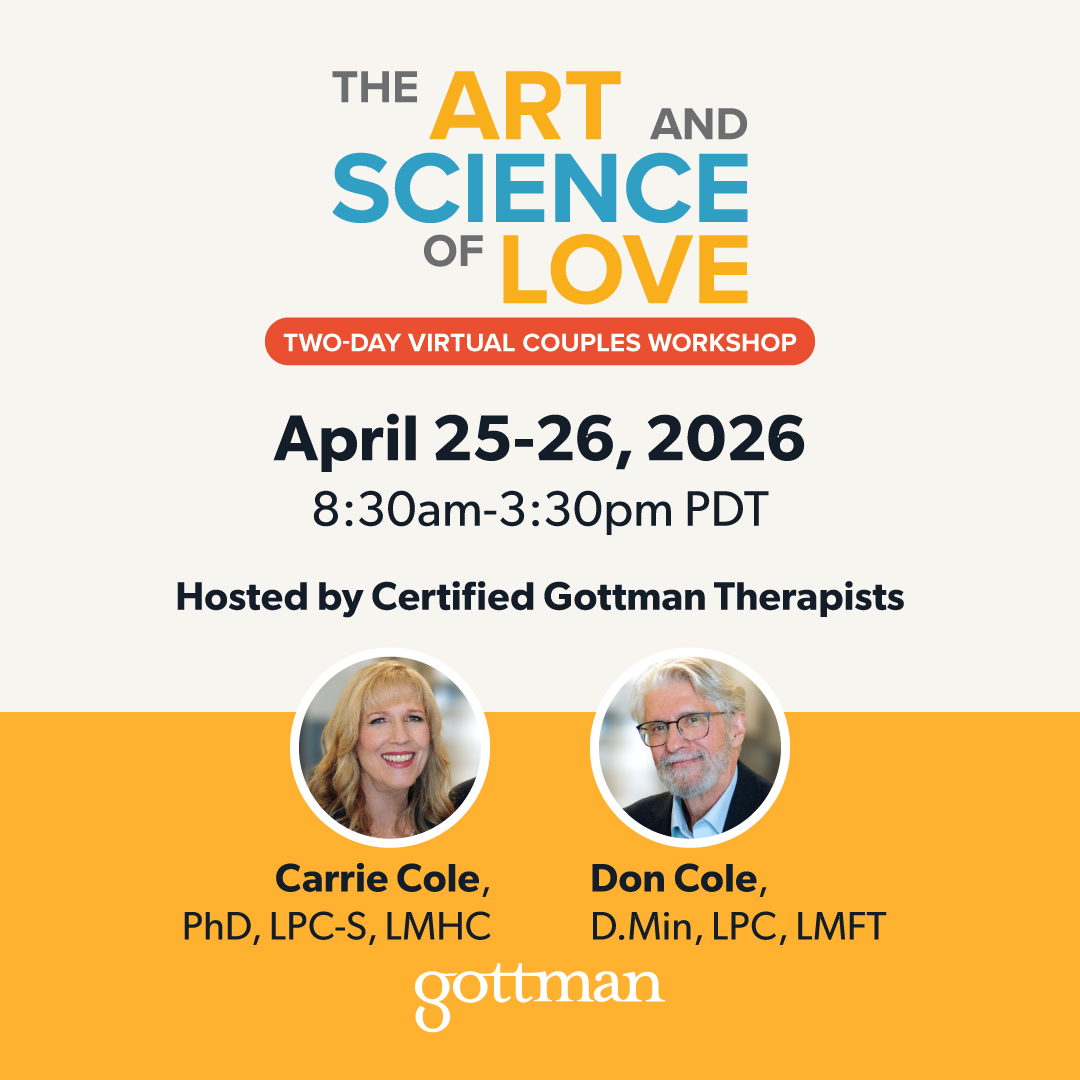
Created by “the Einstein of Love” (Psychology Today), this two-day workshop is grounded on what actually works in relationships that are happy and stable. See for yourself why millions of couples worldwide have benefited from the Gottman Method.

Quote from participant in most recent Live Virtual Workshop:

The Art and Science of Love workshop- where do I begin? It was an absolute stellar workshop. We were looking forward to this for weeks, and it exceeded our expectations! It was well-structured, and well-organized, and provided a wealth of information with real-time demonstrations of how to work through specific scenarios. The outstanding support that was provided throughout the exercises with therapists on standby- WOW! Priceless!

Includes the Art & Science of Love box set.  Please allow time for shipping.  Please Note: This is a live online event. To attend, you will need a reliable internet connection. Our staff will reach out to you with your personal registration and access information.

Related posts

Fondness Admiration Intimacy

Fondness, Admiration, and Intimacy

Kimberly Panganiban

If you feel like the honeymoon phase is over, you can bring back the magic.

Read More

A couple improving their relationship in midlife.

Navigating Perimenopause Together – How to Strengthen Your Relationship in Midlife

Nicole Schiener

Learn how perimenopause can be an opportunity for couples to support one another’s health and improve the relationship.

Read More

Image of the book, The Intimate Animal by Justin Garcia, PhD.

Broken Up But Not Forgotten

Justin Garcia, PhD

An excerpt from The Intimate Animal by Kinsey Institute Director Dr. Justin Garcia illuminating the mysteries of how we date, mate and navigate our love lives.

Read More

A couple saying goodbye, making the most of a small moment in their daily routine.

The Little Things That Keep Love Strong

The Gottman Institute

Learn how small, meaningful rituals of connection help couples build trust, stay close, and keep love strong over time .

Read More

A couple enjoying time together on their back patio.

Communication Reset

The Gottman Institute

Reset your communication and strengthen connection with practical, research-based steps for building a healthier, more resilient relationship.

Read More

A couple having a conversation about new yer's resolutions.

How to Have a New Year’s Relationship Check-in

Center for Relationship Wellness

Make your relationship your New Year's resolution and reap the benefits of a happy, healthy, and meaningful year!

Read More

Improve your Relationship Skills with our Free Newsletters
0