0

Self-Care vs. Criticism

Part of taking care of yourself and your partner is learning how to avoid the use of criticism.

Learning to manage conflict is critical to effective self-care. If conflict in your relationship is a constant source of stress, Dr. Gottman’s Four Horsemen and their Antidotes may help you understand the roots of your issues. The first horseman and its antidote pair: Criticism and Softened Start-up.

People become critical when they are totally overwhelmed. When they are frustrated by a problem, they want solved now. The last straw was a number of straws ago, and they’ve just about had it. As tempers flare, tension rises, and self-awareness goes out the window.

In this frenzied state, they are unlikely to use a particularly Softened Start-up. They are likely to begin conversations on a sour note and, as Dr. Gottman explains, conversations invariably end on the same note that they begin. In fact, they do so 94% of the time.

In “The Relationship Cure”, he describes this idea in the context of harsh start-up:

You want to connect with somebody, so you make a bid for that connection. But because your bid begins in such a negative, blaming, or critical way, you get just the opposite of what you’re after: You drive the person away.

You lose the chance to connect. Or you find yourself suddenly and alarmingly connected (in a fight). The problem you wanted to discuss is eclipsed by a new one (or two, or three).

Identifying and addressing issues with your partner is a great idea, but the following distinction is important to keep in mind. According to Dr. Gottman:

complaint focuses on a specific problem, addressing the other person’s behavior, not his or her perceived character flaws.

Criticism, on the other hand, is more judgmental and global. It frequently includes such phrases as “you always” or “you never” … often with negative labels or name-calling … frequently [assigning] blame.

Distinguishing between the two is pretty important. Criticism is a great way to initiate or escalate conflict. There is a difference between expressing feelings/drawing boundaries and attacking.

As usual, all of this makes sense on paper, but can be tricky in practice. To avoid saying things you don’t mean and hurting each other in the heat of the moment, it’s a good idea to go in with a game plan.

First, internalize something important. The idea of “Honesty is the best policy” can lead to mutual distress. Self-care involves behaving in a way that aligns with your values. Most people feel good about themselves when they treat others with kindness. Criticism is unkind. When they are critical, they are often cruel and end up hurting not only the other, but also themselves.

Second, criticism often erupts when suppression of negative emotions takes the place of communication. In a healthy relationship, partners are able to talk effectively about problems by identifying their feelings, recognizing what they need and want, and then approaching each other in a respectful and loving way.

Their self-awareness determines their ability to assert themselves with compassion and to eliminate problems through mutual understanding and teamwork. Each partner must check in with themselves, making sure that they are getting their needs met, rather than waiting for the dam to break.

In doing so, they build greater trust, a stronger bond, and reduce stress.

How do the “Masters” of relationships get there? You’ll find some answers in this blog post.
Ask Gottman

Your email address will not be published. Required fields are marked *

Ellie Lisitsa is a staff writer at The Gottman Institute and a regular contributor to The Gottman Relationship Blog. Ellie is pursuing her B.A. in Psychology with an emphasis on Cognitive Dissonance at Reed College in Portland, Oregon.

Recommended products

Original price was: $250.00.Current price is: $189.00.

The Gottman Relationship Adviser is a complete approach to relationship wellness. Measure your relationship health with the research-based Gottman Assessment, analyze five key areas of your partnership to identify your strengths and weaknesses, then start a tailored, step-by-step digital program proven to heal and strengthen your connection—all on your schedule and from anywhere.

The Adviser uses the legendary scientific Gottman Method to help you understand what’s really going on in your relationship—and gives you exactly what you need to improve it.


Original price was: $119.00.Current price is: $79.00.

Research-based Foundations for a Lifetime of Love.  The Gottman Relationship Coach is an inspiring and educational multimedia experience designed to enhance the well-being of relationships. Participants will be guided through research-based tools and communication skills that can transform relationships—all based on the popular Gottman Method. The first program, “How to Make Your Relationship Work”, is now available and includes:

  • The Gottman Method and How to Make Your Relationship Work
  • How do we predict the future of a relationship?
  • How to build a Sound Relationship House
  • What to do when the destructive Four Horsemen enter your relationship

“Buy Now” will take you to GOTTMAN CONNECT to purchase and view this product.

$599.00

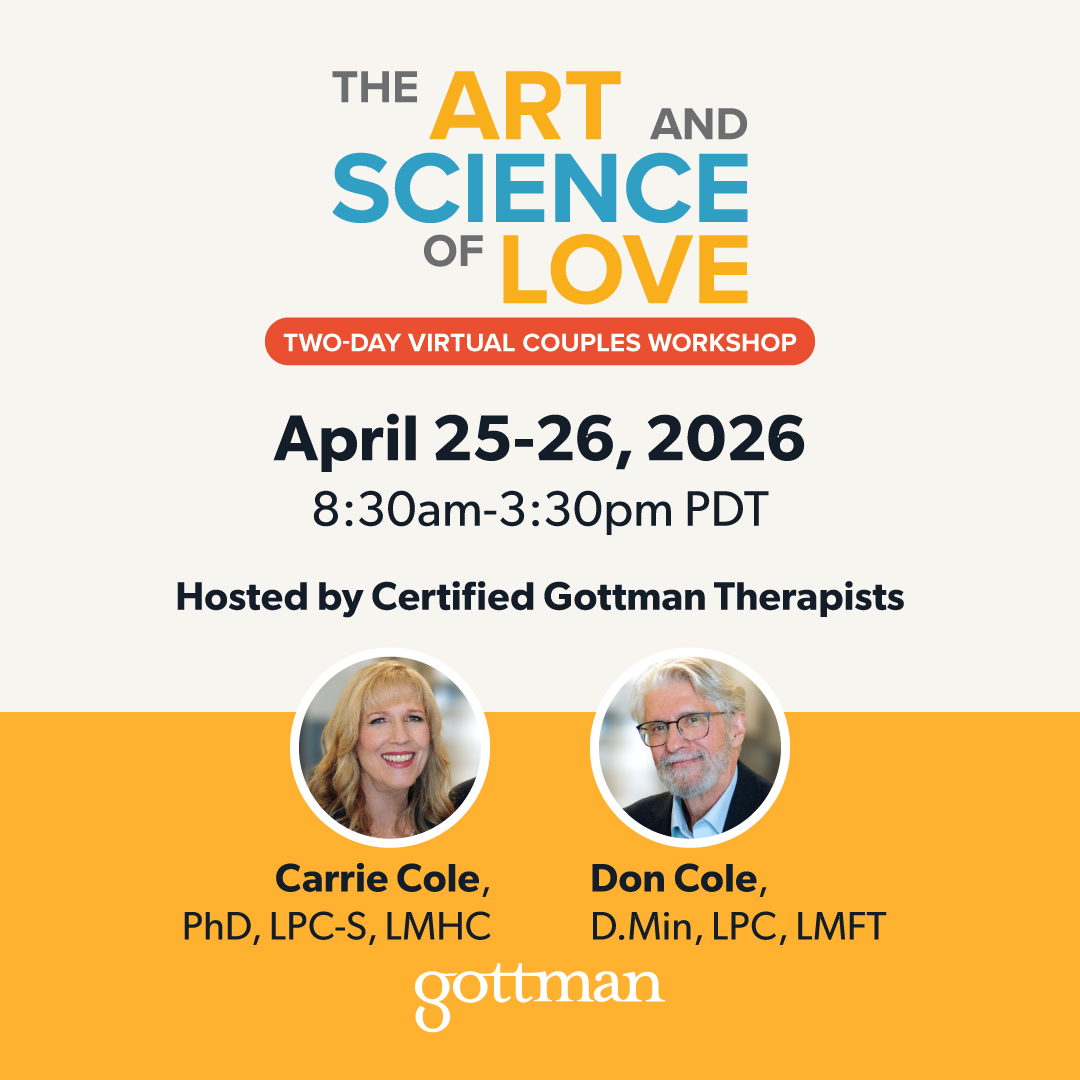
Created by “the Einstein of Love” (Psychology Today), this two-day workshop is grounded on what actually works in relationships that are happy and stable. See for yourself why millions of couples worldwide have benefited from the Gottman Method.

Quote from participant in most recent Live Virtual Workshop:

The Art and Science of Love workshop- where do I begin? It was an absolute stellar workshop. We were looking forward to this for weeks, and it exceeded our expectations! It was well-structured, and well-organized, and provided a wealth of information with real-time demonstrations of how to work through specific scenarios. The outstanding support that was provided throughout the exercises with therapists on standby- WOW! Priceless!

Includes the Art & Science of Love box set.  Please allow time for shipping.  Please Note: This is a live online event. To attend, you will need a reliable internet connection. Our staff will reach out to you with your personal registration and access information.

Related posts

Positive thinking without acknowledging other emotions can negatively impact your relationship.

Can Positive Thinking Save a Relationship?

The Gottman Institute

Is positivity the answer to your relationship issues?

Read More

How to deal with anxiety as a couple

How to Deal With Anxiety in Relationships

The Gottman Institute

Learn how couples can manage anxiety in relationships using Gottman principles, emotional safety, gentle communication, and daily positivity.

Read More

A young couple caught up in roommate syndrome working together in the kitchen.

When You Feel Like Roommates But Want to Be Lovers Again

Mac Stanley Cazeau

It can be easy for couple to fall into routines and feel like roommates. Is it possible to bring back the spark to become lovers again?

Read More

Six Second Kiss

The Six Second Kiss

Kari Rusnak

How long do you share a kiss with your partner?

Read More

Fondness Admiration Intimacy

Fondness, Admiration, and Intimacy

Kimberly Panganiban

If you feel like the honeymoon phase is over, you can bring back the magic.

Read More

A couple together at home celebrating Valentine's Day.

Butterflies Are For Beginners

Alexander Elguren

Feeling butterflies is an exciting part of new love, but lasting love doesn't just happen. It is something you build as a couple.

Read More

Improve your Relationship Skills with our Free Newsletters
0