Years ago, early in my career as an organizational consultant and executive coach, I began applying Dr. Gottman’s research on couple relationships to relationships in the world of work. It is a passionate and interesting mission.
As a matchmaker of sorts, I’m proud to report there have been countless professional relationship success stories born due to this union. When I creatively apply Dr. Gottman’s principles to the workplace, a synergy emerges. It has powerful reverberating effects on individual career advancement as well as organizational development.

Workplace relationships
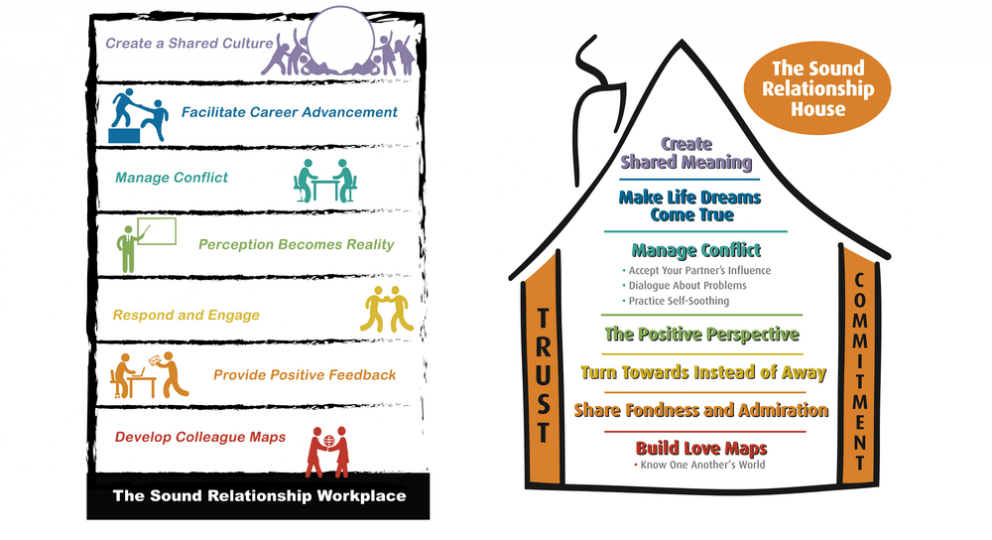
Many of us spend more time at work than we do with our families. Also, career advancement and promotion are often directly correlated with the quality of one’s work relationships. These realities combined mean that having the tools to build, repair, and fortify relationships is very important, regardless of the industry you are in. I’ve seen people leave their job countless times because of a difficult relationship with their manager. I’ve also seen people remain in a job, even if they could make more money elsewhere or receive a title promotion, because they feel closely connected to their colleagues. They just cannot imagine working anywhere else. Interestingly, one of the top indicators of job productivity is having a best friend at work. People with a best friend at work are more engaged, focused, enthusiastic, and loyal. They take fewer sick days and are less likely to leave the organization. How do organizations promote friendship amongst colleagues? Often it is done through HR initiatives, like team building activities or retreats. However, these kinds of events fall short because they are usually isolated experiences with no follow-up. To build the skills necessary for trusting, committed colleague relationships, people need skills to engage with each other. Dr. Gottman’s Sound Relationship House provides a framework for building these types of relationships at work.The Sound Relationship Workplace
Let’s look at the levels of the Sound Relationship Workplace as I’ve defined them.
Level 1: Develop Colleague Maps Sound Relationship House: Build Love Maps This is how well you know your colleague’s current world, both professional (e.g., interests, technical expertise, stresses, victories) and personal (e.g., significant people in their lives, where they live, hobbies).
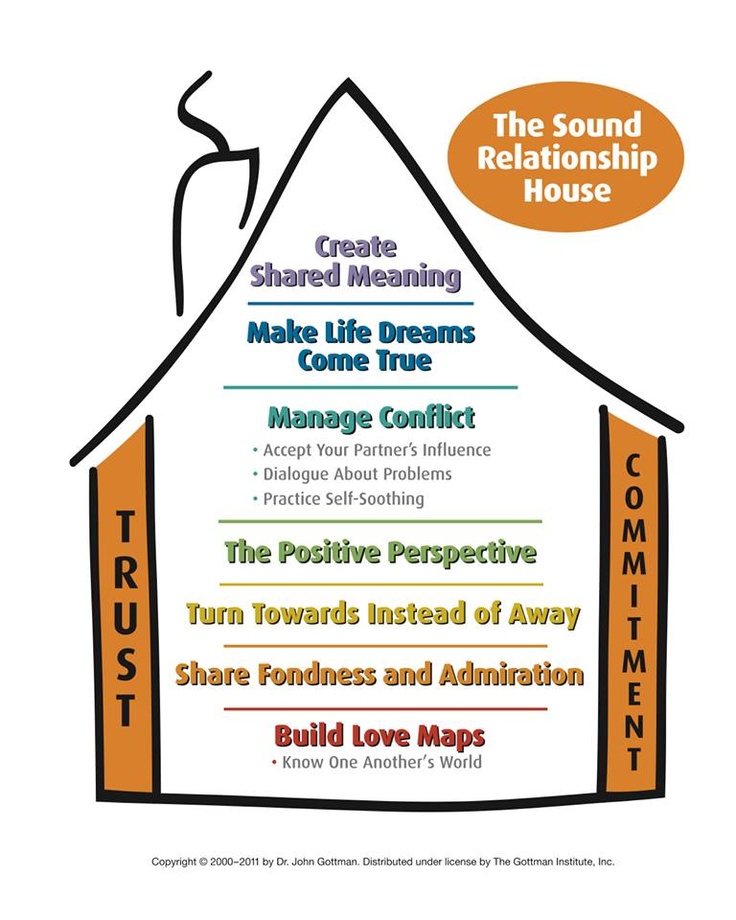
Level 2: Provide Positive Feedback Sound Relationship House: Share Fondness and Admiration Exchanging genuine positive feedback with your colleagues is important, as is having the presence of mind to regularly share positive impressions of performance. Level 3: Respond and Engage Sound Relationship House: Turn Towards Instead of Away Meeting bids to interact by regularly Turning Towards colleagues, both in person and by email. Level 4: Perception Becomes Reality Sound Relationship House: The Positive Perspective Maintaining self and other awareness regarding being in positive or negative perspective with colleagues; if in negative perspective, repairing relationships appropriately. Level 5: Manage Conflict Sound Relationship House: Manage Conflict Addressing both solvable and perpetual problems with colleagues in an open manner. Level 6: Facilitate Career Advancement Sound Relationship House: Make Life Dreams Come True Supporting your colleagues’ professional goals by being mindful of opportunities that consider the other person’s best interests and benefits them. Level 7: Create a Shared Culture Sound Relationship House: Create Shared Meaning Developing work processes and procedures that respect each other’s personal and professional goals, while supporting the organization’s overall purpose. Alongside the levels of the Sound Relationship House, Dr. Gottman includes the “weight-bearing walls” of commitment and trust. Similarly, as we look at work relationships through the lens of the Sound Relationship Workplace, the variables of trust and commitment are equally important. Work relationships without trust and commitment tend to be problematic. Trust is the “we have each other’s back” experience and “my colleague’s success is important to me.” And it’s also “my colleagues are competent and will perform their work effectively.” Similarly, commitment is important for work relationships. This is the “we are in this together” and “my colleague will do what it takes to get the job done.” Commitment means that you will be there for your colleagues “for better or for worse.” Editor’s Note: Dr. John Gottman has spent the past 50 years researching relationships, primarily focusing on married couples. He has also studied families, parents, and children. He has not performed research on workplace relationships. To help increase efficiency and productivity of workplace teams, Dr. Karen Bridbord will be putting his proven findings on intimate relationships in conversation with research and personal experience from the fields of industrial and organizational psychology.