0

Broken Up But Not Forgotten

An excerpt from The Intimate Animal by Kinsey Institute Director Dr. Justin Garcia illuminating the mysteries of how we date, mate and navigate our love lives.

Image of the book, The Intimate Animal by Justin Garcia, PhD.

Behavioral scientists and relationship experts have amassed a considerable body of research related to the “on‑ramp” of courtship processes (searching, dating, and mating). But by comparison, much less is known about the bumpy “off‑ ramp:” when people exit romantic and sexual relationships, willingly or otherwise.

In the digital age, our intimate past lives can live on in ways that make it harder for some of us to move on; nearly half of men and a third of women will hold on to sexually explicit photos of their ex after a breakup. And sometimes staying connected can reignite our remaining passions, as with our data showing that one in five singles has gotten back in touch with a former partner after their ex liked something they posted on social media.1

Behavioral theorists have developed various hypotheses to explain why we can’t stop ourselves from staying connected to or checking up on our exes. More and more, I have come to believe that romantic love makes an indelible imprint on the mind, and when a breakup occurs, it leaves a scar. I mean this both metaphorically and literally— as we’ve seen in fMRI studies conducted by my colleague Bianca Acevedo and others, specific patterns in brain activation associated with long‑ term romantic love suggest that these relationships leave residual marks on the brain. Once we have loved someone, a little bit of them stays with us forever. In many ways, this is nature’s price of intimacy.

I have a friend who can’t smell fresh lavender without it triggering the bittersweet memory of a two‑ decade‑ old teenage crush, and another who gave up cigarettes years ago but still loves the lingering scent of smoke on other people’s clothes because it reminds him of an ex.

The bonds we forge with a romantic partner don’t get wiped away when the relationship ends, as evidenced by the stunning finding that half of the participants in one of our studies said that they have had an on‑again off‑ again relationship at least once in their lives. Our research team has come up with a number of compelling practical reasons we might return to an ex: they’re a known quantity; it doesn’t add to our “body count” of partners; it’s easier than reentering the mating market; a part of us still loves them.

Fundamentally, I believe this form of relationship yo‑yoing is a byproduct of the strength of pair bonds. It’s similar to why we see so much recidivism when it comes to drug use: Our partners get us high on romantic love, which makes us feel good, and we become habituated. Then, when we lose access to the source of that rush, we go through withdrawal while we relearn how to live without them. And many of us won’t make a clean break on the first try.

Evolutionarily, there is a good reason it is emotionally difficult to walk away from romantic bonds. Once we’re out of

that courtship stage and pulled closer and closer into each other’s gravitational orbit, the attachment and commitment ties between us grow tighter, and it becomes biologically, psychologically, and sociologically difficult to uncouple — even more so when children and other family members are involved. We become entangled in each other’s lives, which is perhaps a feature, not a bug, of having to ­ pair‑ bond for survival and reproduction.

Relationships end for a host of reasons. One ingrained judgment that many people have is thinking about all past relationships as failures: a damaging myth I’ve become practically militant about dispelling. The reality is that just because a relationship ends, that doesn’t mean it failed.

Almost all of us will at some point experience lost love, and for many the pain that comes with such loss. But so often we find love again. And sometimes we land on something that feels comfortable and intimate, and that can be enough.
Ask Gottman

Your email address will not be published. Required fields are marked *

Dr. Justin R. Garcia is an evolutionary biologist and sex and relationships researcher. He is Executive Director & Senior Scientist at the Kinsey Institute, Ruth N. Halls Professor in the College of Arts and Sciences, and Adjunct Professor of Medicine at Indiana University, Bloomington. He also serves as Chief Scientific Advisor for dating company Match, providing expertise to the annual Singles in America study. Dr. Garcia has appeared on CNN, MSNBC, HBO, The Dr. Oz Show, Netflix, and National Geographic, and his research has been featured in outlets like The New York TimesThe Wall Street JournalUSA TodayTIMECosmopolitan and Vanity Fair. While working on The Intimate Animal, he fell in love, and recently got married.

Recommended products

Original price was: $250.00.Current price is: $189.00.

The Gottman Relationship Adviser is a complete approach to relationship wellness. Measure your relationship health with the research-based Gottman Assessment, analyze five key areas of your partnership to identify your strengths and weaknesses, then start a tailored, step-by-step digital program proven to heal and strengthen your connection—all on your schedule and from anywhere.

The Adviser uses the legendary scientific Gottman Method to help you understand what’s really going on in your relationship—and gives you exactly what you need to improve it.


Original price was: $119.00.Current price is: $79.00.

Research-based Foundations for a Lifetime of Love.  The Gottman Relationship Coach is an inspiring and educational multimedia experience designed to enhance the well-being of relationships. Participants will be guided through research-based tools and communication skills that can transform relationships—all based on the popular Gottman Method. The first program, “How to Make Your Relationship Work”, is now available and includes:

  • The Gottman Method and How to Make Your Relationship Work
  • How do we predict the future of a relationship?
  • How to build a Sound Relationship House
  • What to do when the destructive Four Horsemen enter your relationship

“Buy Now” will take you to GOTTMAN CONNECT to purchase and view this product.

$599.00

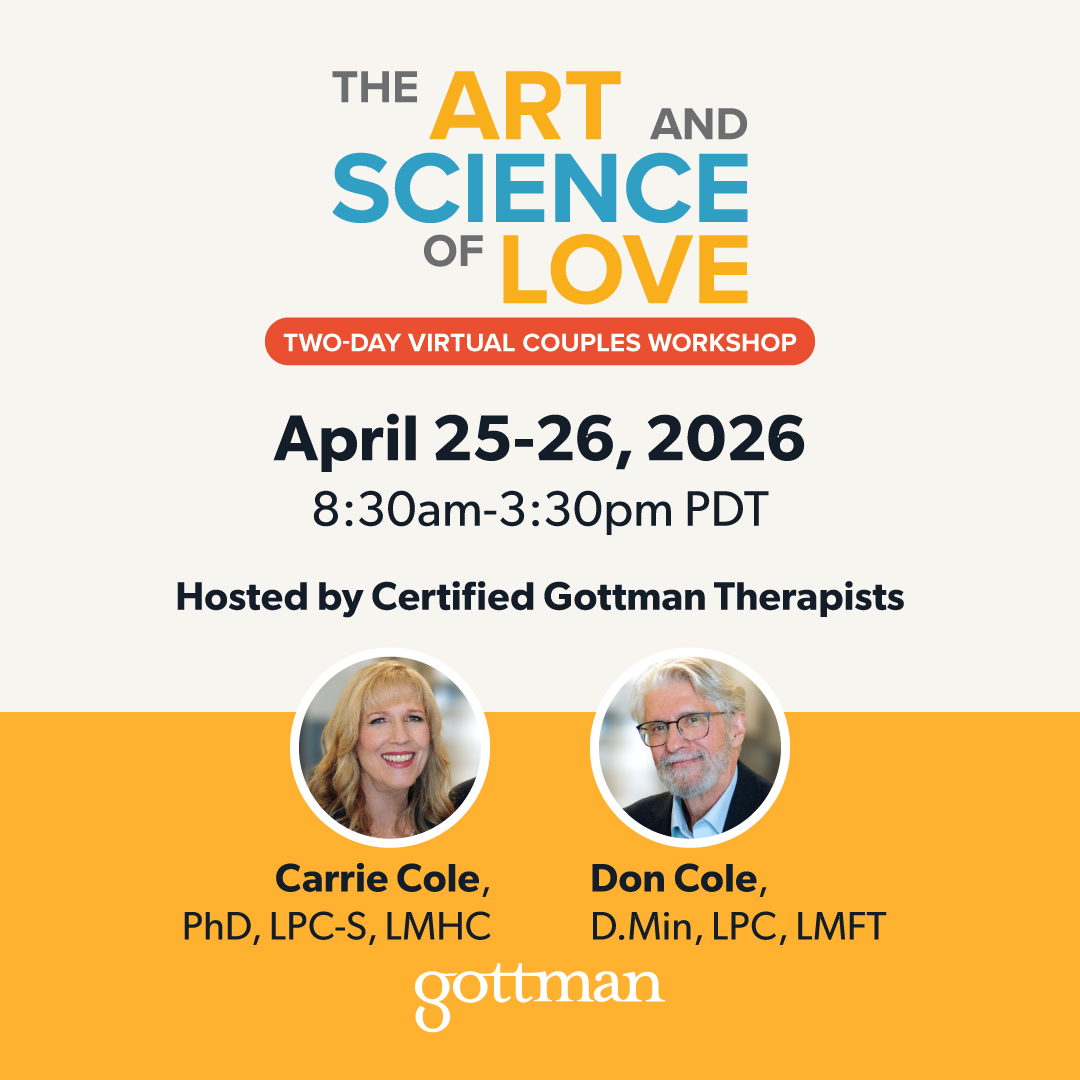
Created by “the Einstein of Love” (Psychology Today), this two-day workshop is grounded on what actually works in relationships that are happy and stable. See for yourself why millions of couples worldwide have benefited from the Gottman Method.

Quote from participant in most recent Live Virtual Workshop:

The Art and Science of Love workshop- where do I begin? It was an absolute stellar workshop. We were looking forward to this for weeks, and it exceeded our expectations! It was well-structured, and well-organized, and provided a wealth of information with real-time demonstrations of how to work through specific scenarios. The outstanding support that was provided throughout the exercises with therapists on standby- WOW! Priceless!

Includes the Art & Science of Love box set.  Please allow time for shipping.  Please Note: This is a live online event. To attend, you will need a reliable internet connection. Our staff will reach out to you with your personal registration and access information.

Related posts

Positive thinking without acknowledging other emotions can negatively impact your relationship.

Can Positive Thinking Save a Relationship?

The Gottman Institute

Is positivity the answer to your relationship issues?

Read More

A young couple caught up in roommate syndrome working together in the kitchen.

When You Feel Like Roommates But Want to Be Lovers Again

Mac Stanley Cazeau

It can be easy for couple to fall into routines and feel like roommates. Is it possible to bring back the spark to become lovers again?

Read More

Fondness Admiration Intimacy

Fondness, Admiration, and Intimacy

Kimberly Panganiban

If you feel like the honeymoon phase is over, you can bring back the magic.

Read More

A couple improving their relationship in midlife.

Navigating Perimenopause Together – How to Strengthen Your Relationship in Midlife

Nicole Schiener

Learn how perimenopause can be an opportunity for couples to support one another’s health and improve the relationship.

Read More

A couple saying goodbye, making the most of a small moment in their daily routine.

The Little Things That Keep Love Strong

The Gottman Institute

Learn how small, meaningful rituals of connection help couples build trust, stay close, and keep love strong over time .

Read More

A couple enjoying time together on their back patio.

Communication Reset

The Gottman Institute

Reset your communication and strengthen connection with practical, research-based steps for building a healthier, more resilient relationship.

Read More

Improve your Relationship Skills with our Free Newsletters
0