
Photo by Candice Picard on Unsplash.
Joel got up early and made coffee before leaving for work. He left it hot in the carafe for David, who usually slept later. He had been doing this since the beginning of their relationship.
When Joel went away on business, David woke to an empty coffeepot. He had to grind the beans himself and work out how to use the machine.
The couple had been struggling. Each believed he was doing more than the other. But at a later therapy session they sat closer together, and the Gottmans asked what had changed. Joel smiled.
“He thanked me for making the coffee.”
Drs. John and Julie Gottman recommend that couples practice noticing these everyday efforts and responding to them. They also teach how to ask for something you need without criticizing your partner. You can learn these skills and use them during the day you already have.
What are you trying to change at home? Perhaps you both try to talk calmly but still end up feeling unheard. You may have agreed to spend more time together, only to find yourselves back in separate rooms a few weeks later.
If you are unsure what to do differently, read about a problem you recognize. You can see how another couple handled it and try a suggestion in your own relationship.
Researchers in the Harvard Study of Adult Development have linked satisfying close relationships with better physical and mental health, and longer lives. With a partner, you also have someone with whom to make a home and decide what you want your years together to contain.
Healthy Relationship Habits You Can Practice Today
The following examples illustrate seven Gottman practices. The suggested dialogue is language to adapt to your own relationship.
1. Turn Toward: The Gottmans’ Number One Relationship Hack
“Come and look at this.”
You are answering an email. Your partner is by the window, waiting.
Gottman calls an attempt to get a partner’s attention or affection a bid for connection. When you acknowledge and respond to it, you turn toward your partner.
You might go over and look. If you cannot stop immediately, answer:
“I want to see. Let me send this first.”
Then join them when you have finished.
The Gottmans call turning toward their “number one relationship hack.” They recommend building friendship through these ordinary exchanges, including when a couple has difficulties to discuss. If most of your conversations concern a problem, when do you get to enjoy each other?
Keep responding throughout the day. Your partner may share good news at breakfast or ask for your company that evening. You will miss some attempts. When you notice, return:
“You were telling me something earlier. What happened?”
2. Ask Something You Do Not Already Know
You know when your partner’s meeting starts. Do you know why they have been dreading it?
Couples can become skilled at coordinating schedules while asking fewer questions about each other’s lives.
The Gottmans call your knowledge of your partner’s inner world a Love Map. You keep it current by asking about what matters to them now.
“What has work been like for you lately?”
If they mention wanting a different role, ask what they would enjoy about it before discussing the practicalities.
Ask an open-ended question, one your partner can answer at some length. You do not have to choose a serious subject. Ask about something they would like to learn, or a place they want to visit. Choose a moment when you can listen rather than asking on your way out of the door.
3. Practice the Positive Perspective: Notice What Your Partner Does Right
You notice the dishes your partner left in the sink. Did you also notice when they took the dog out before an early meeting?
The Gottmans recommend deliberately looking for what your partner is doing right. They describe the positive perspective as “the most potent antidote” to negativity.
If your partner usually gets your child ready for school, join them one morning. What do they do before the child is ready to leave? You may notice an effort you had not seen.
Then say what you appreciated:
“Thank you for finding her library book this morning. I could leave for work on time.”
David began noticing more of Joel’s efforts after the week without his morning coffee. They still had problems, but he could now describe things he appreciated, too.
You can thank your partner for taking the dog out and still discuss who will clear up after dinner.
Read Something You Can Use at Home
Once you understand a bid for connection, you can recognize one while it is happening. After reading examples of a clear request, you can work out how to make your own.
In a randomized study of 80 couples experiencing marital difficulties, the group given a relationship book rather than a workshop reported improved marital satisfaction a year later. Researchers did not monitor how much participants read.
Set aside a few minutes each week to read about something that keeps happening between you. The Gottman blog is free, and Gottman Love Notes delivers research-based relationship advice, including a monthly couples exercise. Share a suggestion with your partner and try it together during the week.
4. Tell Your Partner What You Admire
Your partner has heard you thank them for collecting the children. When did you last tell them what you admire about the way they parent?
Perhaps you watch them listen while your child explains a game. They ask questions and stay until the explanation is finished.
Later, you might say:
“I love how interested you are when she tells you about something.”
The Gottmans distinguish appreciation for what a partner does from admiration for who they are. Think about a quality that drew you to your partner. They may still make you laugh in the same way, or show the generosity you noticed when you first met. Tell them about an occasion you remember.
5. Ask Clearly for What You Need
You mention that it would be nice to have dinner together. Your partner says it sounds nice, then works late again.
What did each of you understand you had arranged?
The Gottmans recommend stating a positive need: something you would like your partner to do. Explain your experience and make a specific request.
“I miss having an evening with you. Can we have dinner together on Thursday, without working afterward?”
Your partner can answer that request, and you can discuss another evening if Thursday is impossible. Begin with “You never make time for me,” and you may end up arguing about how much they work.
Before a longer conversation, check whether they are available. When they cannot talk immediately, agree on when to return to it.
6. Be Affectionate in Ways You Both Enjoy
You spend the evening in the same room, sitting on separate pieces of furniture. At bedtime, you realize you have hardly touched.
Would your partner enjoy sitting close while you talk? A hug when you get home?
People differ in when and how they welcome touch. Someone who enjoys being held after a difficult day may have a partner who wants some space first.
The Gottmans advise couples to discuss these preferences, including the difference between affectionate and erotic touch. A partner may want to cuddle without wanting sex.
“I’d love to lie beside you for a while. I’m happy just cuddling.”
If your partner wants space, respect that. They can also tell you when they would rather not be touched.
7. Keep Dating Each Other
John and Julie Gottman recall a period when they were both working long hours and had stopped going on dates. Looking through their calendars, they struggled to find a free evening.
“Let’s just go out tonight,” John said.
They dressed up and went to a hotel lounge in Seattle, where they ordered a drink and talked for hours on a couch by the fireplace. Afterward, they began making dates a weekly practice.
Where would you like to go together? A date can be a walk or an evening at home after the children are asleep. Choose something you both enjoy and agree on a time.
Put the phones aside. If you have been reading about relationships together, bring a question you would like to discuss. Before you finish, arrange the next date.
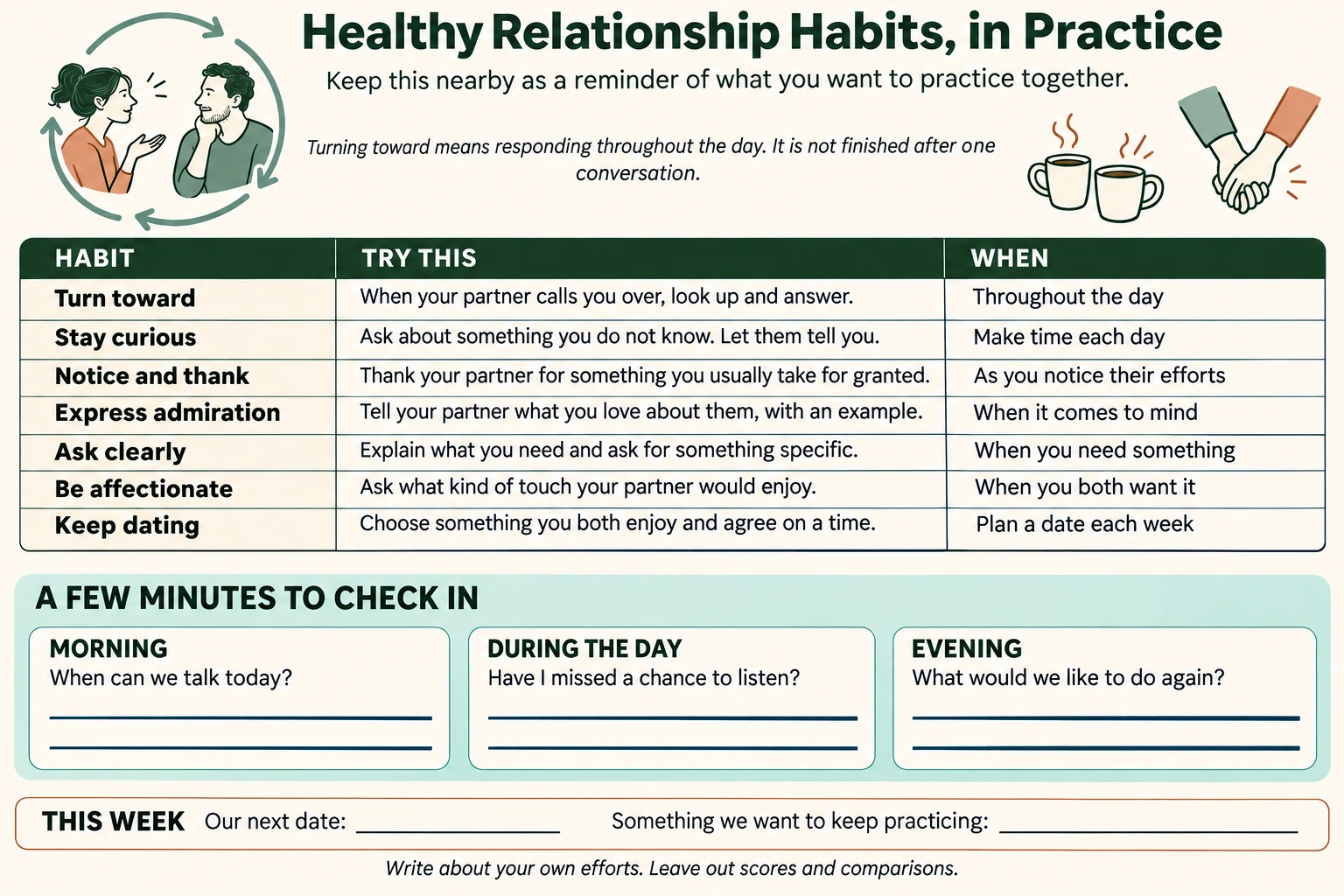
Keep Practicing During the Week
Choose a practice that fits something you recognize between you. If you often miss your partner’s attempts to talk, begin there. Use the habit sheet to note what you tried and what you would like to repeat.
In a Norwegian study published in 2024, participants in a twelve-hour Seven Principles course reported improved relationship quality, with further average improvement at the six-month follow-up. Participants attended a course; the researchers were not testing the effects of reading an article.
If your partner does not want to read, ask whether they would try one practice with you. You can begin with your own responses, but your partner decides whether to participate. If you are afraid of your partner or being controlled or hurt, seek individual support before trying these exercises.
At the end of the week, tell each other about a moment you enjoyed. Be specific about what your partner did.
“When I started looking for what he was doing right, it was just everywhere,” David said.