Most advice on how to improve emotional intelligence starts by telling you to be more empathetic, more self-aware, more regulated — worthy goals, but hard to act on directly. There is an earlier, more practical skill underneath all of them, and there is a name for it: emotional literacy. It is the ability to notice what you feel, find the word that fits it, and say it out loud. Build that, and the rest of emotional intelligence has something to stand on.
What is emotional intelligence?
The term was coined by psychologists Peter Salovey and John D. Mayer in 1990 and popularized by Daniel Goleman. Gottman defines it crisply: the ability to accurately perceive your own and others’ emotions, to understand the signals those emotions send about a relationship, and to manage emotions in yourself and with others. It is, as Gottman’s writing puts it, one of the most important building blocks of a committed relationship — and, importantly, a skill rather than a fixed trait.
What does a lack of emotional intelligence look like in a relationship?
Briefly, because it deserves its own discussion: low emotional intelligence tends to show up as a partner who cannot name what they feel, who dismisses or disapproves of your emotions, and who shuts down rather than stays present when a conversation gets hard. (Our companion piece on the signs of low emotional intelligence goes deeper.) The point worth keeping here is that none of it is necessarily permanent. The same skills can be grown.
What are the signs of high emotional intelligence in a partner?
High emotional intelligence is quieter than people expect. It looks like a partner who turns toward you when you reach for connection, who can let you influence a decision without feeling diminished, and who repairs after a fight instead of pretending it did not happen. It looks like someone who can say “I’m anxious” rather than going cold, and who notices when you are off before you have said a word. These are the behaviors that build emotional safety — the sense that your inner world is welcome in the room.
How do you improve emotional intelligence? Why emotional literacy comes first
Here is the practical core. You cannot manage a feeling you cannot name, and most of us carry a smaller feeling-vocabulary than we realize — defaulting to “fine,” “stressed,” or “annoyed” when something more specific is true. So the first move is literacy: widening the set of words you have for inner states, and practicing saying them plainly.
From there, two skills compound it. The first is attunement: turning toward a partner’s emotion and staying with it, which Gottman’s work treats as trainable, not innate. The second is practice with structure. The Gottman Relationship Coach program Loving Out Loud builds the habit of turning feeling into words a partner can receive, and the Expressing Needs Card Deck gives couples a low-stakes way to rehearse it together. None of this is dramatic. It is small, repeatable reps — which, in Gottman’s research, is exactly what changes a relationship over time.
Can you actually learn emotional intelligence as an adult?
Yes. Emotional intelligence can be learned, no matter whether you are five years old or sixty-five. Gottman´s parenting research showed that children taught to name and navigate their feelings grew calmer, healthier, and more connected — evidence that these are teachable skills, not inborn gifts. Adults are simply older learners. The vocabulary still expands with use; attunement still sharpens with practice. What it asks for is not talent but repetition, and a little willingness to be a beginner.
Improving emotional intelligence, in the end, is less a personality overhaul than a literacy project. Learn the words for what you feel, say them to the people who matter, and stay present when they say theirs back. Emotional literacy is where it starts — and it is closer than it sounds.
Understanding emotional intelligence is the first step. Building it happens through consistent practice.
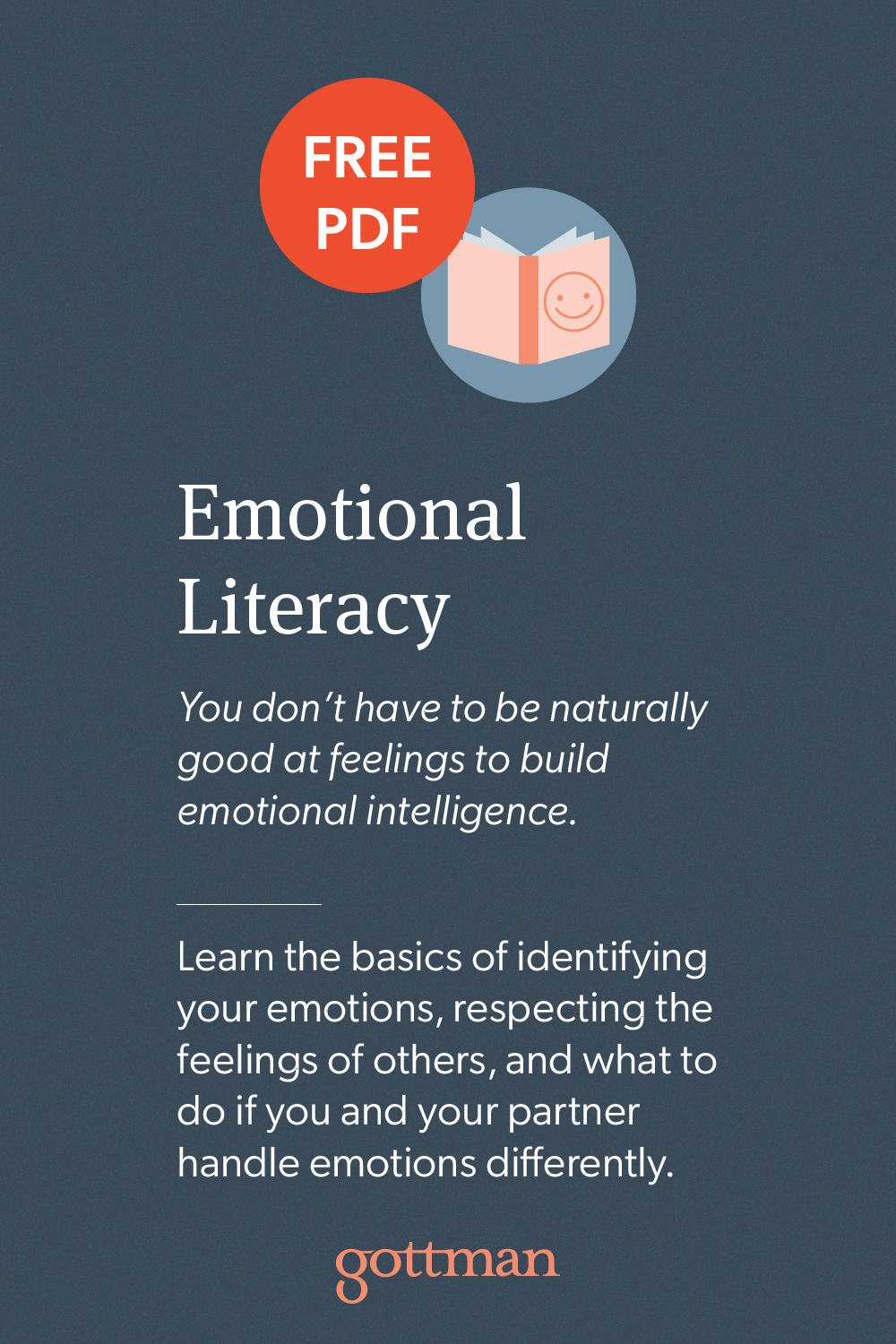
Download our Free Emotional Literacy Guide to access practical exercises that help you recognize emotions, communicate more effectively, and strengthen your relationships one conversation at a time.