0

Manage Conflict: Identifying Your Triggers

Working on understanding each other’s triggers is one of the most important things that you can do to avoid hurting one another.

Triggers

Here’s how to process fights and regrettable incidents with tips on how to identify and understand what triggers you and your partner. Working on understanding each other’s triggers is one of the most important things that you can do to avoid hurting one another. Next time you are processing a fight or a regrettable incident, try the following:

Identify the triggers for each of you: What escalated the interaction?

Put in your own words what escalated the interaction for you. These are often old and familiar feelings. Here are some common examples:
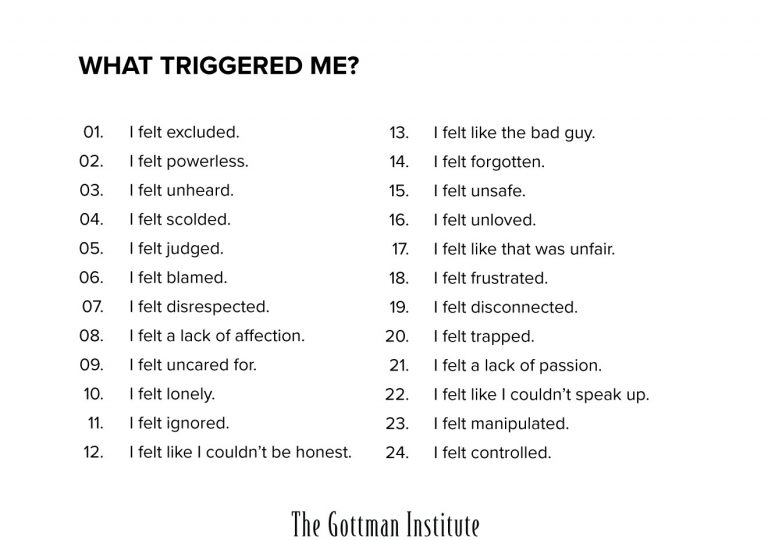
Understand why these are triggers

  • Rewind the story of your life in your mind. Stop at an incident you remember from your childhood or your past in general (not in this relationship) in which you got triggered in the same way or had some of these very same feelings.
  • Tell the story of that incident, how it happened, what you felt. Listen to your partner’s story with empathy.

Figure out how to make it better next time

Consider these questions:

  • What is one way that your partner can make it better next time this kind of incident happens?
  • What is one way that you can make it better next time?

These questions require a great deal of introspection and emotional energy. To figure out what is happening within yourself is difficult and explaining what may be deeply personal experiences to your partner may make you feel scared and vulnerable. Everyone experiences these emotions, but keep in mind that the preceding exercise can be of great benefit to your relationship.

When you and your partner connect the feelings that come up for you in the present with your experiences in the past, you gain insight. You start to understand what’s really going on in each other’s minds. This understanding is invaluable as you grow in your relationship together. As you learn the stories behind your partner’s triggers, you begin to understand where they are coming from. Their sudden attacking or defensive behaviors in conflict start to make sense.

With this knowledge, you can identify which behaviors to avoid, so that the two of you don’t accidentally set each other off. If you use these tools to help you process fights, you will not only learn to have more constructive conversations when conflicts come up, but you will learn more about each other, and grow closer than ever.


FREE Download | What Are You Really Fighting About?

Download an exercise designed to help you learn how to use conflict to communicate better rather than arguing endlessly.

Sign up for Love Notes and Get the FREE Gottman worksheet, What are You Really Fighting About.

What Are You Really Fighting About Free Download Graphic

Ask Gottman

Your email address will not be published. Required fields are marked *

Ellie Wilde holds a PhD in Clinical Psychology, and is the founder of Whale Being Therapy, specializing in helping you build stronger, more connected  relationships. Drawing on extensive training in trauma and nervous system support, she blends evidence-based somatic practices with creativity, play, and embodied imagination, helping you break free from stuck patterns and rediscover connection, awe, wonder, and joy.

Recommended products

Related posts

A woman rests against a man as he kisses the top of her head.

We Agreed. Why Are We Having This Argument Again?

Alexander Elguren

In relationship conflict, we often start persuading before we’ve finished listening. Understanding the three stages of a fight can change how we handle the next one.

Read More

A woman sits on a mustard-colored sofa while a man stands behind her.

Who Has to Calm Down First?

Alexander Elguren

One partner wants to keep talking. The other can’t take in another word. How couples can practice emotional regulation when they disagree about how to disagree.

Read More

A couple in a kitchen, working through weaponized incompetence together

Is It Weaponized Incompetence?

Alexander Elguren

Your Partner Offers to Help. You End Up With One More Job.

Read More

A couple having a conversation about new yer's resolutions.

How to Have a New Year’s Relationship Check-in

Center for Relationship Wellness

Make your relationship your New Year's resolution and reap the benefits of a happy, healthy, and meaningful year!

Read More

In-laws and family sharing holiday traditions at dinner table, as grandmother serves dessert under twinkling Christmas lights

Navigating the Holidays With Your In-Laws

Liz Higgins

Are you nervous about the holidays this year? These therapist-approved tips can help.

Read More

Couple on a computer

Accepting Influence: Find Ways to Say “Yes”

Sinead Smyth

What does "accepting influence" mean?

Read More

Improve your Relationship Skills with our Free Newsletters
0