0

Challenging Behaviors in Couples Therapy: Gaslighting

Gaslighting is a challenging behavior in couples therapy. It is a form of manipulation that leads one partner to doubt their own experiences.

Couple with challenging behavior in therapy

One of the challenging behaviors we are seeing in couples therapy is gaslighting. While it has become a cliche term, this set of behaviors is becoming more common in couples therapy. 

What is Gaslighting?

The American Psychological Association definition of gaslighting is to manipulate another person into doubting his or her perceptions, experiences, or understanding of events.

According to Dr. Dana McNeil, PsyD, LMFT, CGT the gaslighter implies that you misunderstood what they said versus taking responsibility or showing any remorse for their bad behavior. There is an implication that their partner is overreacting. McNeil sees these types of gaslighting behaviors in her San Diego practice:

  • Negative body language and minimizing statements about the other person’s perspective or feelings 
  • Unwillingness to accept any part of the responsibility for a misunderstanding or conflict 
  • Intentional implication that the other person has fabricated a situation in order to create doubt or challenge the other person’s reality 
  • Cutting off the other person, not allowing them to make points or ask questions during a disagreement
  • No acknowledgment of partner’s hurt feelings when expressed, lack of empathy

The partner of the gaslighter may experience self doubt and internalize that they didn’t work hard enough in the relationship. As a result they might feel guilty bringing up issues in the relationship.

How does it show up in therapy?

Here are some examples of what you might hear in session:

  • “You’re making things up.” 
  • “That never happened.“
  • “You’re being dramatic.“
  • “You’re blowing things out of proportion.“
  • “I am sorry you feel that way.”

McNeil says that the gaslighter often times exhibits these behaviors because they:

  • Have low self-esteem and don’t know how to deal with it.
  • Have low capacity to sit with their own emotions.
  • Want to “fix” their partner’s feelings and don’t know how, so they minimize to avoid feeling like a failure.
  • Feel out of control in the relationship and wants to gain power in maladaptive ways.
  • Have difficulty in accepting influence from their partner due to discomfort with vulnerability.

How to decrease gaslighting behaviors

Usually by the time the couple seeks out therapy, one partner is seriously questioning their ability to be a good partner. It is important to validate the experience of the partner who has been manipulated and help them understand the pattern of behaviors. Work with them towards understanding what is in their control versus taking responsibility for all of the relationship problems.

It is important as the therapist that you assume the best and maintain a positive perspective of the partner who is gaslighting. You will need to help them gain perspective about their behavior and how it is impacting the relationship. The behaviors are keeping them from getting their needs met which might be counterintuitive to them at first.

For Our Practitioners: Gottman Interventions to Use in Session:

  • Introduce the idea of a subjective reality and coach each partner to describe theirs (remind them that this isn’t about agreeing with their partner’s perspective).
  • Teach them to validate their partner’s experience and feelings.
  • Redirect partners to use “I” statements.
  • Use the antidotes for defensiveness and criticism (softened start up and taking responsibility, respectively).
  • Do some psychoeducation on softened start up where you ask partners to name their emotion and ask for their needs even if the other partner is unable to do it.
  • Practice the Aftermath of a Fight/Regrettable Incident.

Gaslighting is a challenging behavior for a couples therapist to deal with. However, with the right tools and structure these dynamics can be changed for the better.


FREE Download | What Are You Really Fighting About?

Download an exercise designed to help you learn how to use conflict to communicate better rather than arguing endlessly.

Sign up for Love Notes and Get the FREE Gottman worksheet, What are You Really Fighting About.

What Are You Really Fighting About Free Download Graphic

Ask Gottman

Your email address will not be published. Required fields are marked *

Kendra is the Director of Couples Services at The Gottman Institute. She currently oversees couples workshops, webinars and the relationship blog. Prior to her work at Gottman, she worked in non-profits in South King County and the Bronx, NY. She received a Masters in Social Work from Columbia University.

Recommended products

$30.00

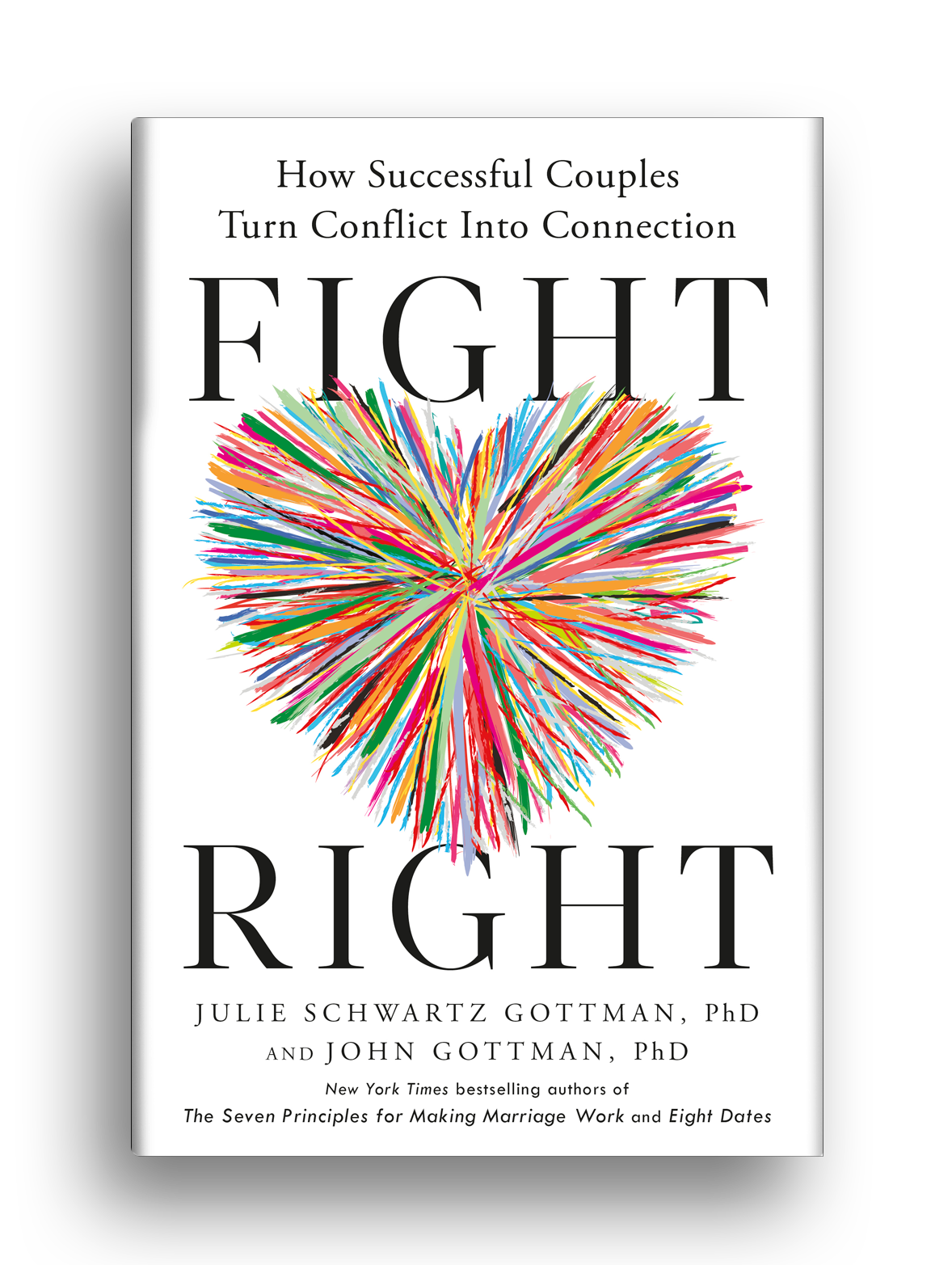
How Successful Couples Turn Conflict Into Connection

Fight Right, the New York Times Best Selling book from Dr. Julie Schwartz Gottman and Dr. John Gottman

LEARN THE 5 SECRETS OF SUCCESSFUL COUPLES

Conflict is the top reason couples seek help—but it’s also an opportunity for greater intimacy, deeper connection, and lasting love according to this essential guide from the world’s leading relationship scientists and bestselling authors of The Seven Principles for Making Marriage Work and Eight Dates.

Click here for free Fight Right resources and products from the Gottmans on how to turn conflict into connection.

On sale now!

$599.00

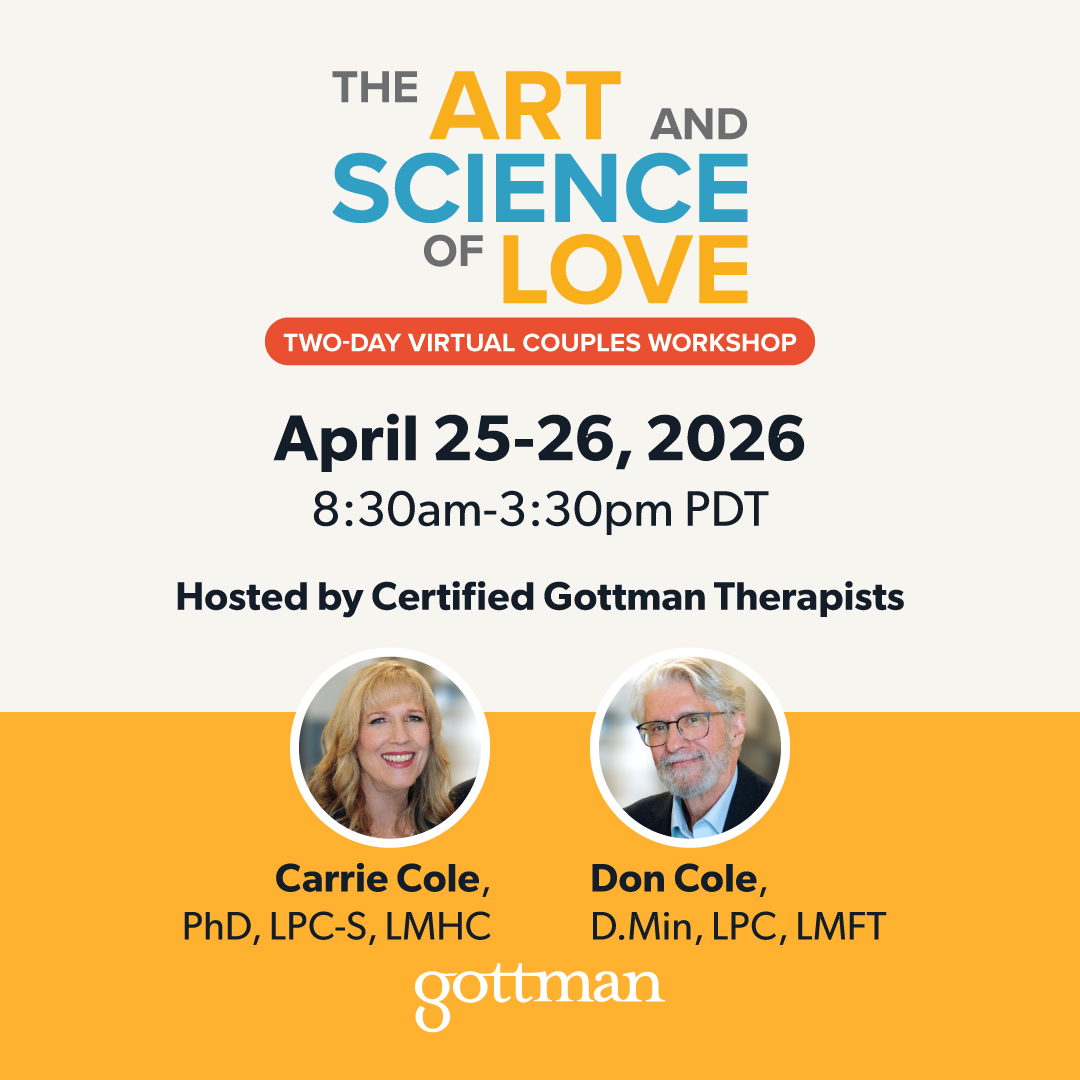
Created by “the Einstein of Love” (Psychology Today), this two-day workshop is grounded on what actually works in relationships that are happy and stable. See for yourself why millions of couples worldwide have benefited from the Gottman Method.

Quote from participant in most recent Live Virtual Workshop:

The Art and Science of Love workshop- where do I begin? It was an absolute stellar workshop. We were looking forward to this for weeks, and it exceeded our expectations! It was well-structured, and well-organized, and provided a wealth of information with real-time demonstrations of how to work through specific scenarios. The outstanding support that was provided throughout the exercises with therapists on standby- WOW! Priceless!

Includes the Art & Science of Love box set.  Please allow time for shipping.  Please Note: This is a live online event. To attend, you will need a reliable internet connection. Our staff will reach out to you with your personal registration and access information.

Original price was: $199.00.Current price is: $149.00.

Now on Sale During February! Drs. John and Julie Gottman’s Art & Science of Love couples workshop is available online for you and your partner to take together from the comfort of your own home.

You and your partner will learn how to foster respect, affection, and closeness in your relationship. You will build and share a deeper connection with each other. You’ll learn how to keep conflict discussions calm, how to break through conflicted gridlock, and how to strengthen and maintain the gains in your relationship

Related posts

A female therapist is working with a client in session.

Decoding the Roles of Therapist, Counselor and Psychiatrist

The Gottman Institute

Confused by the different roles in behavioral health? Learn the distinct differences between a Psychiatrist and a Therapist, and how they work together to save relationships.

Read More

Positive thinking without acknowledging other emotions can negatively impact your relationship.

Can Positive Thinking Save a Relationship?

The Gottman Institute

Is positivity the answer to your relationship issues?

Read More

How to deal with anxiety as a couple

How to Deal With Anxiety in Relationships

The Gottman Institute

Learn how couples can manage anxiety in relationships using Gottman principles, emotional safety, gentle communication, and daily positivity.

Read More

A young couple caught up in roommate syndrome working together in the kitchen.

When You Feel Like Roommates But Want to Be Lovers Again

Mac Stanley Cazeau

It can be easy for couple to fall into routines and feel like roommates. Is it possible to bring back the spark to become lovers again?

Read More

Six Second Kiss

The Six Second Kiss

Kari Rusnak

How long do you share a kiss with your partner?

Read More

Fondness Admiration Intimacy

Fondness, Admiration, and Intimacy

Kimberly Panganiban

If you feel like the honeymoon phase is over, you can bring back the magic.

Read More

Improve your Relationship Skills with our Free Newsletters
0