I have come to think a father-son relationship is built less in the big moments than in the small, repeated ones — but on the night this story begins, I knew none of that yet.
It was a particular evening, many years ago. A low point — maybe the lowest — in my life as a parent.
The divorce was a fact. I was going to be the single dad of two children, a girl and a boy, in a culture where the default setting is that kids are mostly with their moms. I was exhausted. Already burned out from days too full with no time to rest. Most of all I was getting afraid.
I was afraid my shortcomings as a single parent would decide my children’s outcomes. Their grades. Their ability to get along with friends. Their mental and physical health. At night the worry list grew teeth: the wrong neighborhood, the finances, the rupture itself and what it might cost them.
Fear of not being enough is the first thing fatherhood teaches you. It is not the last.
If you’re a parent, you know there’s an inflation of advice out there. Ask twelve experts and you’ll get 24 contradicting opinions. But in that dark season, John Gottman came to me — not personally, but in the form of a book: Raising an Emotionally Intelligent Child. I trusted it because it wasn’t an opinion. It was decades of research on real families, and the framework was precise.
And the promise was almost too good to trust: children who are emotion coached are protected — even through divorce, even through periods of real family trouble — and they come out often doing as well as children from intact homes. The research held up across very different cultures. And there was one more finding that hit me hardest: when fathers do this, the impact on children is especially strong.
So I made a decision. I would drop the obsolete ideas of fatherhood — the strong dad, the distant dad, the dad who provides and disciplines and otherwise stays out of the emotional weather. I would become an emotion coach instead. 15+ years later I can truly say it was one of the best choices I made when it comes to parenting.
I’ll be honest: it was harder than just showing up spontaneously as the parent I would otherwise have been. I had to rewire my brain. I had to learn skills. And the first thing the skill demanded was that I learn to answer a question most men never get asked: What is actually going on inside of me? I had to grow a vocabulary for my own inner life. In order to give my son an emotional language I had to learn to speak it myself.
The framework itself is simple — there are five steps, and they’re worth learning properly. Every emotion is okay; not every behavior is okay. Those are two different categories, and a boy needs to know the difference. Emotion coaching parenting focuses on keeping and maintaining the emotional connection to the child through the journey.
Emotion coaching also solved the problem many fathers wrestle with: discipline. Because when the emotional connection is strong and warm, discipline becomes less dramatic. You don’t need to raise your voice. You cool down the warmth a little. The child feels it and reorients.
My two children taught me how differently this plays out. One look at my face and my daughter knew exactly where the line and the limit was — she never went near it. My son tested, and tested, and tested. He had real trouble hearing limits. So he got more of me on limit setting and problem solving, and she got more of me elsewhere. Same framework, different child.
If you raise a boy you most probably have to face the question of risk judgment. There’s a paper by the Norwegian equivalent of DMV showing that a twelve-year-old girl’s judgment of risk equals that of a twenty-five-year-old man — a man we would legally call an adult.
It can be surprisingly freeing to be an emotion coaching dad
When you commit to being this kind of father, you get to free yourself from a lot of the petty status games, the competitions over money and position and personal bests. You push the stroller. You have your priorities clear. Some people ridicule you for it, at the office or elsewhere. Not everyone will understand what you’re doing for your son, because in our culture moms seem to be the default setting for most parenting tasks. But being an emotion coaching dad also filled me with meaning in ways I couldn’t have imagined 15+ years ago.
Two weeks before my son graduated high school this year, he said something I didn’t ask for and will never forget:
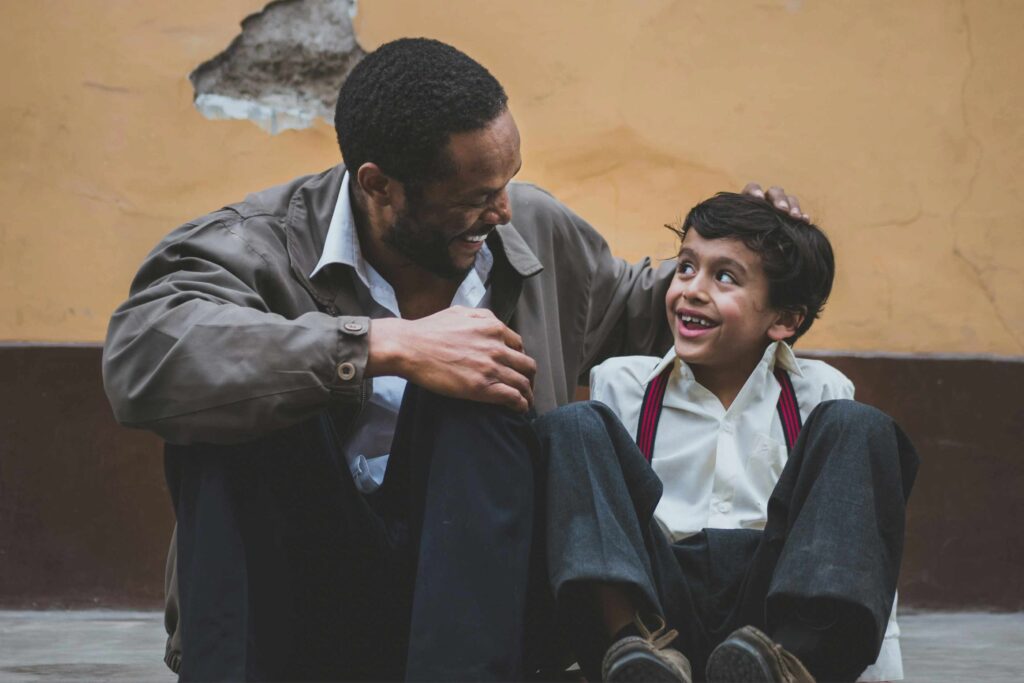
“Dad, I really feel close to you. And that’s a feeling of closeness I don’t have with a lot of other people.”
I stood there with tears in my eyes. Little did he know what those words meant to me. He literally confirmed what I had chosen to believe and go all in on that dark night more than 15 years ago. Fifteen years in one sentence. It was a message delivered backward in time. To the man I was sitting alone on that dark evening, certain he wasn’t equipped.
Drs Julie and John Gottman had promised exactly this. They kept the promise.
In the wider culture, too many boys never will have real closeness to their dads. We are watching what happens to them. Their feeds are full of screaming, angry men with theories about women and weakness and what a “real man” is. And here is what I’ve come to believe about that whole angry universe: the enemy those men are fighting isn’t really feminism, and it isn’t women.
It’s the absence of a close father.
Some name what they carry a father wound — the hole left where a close father should have been.
The father wound wears many costumes
And fatherlessness wears many costumes. There is the father who is physically gone. But there is also the father who sits at the dinner table every night and is still absent — because he is somewhere else entirely. Lost in his career. Lost in his own ambitions, money chasing, in petty status games, in bitterness or desperation from trying to make it in the real, adult world.
It can be so complicated…
It can be hard to be a father. And it can be hard to be a son. We’re chasing a foothold in the world for our sons. We want to prepare them for what is waiting. We want them to have success in some form. For some that looks like money. For others, sports. Education. Arts. Strength. Good values. Structures. Maybe faith. We tell ourselves we’re building the boy a spine. And we might be. Or we might be building a cage. I mean that as a figure of speech, not a literal one — though the difference can be hard to see from inside a family. The question is am I developing my son, or is my parental agenda trying to live through him? Am I building him a door he can walk out of into the world and live his own life — or a cage in the shape of my ambitions, bitterness and fears?
My father died last year. I still feel I wasn’t a good son the last few years of his life. We had distance at the end. I was in the pacific northwest of the US, he was in Norway. The distance and time difference was real. But I was at his deathbed, and I got to tell him what I was grateful for and what an amazing father he was. Not every son gets that.
The relationship with him continues. His values come to me. His sentences come to me. His wisdom arrives, sometimes daily, and I receive it more clearly now than I maybe did when he was alive. I see him in a new light — I understand his sacrifices, his fears, and understand some of his bitterness in a way I couldn’t while he could still explain himself.
A father lives as long as his son remembers him. What he becomes in that memory is the last thing you build together.
So this Father’s Day, I find myself standing at a strange hinge: still a son receiving from a father who is gone, still a father receiving from a son who is grown and will move back to Europe in a matter of days and begin his young adult life separately from me.
And it is urgent…
And if I’ve learned anything standing here, it’s urgency. That is the message on this Fathers day. It is urgent to say what you want to say. About love. Gratitude. Fathers die. Sons drift. The window for saying the true thing is always smaller than it looks. If there has been a rupture, don’t wait for the perfect reconciliation — there is no time to lose. Tune the warmth back up. Make the call.
And if your boy is still small enough to test your limits and ride in the stroller. That is not the warm-up. That is the work, and it is happening now. Focus on the emotional connection. Coach the emotions. Hold the limits, the values and the spine.
The rest, I promise you, follows.
If you want the five steps themselves — the method that carried me through that dark season — the Gottmans teach them in Emotion Coaching: The Heart of Parenting.
Sign Up and Join Our Community!
Sign Up and Become a Super Parent
Become a Super Parent
As a Super Parent you get:
- Exclusive access to the Gottman Parenting Newsletter
- Special pricing offers and discounts
- $58 saving on the Gottman Toddlers Bundle
- Parenting tool and case study on "Toddler Boundaries and Meltdowns: The Secret to Setting Limits"
- Get weekly notifications of new Parenting Blog Posts